lecture 9 International Institutions and War II - Collective Security and the UN
 Call Kai
 Learn
Learn Practice Test
 Spaced Repetition
 Match
Match Flashcards
 Knowt Play
1/44

Earn XP
Description and Tags
Flashcards reviewing Lecture 9 on international collective security institutions, alliances, UN Security Council voting rules, peacekeeping versus peace-enforcement operations, historical UN successes, and UN failures.
Name | Mastery | Learn | Test | Matching | Spaced | Call with Kai | Chat |
|---|
No analytics yet
Send a link to your students to track their progress
45 Terms
Condition under which alliances influence crisis bargaining
Alliances influence crisis bargaining by changing war costs and expected outcomes only when the alliance commitment is credible.
Effect of an expected third-party ally (State C) joining State A on the bargaining range
It shifts the expected war outcome in favor of State A from p to pC, moving the bargaining range boundaries to pC−aC and pC+bC.

Primary functional distinction between alliances and collective security organizations
Alliances form to cooperate against a common foe based on shared interests, whereas collective security organizations form to prevent war regardless of the perpetrator or victim.
Core principle of collective security
An attack on one member state is considered a threat to all member states.
Collective security organization
A broad-based institution that promotes peace and security among its members, such as the League of Nations, United Nations, Organization of American States, African Union, and OSCE.
Expanded scope of modern collective security organizations
Beyond preventing interstate wars, they have expanded their mandates to address civil wars and genocide.
Three primary mechanisms by which collective security organizations promote peace
- Making war less attractive through large-scale outside intervention; 2. Helping resolve commitment problems by enforcing agreements; 3. Strengthening cease-fires with neutral observers and peacekeepers.
Two central operational challenges faced by collective security organizations
Collective action problems and joint decision-making problems.
Three main causes of joint decision-making problems in collective security
Disagreements among member states regarding which acts constitute a threat, which states are aggressors, and how to respond.
Cause of collective action problems in collective security operations
International peace and security is a public good, creating an incentive for member states to free-ride and shift enforcement costs onto others.
Institutional solution designed into the UN and League of Nations to address decision-making dilemmas
Granting decision-making authority to the strongest world powers to determine threats and responses.
League Council structure and membership
It consisted of 10 nonpermanent members elected to 3-year terms and 5 permanent members (Britain, France, Italy, Japan, and later Germany).
League Council voting rule
Decisions required unanimity among all 15 members, effectively giving every member state veto power.
United Nations Security Council structure
Consists of 10 nonpermanent members elected to 2-year terms and 5 permanent members (P5).
Five permanent members (P5) of the UN Security Council
United States, Britain, France, Russia (formerly Soviet Union), and China (formerly Taiwan).
UN Security Council voting rule
Decisions require majority support including the explicit consent of all P5 members, giving only the P5 veto power.
Advantages of concentrating power in a few strong states within international institutions
Reduces agreement costs, enables quicker crisis response, and ensures all enforcement actions have the consent of major powers.
Disadvantage of granting veto power exclusively to powerful states in the UN
Policy bias, as powerful member states and their geopolitical allies are shielded from Security Council action.
Two conditions required for collective security to succeed in practice
When powerful member states agree on the necessity of collective action and when at least some members are willing to pay the enforcement costs.
Deadliest war recorded in historical battle-related death statistics
World War II, which caused over 15,000,000 battle-related deaths.
Fundamental obligation accepted by UN member states regarding dispute resolution
Member countries agree not to use force in settling their disputes with one another.
Two types of military operations authorized by the UN Security Council
Peace-enforcement operations and peacekeeping operations.
Peace-enforcement operation
A military operation in which force is used to make and/or enforce peace among warring parties who have NOT agreed to stop fighting.

Key military and political characteristics of UN peace-enforcement operations
Forces are heavily armed, target perceived aggressors, and rely heavily on central participation from P5 members.
Three major historical examples of UN peace-enforcement operations
Interventions in North Korea (1950), the Persian Gulf War (1991), and Libya (2011).
Peacekeeping operation
An operation deploying troops and neutral observers to monitor a ceasefire or peace agreement after parties have agreed to end fighting.
Key operational characteristics of UN peacekeeping missions
Forces are lightly armed, maintain an impartial stance, and draw primarily on non-P5 troop contributors.
Main reason for UN Security Council inactivity during its first five decades
Cold War gridlock, during which frequent vetoes by the United States and the Soviet Union blocked resolutions.
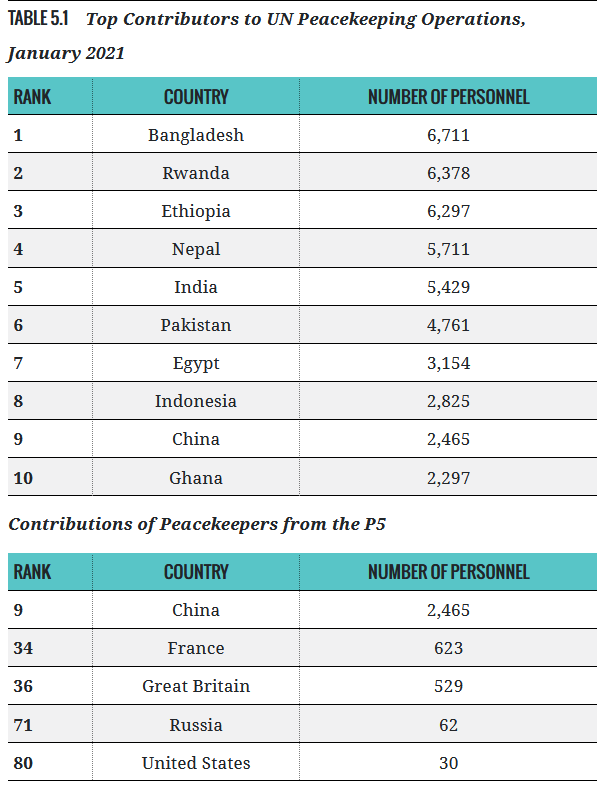
Top national contributor of personnel to UN Peacekeeping Operations as of January 2021
Bangladesh, contributing 6,711 personnel.
Highest-ranking P5 country in terms of peacekeeping personnel contributions as of January 2021
China, ranking 9th overall with 2,465 personnel.
First UN peacekeeping mission
UNTSO (United Nations Truce Supervision Organization), established in 1948 to supervise the ceasefire between Israel and neighboring Arab states.
UN Security Council response to Iraq's 1990 invasion of Kuwait
Passed a resolution authorizing force to remove Iraqi troops, leading to a US-led coalition liberating Kuwait in the Persian Gulf War.
Largest troop contributor to the 1990-1991 Persian Gulf War coalition
United States, contributing 540,000 troops out of the total coalition force.

Primary national self-interest driving US intervention in the 1990-1991 Persian Gulf War
Preventing Iraq from gaining possession of the region's oil reserves.
Human cost of the 1992 conflict following Bosnia's declaration of independence
Approximately 300,000 people killed, the majority of whom were civilians.

Seven states created following the breakup of Yugoslavia
Slovenia, Croatia, Bosnia & Herzegovina, Serbia, Montenegro, Kosovo, and Macedonia.
Ratko Mladic
Bosnian Serb commander found guilty of genocide for leading forces that besieged Sarajevo and carried out the Srebrenica massacre.
Casualties and demographic impact of the 1994 Rwandan genocide
An estimated 800,000 people killed, representing 75% of the Tutsi population.

Humanitarian impact of government-backed militia violence in Sudan beginning in 2003
Over 400,000 deaths and 3,000,000 displaced refugees.
Context in which UN intervention is statistically most likely to succeed
When intervention costs are relatively low, primarily in post-conflict peacekeeping settings (e.g., El Salvador, Mozambique, Liberia, Sierra Leone).
Virginia Page Fortna (2004) empirical finding on peacekeeping
Peacekeeping after civil wars makes a statistically significant contribution to increasing the durability and stability of peace.
Three key contributions the UN provides to enhance international peace despite structural limitations
- Impartiality that facilitates peacekeeping; 2. Institutional support that builds international consensus, lowering intervention costs; 3. Established procedures that facilitate rapid crisis decision-making.
Public good in the context of international relations
A non-excludable, non-rivalrous benefit—such as international peace and security—that states are tempted to free-ride on.

Free-rider problem in collective security
The tendency of member states to shirk paying military or financial costs for enforcing global peace while still enjoying security benefits.
Policy bias in international institutions
The systemic favoring of powerful states' strategic interests, such as P5 members shielding themselves and their allies from Security Council enforcement.