Etruscans and Romans
 Call Kai
 Learn
 Practice Test
 Spaced Repetition
 Match
 Flashcards
 Knowt Play
1/15

Earn XP
Description and Tags
Etruscan #29 Sarcophagus of the Spouses #31 Temple of Minerva #32 Tomb of Triclinium Roman Republic #39. House of the Vettii #40. Mosaic of Alexander the Great - House of the Faun, Pompeii #42. Head of a Roman Patrician Imperial Rome #43. Augustus of Primaporta #44. Colosseum (Flavian) #45. Forum, Column, and Markets of Trajan #46. The Pantheon #47. Ludovisi Battle Sarcophagus
16 Terms

Sarcophagus of the Spouses
Etruscan
Terracotta
stylization from arcahic greece
unique etruscan posititoning and gestures
form
life size portrait, emphasis on hand gestures, unrealistic L of the body, painted
reclined whiel “ eating at a banquet “
function
funerary art, banquets. were comon ritual to send offf the deceasesd; the sarcophagus contains both their ashes
celebrates the life of the priveleged elite

Tomb of the Triclinium
Etruscan
Tufa, Fresco
Trinclinium = formal dining room
tomb containas the deceaseed as well as goods and offerings
Walls are frescoes = color pigment on wet plaster
Painting has greater sense of movement and gesture than Greek pottery at the time
gender roles
The left and right walls show dancers and musicians
The rear walls show men and woman at a banquet reclining on dining couches together
Women held high standing in Etruscan society
The Greeks would never have allowed their women to banquet with the men

Temple of Minerva
Etruscan
Wood mud brick, or tufa
Tuscan columns (Doric columns with bases) have a lasting impact
This Etruscan Temple was dedicated to Minerva
- Roman name for Athena
Triple cella
Etruscans worshipped their deities in a triad
Minerva (Athena), Tunia (Zeus), Uni (Hera)
Form
No Greek orders, all columns are Tuscan
Deep porches - approach only from front entrance
More square than rectangular
Material: Made entirely of wood and mud brick
Sculptures on roof
Elevated (with steps)

Statue of Apolllo from the Temple of Minerva
Vulca
terracotta
on the roof of the temple
movement shown in the drapery and hands
Etruscans place statues on the roof of the temple
They are over-life-sized to create memorable scene for audience who views them from below

Head of a Roman Patrician
Republican Roman
Marble
Only for the most wealthy
These functioned as a way to honor distinguished family members in family shrines called Lararium
The Toga indicates Roman citizenship and was a visual display of social status
old heads were placed on youthful bodies, to show wisdom
form
Verism= hyperrealism,even exaggerated wrinkles, no emotin
Patrician- male head of family
His physical traits of age reveal seriousness of mind and the virtue of having a public career (The Republic)
He represents the ideal Roman male aristocrat:
function: Shows elevated social class

Alexander Mosaic from the House of Faun
Republican Roman
Mosaic
Floor mosaic made of tessaerae
form: foreshrotening adds drama,
contetn:
Art was used in Rome to show the taste, education, and social status of the owner
It was intended to be seen by visitors to the house
Alexander fights reckelssley while darius is sohcked
based on an original greek wall painting
evokes sympathy for the persians and shows alexander’s domiance ( not roman!! this is js a copy )

House of the Vettii
Imperial Rome
cut stone and fresco
The patron's home was also a meeting place for clients and often had spaces for merchan
In the Roman world, individuals were frequently bound to others in a patron-client relationship whereby a wealthier, better-educated, and more powerful patronus would protect the interests of a clients, sometimes large numbers of them.
The size of a patron’s clientele was one measure of his standing in society.
In this system, a plebeian might be bound to a patrician, a freed slave to a former owner, or even one patrician to another.
~~
The Vettii brothers were a prime example of a new social class that arrived in Pompeii.
The very fact that these two brothers were able to rise from the status of slaves to wealthy merchants speaks to the social mobility within their society.
It is theorized that the Vettii brothers made their fortune as wine merchants and were then able to essentially purchase the elite status of freeborn aristocrats.
The Vetti brothers were social climbers.
Former slaves, it is unlikely that they were patrons to numerous clients. Maybe they did not need on office, but instead relied on interior decoration to impress visitors and clients.
Style:
Artist uses paint to create faux (fake) marble or granite
Artists would create linear perspective or the appearance of depth in space by making things look smaller further away.
OR by using lighter colors in the distance (which is called atmospheric perspective)
This style was supposed to be more elegant and refined instead of the ‘new money’ look of the 2nd style.
incredibly over the top and included all three styles combined.
Faux marble (1st), architectural scenes with illusion of depth (2nd), combined with large, flat planes of color and thin architectural features (3rd)


Colosseum
Imperial Roman
Stone and Concrete
Function:
Entertainment
Patron: Flavian family, was a fit to t the citizens to gain poltical support
from private use by nero to public use cuz of the flavians
romans invented convrete
arch: voussoirs and key stone that holds arch in palce
barrel vault, makes big spaces possible
Velarium tented roof
Engaged colums, mix of Corintihan, Ionic, and Tuscan orders
audeince sat in social hierarchy

Forum of Trajan
Apollodorus of Damascus
Brick and concrete
Patron: emperor trajan
the stoa had statues of roman staemen, genreals and prisoners
glorifeid the miitlary might of Rome
trajan wins two vicotries over the Dacians, the wealth gained will fudn this public space, shows his military prowersss


Basillica Ulpia ( forum of trajan )
Apollodorus of Damascaus
brick and concrete
Roman civil building used for meetings and law court


Column of Trajan
Marble
Low relif sculpure located between the two libraries
continous narrative as you go up the column
roman gods are there to apporve trajan’s actions
trajan effortlessly conquers the darcians

Trajan Markets
brick and concrete
shops and administative offices
semi circular bildingn
main space is groin vaulted, shops are barrel vautled
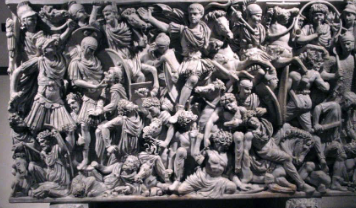
Ludovisi Battle Sarcophagus
Late Imperial Roman
Marble
shows an epic battle scene between the Roman army and the Goths
Romans are shown as noble
Goths are shown as barbaric, with beards and wild hair
Deep carving creates harsh contrast between lights and darks
Used to emphasize DRAMA - similar to Hellenistic art
This is an intentional rejection of perspective to create an overall feeling of tension and chaos. It forces your eyes to spend time and look at all of the details.
Horror vacui—the filling of an entire surface or work of art with detail
FUNCTION
Commemorative - celebrates the person who is buried here as victorious
Shift in funerary practices
Romans previously cremated the dead but began to bury the body intact
Maintains lineage - these were placed in a mausoleum against a wall

Augustus of Primaporta
Early Imperial Roman
Marble
Idealized male figure
Contrapposto
Breastplate = warrior/soldier
Judges robes = civic ruler
Barefoot = sacred ground (because he is divine)
Right hand raised in Roman orator (speaker) pose
Cupid = divine lineage from Venus
Military victory, divine leadership, and pax romana on his breastplate
represetns change in rule form the sentate of elders to young caesaer, he wants to be shown as young

Pantheon
Imperial Roman
Concrete with Stone Facing
Sphere
The perfect sphere (124 feet in diameter) represents the orb of the earth
The ceiling represents the vault of the heavens
Audience response: It was totally unexpected
Oculus—a round opening
On sunny days the beam of light from the oculus moves across the dome, highlighting various sections
Practical function: it allows light to illuminate the interior
Symbolic function: it heightens the drama and possible spirituality by associating the building with the heavens
Coffer – decorative sunken panel in the ceiling
Romans invent concrete!!!
The concrete mixture was altered to provide strength and make the dome physically lighter
Hard basalt was added to the base and transitions to lighter pumice stone on the top
