Covering Problems
 Call Kai
 Learn
Learn Practice Test
 Spaced Repetition
 Match
Match Flashcards
 Knowt Play
1/3

There's no tags or description
Looks like no tags are added yet.
Name | Mastery | Learn | Test | Matching | Spaced | Call with Kai | Chat |
|---|
No analytics yet
Send a link to your students to track their progress
4 Terms
Covering Prob
Given a combinatorial structure, how can it be covered with the lowest possible cost using a second structure?
Vertex Cover
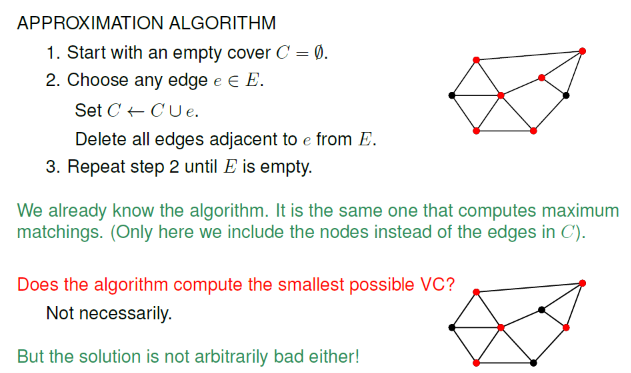
In the Vertex Cover Problem, we want to cover all edges of a graph with as few nodes as possible.
FORMAL DEFINITION: Given a graph G(V,E), find a subset C ⊆ V of the nodes such that ∀e ∈ E : e ∩ C ̸= ∅.
VC is a hard optimization problem.
BRUTE FORCE Try all 2n subsets of nodes
The approximation algorithm provides a 2-approximation, i.e., a VC that is at most twice as large as OPT (optimal VC).
Set Cover
FORMAL DEFINITION: Given a set U (the universe) and a collection S of subsets of U, find a subset S′ of S such that UnionS∈S′ S = U.
Find the smallest possible S′ that is a Set Cover for U.
Vertex Cover is a special case of Set Cover.
Covering points P with circular disks (or other geometric objects) is also a special case of Set Cover.
The greedy algorithm provides an O(log n) approximation.

Hitting Set
In a hitting set problem, we want to find representatives for a collection of subsets of a universe such that each set is represented.
FORMAL DEFINITION: Given a set U (the universe) and a collection S of subsets of U, find a subset U′ of U, such that ∀S ∈ S : S ∩ U′ ̸= ∅.
SC and HS are dual to each other.
Thus, any SC instance can be translated into an HS instance with the same solution and vice versa.