Chapter 3
 Call Kai
 Learn
 Practice Test
 Spaced Repetition
 Match
 Flashcards
 Knowt Play
1/57

There's no tags or description
Looks like no tags are added yet.
58 Terms
single nucleotide polymorphisms (SNPs).
(SNPs) single base changes in DNA that differ from the usual bases at those positions.
Some cause disease, and others are normal variations in the DNA sequence.
Majority of cancer related SNPs are in non-coding regions in genome
Most are located in intergenic regions and introns
What is intergenic
regions in-between genes
intronic
sequences that code for introns
Gene Regulation Steps
1 & 2 - Transcription
3 & 4 - Post Transcription
Translation
& 7 - post-tranlation
Trancription
DNA packing
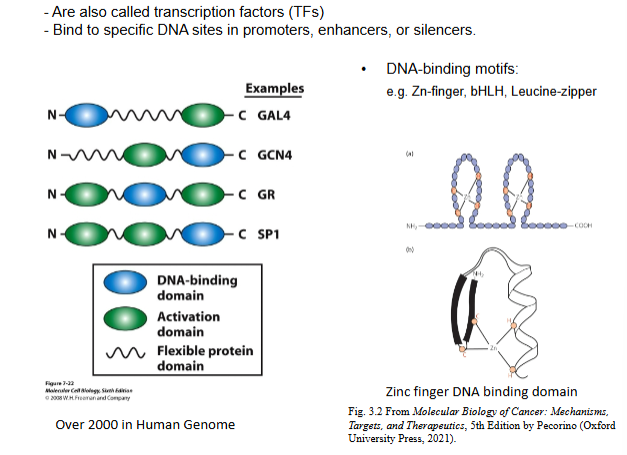
transcription factors
Post Transcription
mRNA processing
splicing
5’cap & poly-A tail
breakdown by siRNA
Translation
block start of translation
Post Translation
protein processing
protein degradation
Regulatory regions
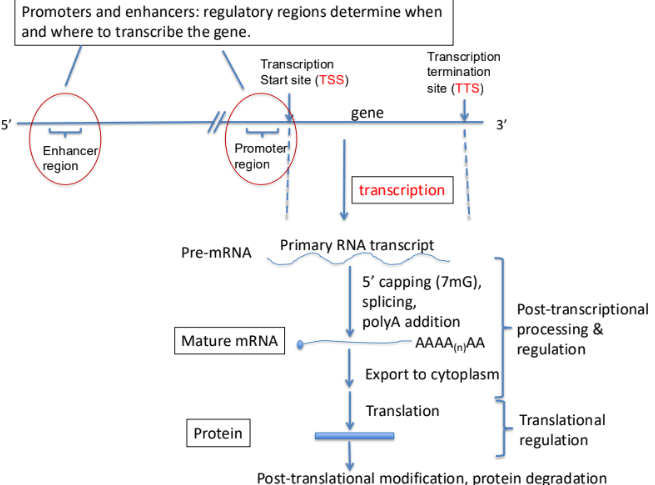
Gene Expression Mechanisms

DNA modification
e.g. DNA methylation (CpG island)
Histone Variants and histone modification
acetylation, methylation, etc.
Noncoding RNA (ncRNAs)
Long noncoding RNAs (LncRNAs)
Transcription Factors
binds a specific DNA sequence to switch a gene on or off
examples:
Gel/band shift (EMSA)
DNase footprinting
Promoter mutagenesis + in vitro transcription
Bisulfite + methylation-specific PCR
Gel/band shift (EMSA)
bound DNA runs slower → shifted band. Tests: does this protein bind this DNA?
DNase footprinting
bound protein blocks DNase → a gap in the cleavage ladder. Tests: exactly where does it bind?
Promoter mutagenesis + in vitro transcription:
mutate the site, measure transcription. Tests: does the site matter functionally
Nuclear Receptors
Steroid hormone receptor superfamily (aka nuclear receptor family): ligand dependent transcription factors
Heterodimeric nuclear receptors
located in the nucleus
without ligand: repress transcription
with ligand: activate transcription
Ligand-Induced Nuclear Translocation of homodimeric nuclear receptor

Molecular Methods Used to Examine transcription Factor Binding
a. EMSA Electrophoretic Mobility Shift Assay
b. Dnase footprinting
c. chromatin Immunoprecipitattion - analysis of the in vivo biding of proteins to DNA
Chromatin Immunoprecipitation (ChIP)
To analyze protein DNA interaction in vivo
To map genome localization of chromatin binding proteins,histone variants, and histone modifications

DNA replication and chromosomal shortening ater DNA replication

What do telomeres do?
they protect the ends of chromosomes from digestion by nuclear enzymes
also prevent induction of mechanisms that repair DNA double-stranded breaks.
sensors for global DNA damage
What normal cells have high telomerase activity?
stem cells and gametes
What advantage does a cancer cell have with high telomerase?
they both have a reverse transcriptase enzyme
What will telomerase inhibitors do to cancer cells?
et the enzyme telomerase to limit cancer cell proliferation by inducing telomere shortening, leading to senescence or apoptosis
Telomerase
a ribonucleoprotein containing human telomerase reverse transcriptase (hTERT) and a human telomerase RNA (hTR)
reverse trasncriptase mechanism
maintains telomere length in certain cell types such as stem cells
extends telomere regions
Telomeres in the presence of ROS
less effective telomere repair
accelerated telomere shortening
Examples of Gene Regulation
DNA modification
ie DNA methylation
Histone variants and histone modifications
ncRNAS (non coding RNAs)
DNA methylation
repressive
methylates a Cytosine Complex (CpG island → Cytosine Phosphate-Guanine)
leads to instability because spontaneous deamination of methylcytosine leads to a C to T transition
Histone Acetylation
usually activating
Acetylation neutralizes the positive charge on histone tails, so chromatin loosens and genes turn on. Removing acetyl reverses this.
Histone-tail lysines are positively charged and grip negatively charged DNA → tight, compact chromatin (gene off).
HAT → adds acteyl
HDAC → removes acetyl
HAT
histone acetyltransferases (HATs)
adds acetyl groups → charge neutralized → chromatin relaxes → transcription up
HDAC
histone deacetylases (HDACs)
removes acetyl → + charge restored → chromatin compacts → transcription down.
Histone methylation
can be either activating or repressing
miRNA
microRNAs, non-protein coding RNAs
18-25nucleotides long
repress expression of target mRNAs
can have hundreds of targets
processed from pri-miRNA, pre-miRNAs
many are abnormally regulated in cancer cells
some are oncogenic
Oncomirs
oncogenic miRNAs
lncRNAs
long noncoding RNAs
>200 nucleotides
lacks open reading frame
polyadenylated
many are abnormally regulated in tumors
Gene Regulation by lncRNAs
Transcriptional interference by an adjacent lncRNA gene.
(b) lncRNAs can act as guides for chromatin remodeling activities and transcription factors
(c) lncRNA genes themselves are targets of epigenetic regulation, thereby facilitating a feed-forward cascade of gene expression states.
(d) They can serve a sponge for miRNAs

Epigentics
alteration of gene expression that doesn’t change te gene itself
Claude: Epigenetic changes alter chromatin structure and gene expression without changing the DNA sequence — not mutations, and reversible.
Main tools: DNA methylation Histone modification, non-coding RNA (miRNA)
Promoter hypermethylation → gene silencing → in cancer this shuts off tumor suppressor genes (like BRC1) with no mutation needed
3 Mechanisms of Gene Silencing by methylation
Adding Methyl Groups may:
physically block transcription factor access to DNA;
directly induce mutations via deamination; or
recruit other chromatin-modifying enzymes to alter chromatin structure.
Methylation in Tumors
Tumors often show gene specific hypermethylation and global hypomethylation (genomic instability)
repression
DNA methylation at promoter regions mediates transcriptional
Point mutation
Deamination leads to
DNA Demethylation
passive - DNA replication without maintenance DNA methylation
active - TETs: Ten-eleven translocation (TET) family enzymes: oxidize 5-methylcytosine
How does DNA Methylation affect transcription of CpG containing promoters
mCpG and CpG lead to different chromatin structure and accessibility
mCpG – reduced chromatin accessibility (e.g. MeCP2 mediated chromatin condensation)
mCpG disrupts the binding of certain TFs to their recognition sites that contains CG,
e.g. c-MYC.
mCpG binding by repressors, co-repressors; e.g. MeCP2
Bisulfite sequencing → Bisulfite + methylation-specific PCR
Analyze methylation status of every CpG in the region
Denature fragmented dsDNA to get ssDNA--Treatment with sodium bisulfite to convert Unmethylated C to U
***Conversion only happens on Unmethylated Cytosine
forllowed by PCR and Sequencing
not TF binding — unmethylated C becomes T after conversion.
Epigenetic Therapy as a Cancer Treatment
Genetic mutations are irreversible, epigenetic
modifications are somewhat more reversible.
opens up the possibility of reversing epigenetic modifications in cancer cells to restore the cells to their healthy state.
goal is to restore a distorted epigenome to a ‘normal’ epigenome
cancer
What happens when you don’t have enough methylation? (hypomethylation)
Lysine acetylation
relaxes chromatin, condenses DNA
removes + charge

Oncohistones
Cancer associated histone mutations impact in all histones, including the 4 core histones and H1 linker histone.

How might gene expression mechanisms be used for therapeutics?
Global inhibition of methylation can help cancer cells look virus like, which will cause the immune cell to attack the cancer cells
AP-1
dimer TF (Jun + Fos families) switched on by stress and growth signals; contributes to carcinogenesis.
Structure: dimer of Jun-family + Fos-family proteins — never a single component.
Binds: the TPA response element (TRE) and the cAMP response element (CRE).
Activated: growth factors, ROS, radiation
microRNAs
small non-coding RNAs that turn down specific mRNAs by binding their 3′ UTR.
Processed in several steps into a mature single-stranded miRNA that joins RISC (RNA-induced silencing complex).
uses the miRNA to find the 3′ untranslated region of target mRNA(s): perfect match → one mRNA; imperfect → a set of mRNAs.
miRNA expression profiles can distinguish tumor types (unlike mRNA profiles, per your bank).
Telomeres
cap chromosome ends and act as a division counter. Cancer cells break the counter by re-activating telomerase.
protect ends from nuclease digestion, and prevent the cell treating the end as a double strand break.
Structure: thousands of TTAGGG repeats + the shelterin protein complex
Telomerase
reverse transcriptase + its own RNA template; adds repeats back
telomerase activity is increased in ~90% of tumors.
Components: TERT (reverse transcriptase) and TERC/hTR (RNA template)
Epigenetic and telomere-directed therapies
DNMT inhibitor — 5-aza-2′-deoxycytidine: less methylation, silenced genes can switch back on.
HDAC inhibitors — SAHA (vorinostat), romidepsin: more acetylation, open chromatin, genes on.
Telomerase inhibitor — Imetelstat: blocks telomerase, telomeres shorten.
Enzymes tied to epigenetic carcinogenesis: DNMT, HAT, telomerase. DNA polymerase does not count — it's replication/repair (e.g. nucleotide excision repair).