Antibodies 1
 Call Kai
 Learn
 Practice Test
 Spaced Repetition
 Match
 Flashcards
 Knowt Play
1/40

There's no tags or description
Looks like no tags are added yet.
41 Terms
B lymphocytes
Antibodies are secreted by what
Antigen
protein that an immune cell can recognize, usually foreign
Epitope (aka antigen determinant)
Particular part of the antigen bound by the antibody
Antibody
specialized protein that directly binds to a specific antigen
Pathogen
organism that can cause disease
Proteins, immunoglobulins (Ig)
what are antibodies?
IgG
IgD
IgE
IgA
IgM
5 different types of antibodies
isotopes have different structures and specialties
antigen “types”
recognize function
deffence (effector) function
two major functions of antibodies
Must recognize foreign material (bacteria cell wall, protein, virus, etc.)
Antibodies recognization function":
Must initiate a response to protect against a foreign material
defence antibody function
Domains
fundamental units of tertiary structure and function
functions
A protein that has several domains has several…
multiple polypeptide chains that make up domains:
two heavy chains and two light chains
antibodies are composed of:
one constant and one variable domain
two light chains:
three constant and one variable domains
heavy chains:
Variable domains
domains of antibody chains that make up the antigen binding site which are hypervariable, confers to antigen specificity
two
how many antigen binding sites per antibody?
One certain ligands bind
Proteins are this highly specific:
size
shape
charge
hydrophobicity
antibodies are complementary in: [4]
Induced fit
Conformational changes may occur upon ligand binding. This adaptation is called:
tighter binding of the ligand
high affinity for different ligands
induced fit of antibodies allows for:
complementary groups to interact fully
Conformational changes in the antibody or antigen can lead to tighter binding, by allowing;
NOn-covalent interactions
Antibodies bind to antigen via:
complementarity determining regions (CDR)
Antibodies interact with antigen at :
12 domains
how many domains in IgG have the same domain fold:
Immunoglobulin fold
domain fold in IgG
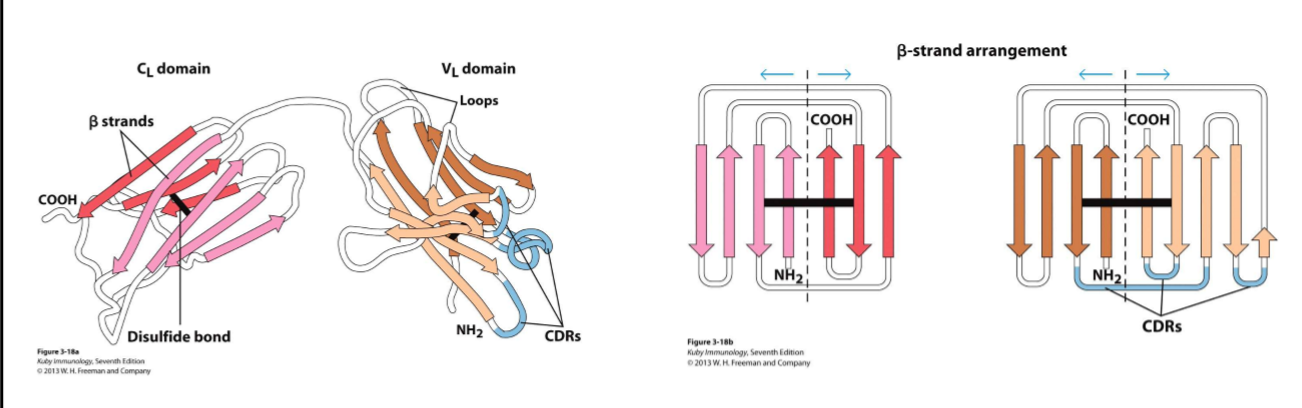
2 beta sheets with loops connecting the antiparallel beta strands
The Ig domain is sandwich of:
disulphide bonds
link between light and heavy chains, and the two heavy chains together
two fragments bound antegen and called Fab
thirdfragment called Fc. Fc retains effector functions
What happens after papain digestion
initiates the processors your immune system used to actually take out the invader
Fc retains the effector functions by
small molecules (e.g., phosphorylcholine)
macromolecules (e.g., protein)
two kinds of antigens
in the cleft of antigen binding region
Small molecules often bind where in antigen-binding
electrostatic
hydrogen bonds
van der waals
hydrophobic
Interactions between the antibody and antigen [4]
contact is more extensive, sometimes interacting with all CDRs and 20 or more residues of the antibody. Interaction tends to be larger and flatter
how do large molecules contact with antigen binding site
histamine
detection of allergen causes body to release:
tighter the binding
the more interactions there are and the more complementary the binding surface, the
shape at binding site (complementary and concave)
Amino acid sidechains to maximize noncovalent interactions
factors determine specificity and affinity of antibody for antigen
dissociation constant, Kd, which is in units of molar concentration
Most common way to quantify the strength of binding between protein and ligand
Tighter the binding
greater the binding affinity
The smaller the Kd, the