AP Chemistry Unit 2 Bonding
 Call Kai
 Learn
 Practice Test
 Spaced Repetition
 Match
 Flashcards
 Knowt Play
1/31

There's no tags or description
Looks like no tags are added yet.
32 Terms
What is electronegativity (EN). What causes EN to increase?
Electronegativity is the relative ability for an atom to pull on a bonding pair of electrons.
An atom has a higher EN if it has higher coulombic attraction between its nucleus and valence electrons
What is the trend in EN in the periodic table, which atoms have the highest EN?
Highest EN found in top right corner, lowest found bottom left corner. Fluorine has highest EN of 4.0

If ΔEN is 0, what happens? If ΔEN is 1.7 or higher what happens? If ΔEN is less than 1.7 but greater than 0 what happens?
ΔEN is 0 then there is a nonpolar covalent bond (perfect electron sharing)
ΔEN is between 0 and 1.7 then there is a polar covalent bond (electrons are pulled more towards one atom)
ΔEN is 1.7 and greater, then there is electron transfer and an ionic bond
What is ionic character? What is covalent character?
Ionic character is a measure of how much a chemical bond behaves like an ionic bond. A higher ΔEN indicates a higher ionic character.
Covalent character is a measure of how much a much a chemical bond behaves like a covalent bond. A lower ΔEN indicates a higher covalent character.
Ionic and covalent character lie on a spectrum.
Unless given evidence to the contrary what should we assume about metal-nonmetal bonds
We should assume they are ionic bonds
What is an ionic bond? What shape do ionic compounds form? What is a formula unit?
Ionic bond is electrostatic attraction between a cation and anion. The transfer of electrons makes a cation and an anion, then the oppositely charged ions attract each other.
Ionic compounds are in the shape of a 3d crystal lattice (cations are surrounded by anions and vice versa)
A formula unit is the lowest ratio of cations/anions in a non-molecular substance. (Example CaCl₂ → 2Cl⁻ for every Ca⁺)
What is a covalent bond? What is a molecular formula?
Covalent bonds occur when both nuclei pull on the bonding pair of electrons. This results in individual molecules (Example C₆H₁₂O₆ is an individual molecule). For a covalent bond to form, there has to be orbital overlap where the electrons are shared.
Molecular formula → # and type of atoms bonded together (molecular formulas are not reduced)
What is a metallic bond? What are metallic bonds characterized by?
Metallic bonds are attraction between the positive core of the metal, and the delocalized valence electron sea that move through the sample.
Metallic bonds are characterized by the delocalized valence electron sea.
How do we draw lewis dot diagrams for atoms?
For atoms, you draw just the valence electrons. Lewis dot diagrams are only drawn for representative elements (s and p block elements)

How do we draw lewis dot diagrams for monoatomic ions?
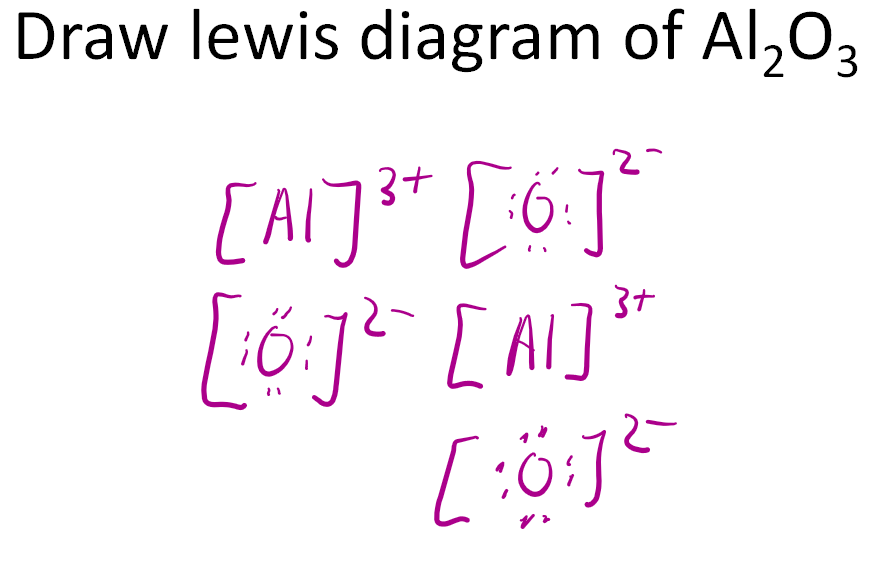
You include a square bracket with charge on outside. Metals have no valence electrons drawn. Nonmetals have full valence shell drawn.

How do you draw lewis diagrams for ionic compounds?
You alternate cations and ions in the correct ratio
What is lattice energy? (both way definitions)
Lattice energy is the energy required to separate 1 mol of an ionic crystal into individual gaseous ions.
Lattice energy is the energy released when gaseous ions form a crystal
(both definitions mean the same thing)

What factors increase/decrease lattice energy?
Lattice energy depends on coulombic attraction.
Depends on product of ion charges (q₁ * q₂). If the value increases, then lattice energy increases.
Sum of ionic radii (r). If the sum of ionic radii increases (size of ions increases), then lattice energy decreases.
What is the Born-Haber Cycle?

What are the properties of solid and molten/aqueous ionic compounds? Why do ionic compounds have these properties?
Solid ionic compounds are brittle because they are cations and anions alternating in the crystal lattice. If you hit the ionic compound then the cations and anions get displaced and repel each other which causes it to break along clean lines.
Solid ionic compounds do not conduct electricity because electricity is the flow of charged particles and the ions are trapped in the crystal lattice
Molten/Aqueous ionic compounds do conduct electricity because the ions are loose and are able to move around. The ions can be directed to flow by a voltage
what is bond polarity? How do you communicate it?
Uneven distribution of charge due to unequal pulling on bonding pairs.
The bonding pairs are closer to the atom with the higher EN
You communicate bond polarity with a bond dipole or partial charge symbols.
What is bond order? What is resonance?
The number of shared pairs of electrons. Bond order of 1 means 1 shared pair, bond order of 2 means 2 shared pairs, bond order of 3 means 3 shared pairs. (single, double, triple bond)
Resonance happens when there is a delocalized double/triple bond. When there is resonance this results in the molecule having a fractional bond order (1.5, 1.33, etc.). Resonance is a delocalized pi bond.
What is a sigma bond, what is a pi bond? What are the properties of pi bonds?
A sigma bond occurs when orbital overlap happens along the internuclear axis. S and P orbitals can form sigma bonds
A pi bond occurs when orbital overlap happens above and below the internuclear axis. P orbitals can overlap to form pi bonds. Pi bonds restrict rotations.

How do you determine the number of sigma and pi bonds in a molecule?
All bonds contain 1 sigma bond.
Double bonds contain 1 sigma and 1 pi bonds.
Triple bonds contain 1 sigma and 2 pi bonds.
What is bond length?
The distance between two nuclei of atoms bonded together
What is bond enthalpy? (also known as bond dissociation energy).
The energy required to break a bond.
Breaking bonds requires energy and making bonds releases energy
What do bond length and bond enthalpy depend on?
size of atoms. Smaller atoms will result in shorter bonds and stronger bonds
Bond order. Higher bond order will result in shorter bonds and stronger bonds.

According to the potential energy vs internuclear distance graph, what happens as:
The distance between the nuclei goes to 0
The distance between the nuclei goes to infinity
The graph reaches its lowest y-value (potential energy is at its lowest)
As the distance between the atoms goes to 0, potential energy goes to infinity because the nuclei repel each other according to electrostatic attraction.
As the distance between the nuclei goes to infinity, potential energy goes to 0. If the atoms are pulled far enough apart, the attraction between the two gets so weak that they they don’t come together anymore
When potential energy is at its lowest, that means that the distance between the two nuclei is at a stable distance. The attraction of one nuclei for the other’s electrons equals the repulsion of the two nuclei.

According to the potential energy vs internuclear distance graph, what do the x and y coordinates represent
X coordinates represent bond lengths
Absolute value of y coordinates represents bond dissociation energy
What is the octet rule (for molecules or polyatomic ions)?
Generally in a molecule or polyatomic ion, all atoms will have 8 electrons around them
What are the exceptions to the octet rule?
incomplete octets
Hydrogen will have 2 electrons and will be satisfied
Boron will have 6 electrons and will be satisfied
Hypervalence/expanded octets
Atoms can have more than 8 electrons. Period 3 elements may have expanded octets meaning the electrons use empty “d” orbitals.

What are molecules with remaining bonding electrons called?
Free radicals
What are the steps to building lewis diagrams for molecules or polyatomic ions?
Find total valence electrons
Connect with single bonds
Fill outside octets
Put leftover electrons on central atom as lone pair
Check central atom. If there are less than enough electrons to form an octet, then take a lone pair and make it another bond.
What is a coordinate covalent bond (CCB)
It happens when both the electrons in a shared pair originate from one atom.
The donor is missing lone pair and the acceptor gains 2 electrons.
What is formal charge?
Formal charge does not represent real charge
Lewis diagrams can be evaluated based on the octet rule and formal charge.
Formal charge = #valence electrons - sticks - dots
the sum of the formal charge on all atoms must = the overall charge of the species. the preferred lewis structure generally has FC closest to zero on all atoms, has negative FC on the most electronegative atom
What is VSEPR
valence shell electron pair repulsion theory.
Electron domains (bonding domains and lone pairs) will repel each other therefore they spread out in 3d around the atom.
What are the basic shapes (electron domain geometry)
AX2