Business Ethics - Quiz 1 - Giordano
 Call Kai
 Learn
Learn Practice Test
 Spaced Repetition
 Match
Match Flashcards
 Knowt Play
1/63

There's no tags or description
Looks like no tags are added yet.
Name | Mastery | Learn | Test | Matching | Spaced | Call with Kai | Chat |
|---|
No analytics yet
Send a link to your students to track their progress
64 Terms
Integrity is doing the right thing even when no one is watching.
What is the C.S. Lewis Quote?
Individual, Organizational, Social/Governmental
What are the 3 Levels of Ethical Decisions in Business?
Each person interacts with businesses as
customers, as employees, and as citizens of the countries in which they operate.
As Individuals........
Developing the knowledge base and skills needed to identify ethical issues.
Understanding how and why people behave unethically.
Deciding how one should act, what one should do, and the type of person one should be as an individual.
Creating ethical organizations.
Thinking through the social, economic, and political policies that we should support as citizens.
Goal of Business Ethics?
Separation Thesis
Asserts that ordinary ethical standards should be kept separate from, and not be used to judge, business decisions because business has its own standards of good and bad.
business stakeholder
A ________ ______ is anyone who affects or is affected by
decisions made within the firm, for better or worse
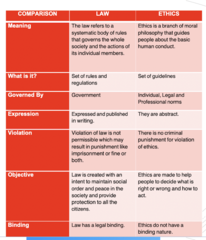
Law
Is a systematic body of rules that governs the whole society and the actions of its individual members.
Is a set of rules and regulations
Is governed by the Government
Is expressed and published in writing
Violation of law is not permissible which may result in punishment like imprisonment or fine or both
Is created with an intent to maintain social order and
peace in the society and provide protection to all the
citizens
Has a legal binding
Ethics
Is a branch of moral philosophy that guides people about
the basic human conduct
Is a set of guidelines
Is governed by Individual, Legal and Professional norms Is abstract
No criminal punishment for violation of ethics
Made to help people to decide what is right or wrong and how to act.
Does not have a binding nature.
Law vs Ethics
Risk Assessment
________ _________ is a process to identify potential events
that may affect the entity, and manage risk to be within its
risk appetite.
To provide reasonable assurance regarding the
achievement of entity objectives.
When the risks involve potential harms and benefits to a variety of stakeholders, it is a judgment that involves ethics as well.
Business must take ethics into account and integrate ethics into its organizational structure.
Operational, Financial, Reputational, Regulatory
Components of a Risk Assessment??
Personal Integrity
the ability of knowing right from wrong and choosing to do that which is right
How should we individually act?
Social Responsibility
the obligation of a business to contribute to society
How should we live together?
Normative
Implying or attempting to establish a norm; expressing value judgments or telling people what to do (rather than merely describing that which is happening)
Descriptive
giving details about; illustrating; explaining
- They provide an account of how and why people do
act the way they do - they describe.
Morality
concern with the distinction between good and evil or right and wrong
Social Ethics
Standards that govern how members of a society should deal with one another in matters involving issues such as fairness, justice, poverty, and the rights of the individual
- Here, we judge companies from a social perspective;
for their social responsibility.
- Personal integrity
- Social responsibilities.
Managerial decisions involve the following aspects of ethics:
Social-scientific approach:
Examines the situation and the decision by exploring the factors that led to one decision rather than another or by asking why the manager acted in the
way that he did.
Norms
Those standards of appropriate and proper (or "normal") behavior
- Establish the guidelines or standards for determining what we should do, how we should act, and what type of person we should be
Values
are the underlying beliefs that cause us to act or to decide one way rather than another.
- Those beliefs that incline us to act or to choose in one way rather than another
Ethical values
serve the ends of human well-being
- Those properties of life that contribute to human well-being and life well lived
Practical Reasoning
figuring out what to do, or reasoning directed toward action
- reasoning about what we should do
Theoretical Reasoning
reasoning directed toward arriving at a belief
- reasoning about what we should believe
- Is the pursuit of truth
Ethical decision-making process
1. determine the facts
2. recognize an ethical decision or an ethical issue—then identify the ethical issues involved.
3. The third step is to identify and to consider all of the people affected by a decision, the people often called stakeholders
4. Consider the available alternatives—also called using
moral imagination.
- Compare and weigh the alternatives on each stakeholder you defined
- Responsible and ethical decision should be explainable, defensible, and justifiable to all stakeholders involved
5. Make a decision, formulate a plan and carry it out
6. Monitor and learn from your outcome(s)
Perceptual differences
surrounding how individuals experience and understand situations can explain many ethical disagreements in a
situation.
normative myopia
Some call the inability to recognize ethical issues
as ___________ _________, or shortsightedness about
values.
- The tendency to ignore, or the lack of the ability to recognize, ethical issues in decision making
inattentional blindness
If we happen to focus on or are told specifically to pay attention to a particular element of a decision or event, we are likely to miss all of the surrounding details, no matter how obvious.
which is a result of focusing on too narrow a range of
questions.
- When we focus on the wrong thing, or fail to focus,
we may fail to see key information that will lead us to success or prevent unethical behavior
Change blindness
A decision-making omission that occurs when decision makers fail to notice gradual changes over time.
Moral imagination
When one is facing an ethical decision, the ability to envision various alternative choices, consequences, resolutions, benefits, harms.
- Consider the available alternatives
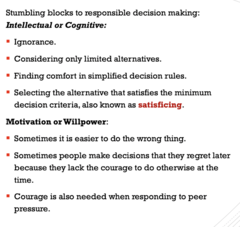
satisficing
choosing a "good enough" alternative
- Selecting the alternative that satisfies the minimum
decision criteria,
Intellectual or Cognitive and Motivation or Willpower
Personal and Professional decision making

stakeholders
All the people who stand to gain or lose by the policies and activities of a business and whose concerns the business needs to address.
Stages of Cognitive Moral Development

Utilitarianism
- is an ethical tradition that directs us to decide based on overall consequences of our acts.
Jeremy Bentham (1748-1832)
idea that the goal of society should be to bring about the greatest happiness for the greatest number of people
Principle-based
Statements that define fundamental values and reference organizational responsibilities, products and employees are often called:
principle-based/justice framework
The __________________ (deontological) directs us to act on the basis of moral principles such as respecting human rights and fairness for all. Immanuel Kant (1724-1804)
Virtue ethics
________ ___________ tells us to consider the moral character of individuals and how various character traits can contribute to, or obstruct, a happy and meaningful human life. Aristotle (4th Centur y B.C.)
consequentialist
moral rightness of an action is determined by its results only
Egoism
As a psychological theory, _______ holds that all people act only from self interest.
the tendency to see things in relation to oneself; self-centeredness
a consequentialist theory, but it focuses exclusively on the happiness of the individual making the decision.
pyschological egoism
An alleged theory of human motivation that claims that all human actions are selfish and by self interest
risk assessment
A process to identify potential events that may affect the entity and manage risk to be within its risk appetite, to provide reasonable assurance regarding the achievement of entity objectives
ethics
refers not only to an academic discipline, but also to that arena of human life studied by this academic discipline, namely, how human beings should properly live their lives.
normative ethics
As a normative discipline, ethics deals with norms and standards of appropriate and proper (normal) behavior. Norms establish the guidelines or standards for determining what we should do, how we should act, what type of person we should be. Contrast with descriptive ethics.
descriptive ethics
As practiced by many social scientists, provides a descriptive and empirical account of those standards that actually guide behavior, as opposed to those standards that should guide behavior.
morality
sometimes used to denote the phenomena studied by the field of ethics. This text uses _________ to refer to those aspects of ethics involving personal, individual decision making. "how should i live my life?" or "What type of person ought i be?" __________ can be distinguished from questions of social justice
Personal integrity
The term integrity connotes completeness of a being or thing. ________________, therefore, refers to individuals' completeness within themselves, often derived from the consistency or alignment of actions with deeply held beliefs.
norms
those standards or guidelines that establish appropriate and proper behavior. Norms can be established by such diverse perspectives as economics, etiquette, or ethics
Practical reasoning
involves reasoning about what one ought to do, contrasted with theoretical reasoning, which is concerned with what one ought to believe. Ethics is a part of practical reason
Theoretical reasoning
involves reasoning that is aimed at establishing truth and therefore at what we ought to believe
Ethical Decison Making process
requires a persuasive and rational justification for a decision. Rational justifications are developed through a logical process of decision making that gives proper attention to such things as facts, alternative perspectives, consequences to all stakeholders, and ethical principles
perceptual differences
Psychologists and philosophers have long recognized that individuals cannot perceive the world independently of their own conceptual framework. Experiences are mediated by and interpreted through our own understanding and concepts. Thus, ethical disagreements can depend as much on a person's conceptual framework as on the facts of the situation. Unpacking our own and others' conceptual schema plays an important role in making ethically responsible decisions.
Personal and Professional Decision Making
Individuals within a business setting are often in situations in which they must make decisions both from their own personal point of view and from the perspective of the specific role they fill within an institution. Ethically responsible decisions require an individual to recognize that these perspectives can conflict and that a life of moral integrity must balance the personal values with the professional role-based values and responsibilities.
Principle-based framework
A framework for ethics that grounds decision-making in fundamental principles such as justice, liberty, autonomy and fairness; asserts that individual rights and duties are fundamental and thus can also be referred to as a rights-based or duty-based (deontological) approach
Virtue Ethics
An approach to ethics that studies the character traits or habits that constitute a good human life, a life worth living. The virtues provide answers to the basic ethical question "What kind of person should I be?"
Ethical relativism
An important perspective within the philosophical study of ethics that holds that ethical values and judgements are ultimately dependent on, or relative to, one's culture, society, or personal feelings. Relativism denies that we can make rational or objective ethical judgments.
Consequentialist theories
Ethical theories, such as utilitarianism, that determine right and wrong by calculating the consequences of actions.
Principles
Ethical rules that put values into action
duties
Those obligations that one is bound to perform, regardless of consequences. Duties might be derived from basic ethical principles, from the law, or from one's institutional or professional role.
Categorical imperative
an imperative that we should follow regardless of our particular wants and needs; also, the principle that defines Kant's ethical system
autonomy
From the Greek for "self-ruled", is the capacity to make free and deliberate choices. The capacity for autonomous action is what explains the inherent dignity and intrinsic value of individual human beings
human rights
Those moral rights that individuals have simply in virtue of being a human being. Also called natural rights or moral rights
character
the sum of relatively set traits, dispositions, and habits of an individual.