ch13 CVD
 Call Kai
 Learn
Learn Practice Test
 Spaced Repetition
 Match
Match Flashcards
 Knowt Play
1/272

There's no tags or description
Looks like no tags are added yet.
Name | Mastery | Learn | Test | Matching | Spaced | Call with Kai | Chat |
|---|
No analytics yet
Send a link to your students to track their progress
273 Terms
CVD INTRO
what is the leading cause of death in the U.S
CVD
what are the major forms of CVD (5)
HTN
atherosclerosis
ischemic heart disease
peripheral vascular disease
heart failure
ischemic heart disease aka (2)
coronary heart disease (CHD) or coronary artery disease (CAD)
what are the types of ischemic heart disease (2 categories)
acute coronary syndrome and chronic ischemic syndrome
acute coronary syndrome includes which diseases
unstable angina
acute MI (STEMI, STEMI)
chronic ischemic syndrome includes which?
stable angina
atherosclerosis can result in what CVDs?
MI, cardiovascular accident, peripheral vascular disease, coronary heart disease, heart failure
what are the 2 main types of heart failure
compensated and decompensated HF
what are the HF categories regarding heart structure
right and left HF
heart failure can result in a need for
heart transplant
HEART STRUCTURE AND FUNCTION

what are the 3 layers of the heart
Epicardium- outer
Myocardium- middle
Endocardium - inner

what are the 4 chambers of the heart
left atrium, left ventricle, right atrium, right ventricle

what does the right side of the heart do (right ventricle and atrium)
receive deoxygenated from the body and pump it to the lungs for oxygenation

what does the left side of the heart do (left ventricle and atrium)
receive oxygenated blood from the lungs and pump it to the body

what is the blood flow of the heart (starting with right side)
Deoxygenated blood enters right atrium via superior vena cava-->
right ventricle -->
pumped through pulmonary trunk (right & left pulmonary arteries) -->
pulmonary circulation (CO2 removed and O2 added) -->
blood returns to heart via pulmonary vein -->
left atrium -->
left ventricle -->
enters systemic circulation through aorta (artery)

the heart pumps via what type of activity
electrical

electrical activity of the heart originates at
the sinoatrial (SA) node
what is the process of the electrical conduction of the heart?
SA —> internodal pathway —> atrioventricular (AV) node —> bundle of his —> Purkinje fibers
OR
SA —> interatrial pathway

electrical activity of the heart is measured via
electrocardiogram (ECG)
what is the cardiac cycle (what does it refer to>)
the repeating contraction and relaxation cycle
what are the 2 phases of the cardiac cycle that
systole and diastole
what is systole
contraction
what is diastole
relaxation
what is systolic blood pressure
force exerted on the walls of the blood vessels during contraction
what is diastolic blood pressure
force exerted during relaxation
when we measure blood pressure, we are usually measuring what type?
arterial blood pressure (ABP)
seen as 130/76 for example
what is arterial blood pressure regulated by? (3)
sympathetic nervous system
renin-angiotensin-aldosterone system (RAAS)
renal function
what hormones are involved in blood pressure regulation? (3)**
epinephrine, vasopressin (ADH), and angiotensin 2
epinephrine is from what system?
sympathetic nervous system
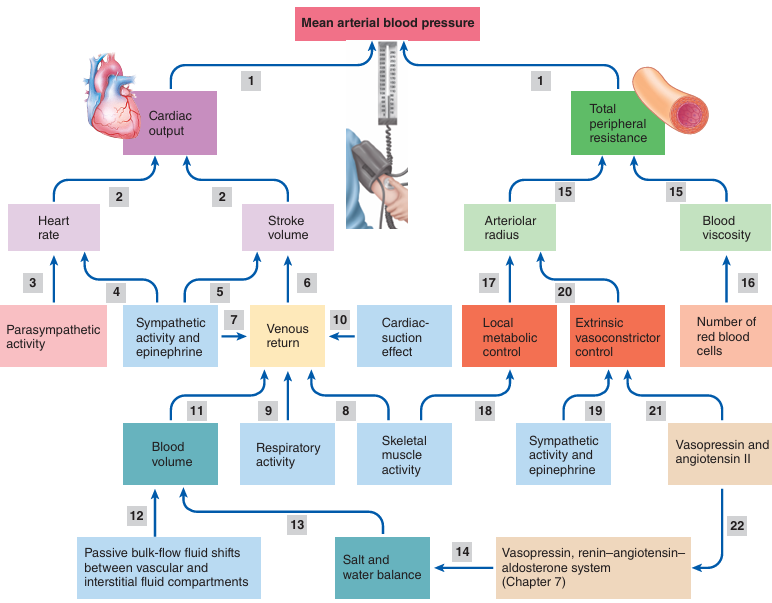
what is mean arterial blood pressure (MAP)
represents the resistance against which the ventricles must contract in order to eject blood into systemic circulation (an average)
mean arterial pressure (MAP) is determined what 2 factors
cardiac output and total peripheral resistance

what is cardiac output? (what is it determined by)
stroke volume x heart rate

what is stroke volume?
volume of blood ejected with each contraction of LV (left ventricle)
The amount of blood pumped per beat

stroke volume is regulated by what 3 things?
end diastolic volume (EDV), mean aortic blood pressure (MAP), and strength of ventricular contraction

what is end diastolic volume (EDV)?
amount of blood in the ventricles at the end of a diastole
aka end-load

stroke volume is enhanced by (2)
sympathetic stimulation (which increases heart contractility) and by increasing Venous Return

what 5 factors impact venous return?
sympathetic activity (epinephrine)
blood volume
respiratory activity
skeletal muscle activity
cardiac suction effect

what is blood volume regulated by?
salt and water balance (vasopressin, RAAS)

what is heart rate determined by? (what regulates it)
balance between parasympathetic and sympathetic NS

parasympathetic nervous system effect on HR
decrease

sympathetic NS effect of HR
increase it (via epinephrine)

what is total peripheral resistance determined by? (2)
arteriolar radius and blood viscosity
HYPERTENSION
blood pressure measurement is what BP over what BP
systolic/diastolic
hypertension is characterized by how many elevated reading
2 or more
what is considered hypertension?
≥140/90 mmHg
what is normal blood pressure? (#’s)
<120/80 mmHg
what is elevated BP (#’s)
120-129/<80 mmHg
what is stage 1 HTN
130-139 mmHg OR 80-89 mmHg
what is stage 2 HTN
≥ 140mmHg OR ≥ 90mmHg
HTN is classifies as either one of what 2 categories?
primary or secondary
what is primary HTN
idiopathic (no known cause) but influenced by lifestyle factors and inflammatory factors
what is secondary HTN
result of another chronic condition (e.g. kidney disease, other cardiovascular diseases, endocrine disorders, or neurogenic disorders)
what specific factors contribute to HTN? (4)
excessive vasopressin and angiotensin II
smoking
renal disease
adrenal disorder
adrenal disorder can result in excessive secretion of
epinephrine and norepinephrine
what hormones can contribute to HTN***
vasopressin, angiotensin, epinephrine/norepinephrine
how can vasopressin (ADH) and angiotensin II contribute to HTN
excessive secretion of these 2 can lead to vasoconstriction and fluid retention which increase BP
how can epinephrine and norepinephrine contribute to HTN?
cause vasoconstriction —> increase cardiac output and peripheral resistance —> increased BP
for HTN treatment, what are the 2 main goals
reduce risk of CVD and renal disease
lower BP to clinically appropriate levels
how do we treat HTN (4 main components)
weight reduction
physical activity
nutrition therapy
pharmacological intervention
what are the recommendation for weight reduction in HTN treatment?
reduce weight to maintain or get to a normal BMI (18.5-24.9 kg/m²)
per 10kg weight loss, what is the reduction we see in systolic BP?
5-20 mmHg
what are the physical activity reccomendations for HTN treatment?
engage in regular exercise 150-300 mins/week (especially moderate to vigorous range)
any amount of physical activity will have a positive impact on BP
physical activity can decrease systolic BP by how much?
4-9 mmHg
what types of medications are commonly used for HTN treatment (2 main)
ACE inhibitors and diuretics
what do ACE inhibitors do?
are vasodilators that reduce BP by decreasing peripheral vascular resistance by interfering with the production of angiotensin II from angiotensin I
ACE inhibitor end in what suffix?
-pril
common ACE inhibitors
enalapril
lisinopril
captopril

nutrition assessment for CV system (overall)

what are the common nutrition diagnosis for HTN?
Excessive energy intake
Excessive sodium intake
Inadequate calcium, fiber, potassium, or magnesium intake
Overweight/obesity
Food- and nutrition-related knowledge deficit
Physical inactivity
what is the nutrition intervention for HTN (main diet)
DASH + low sodium diet
DASH diet provides (per 2000 kcals)
potassium
mg
calcium
pro
fiber
sodium
4,700 mg potassium
500mg magnesium
1,240 mg calcium
90g pro
30g fiber
2,400 mg sodium
what are the 7 main food groups of DASH diet?
Grains and gran products
Vegetables
Fruits
Low fat/fat free dairy
Meats, poultry, fish
Nuts, seeds, beans
Fats and oils
what are the 2 food groups of DASH diet that are to restrict?
sweets
sodium
what is the main emphasis of the DASH diet? (food groups)
fruits and vegetables
what types of grain and grain products are recommended in DASH diet
whole wheat bread (English muffin, pita, naan, bagels), cereals, grits, oatmeal, crackers, unsalted pretzels and popcorn
why are grains and grain products recommended in DASH diet? (nutrients)
major source of energy and fiber
what are the recommended daily servings for fruits and vegetables
4-5 servings a day for each (largest increase)***
why are vegetables recommended in DASH diet? (nutrients)
rich sources of potassium, magnesium, and fiber
why are fruits recommended in DASH diet? (nutrients)
important sources of potassium, magnesium, and fiber
why are low-fat or fat free dairy foods recommended in DASH diet? (nutrients)
major sources of calcium and protein
how many servings of meats, poultry, and fish and recommended per day in DASH diet?
2 or less
what types of meats, poultry, and fish are reccomended in DASH diet
only lean types; do not fry; remove skin and fat
why are meats, poultry, and fish recommended in DASH diet? (nutrients)
rich sources of protein and magnesium
how many servings of nuts, seeds, and beans per week in dash diet
4-5
why are nuts, seeds, beans recommended in DASH diet? (nutrients)
rich sources of energy, mg, potassium, protein, and fiber
for fats and oils, what % of fat should come from diet
27% of calories
for sweets, they should be low in
fat
sodium should be restricted to at least
2,300 mg
one tsp of salt provides how much sodium?
2300mg
what are methods to reduce sodium intake? (6)
Avoid fast food restaurants (most items are high sodium)
Ask about how food is prepared. Request that they prepare without salt, MSG, or salt-containing ingredients. Most restaurants are willing to accommodate
Know the terms that indicate high sodium content (pickled, cured, soy sauce, broth)
Do not add salt to food preparation or at table
Limit condiments such as mustard, ketchup, pickles, and sauces with salt-containing ingredients
Choose fruits or veggies instead of salty snack foods
for optimal blood pressure control, sodium should be restricted to
1500 mg/day
adopting DASH in HTN treatment can reduce systolic BP by how much?
8-14 mmHg
adopting lower sodium intake in HTN treatment can decrease systolic BP by how much?
2-8 mmHg when consuming no more than 2,400mg/d
decreasing alcohol consumption to 2 drinks/day (men) or 1 drink/day (woman) impacts systolic BP how?
decrease by 2-4 mmHg
ATHEROSCLEROSIS
what is atherosclerosis
thickening of blood vessel walls caused by presence of plaque and loss of vascular elasticity
atherosclerosis results in
restriction of blood flow