Anatomy Unit 2- Test Review: Cells and Tissues
 Call Kai
 Learn
Learn Practice Test
 Spaced Repetition
 Match
Match Flashcards
 Knowt Play
1/67

There's no tags or description
Looks like no tags are added yet.
Name | Mastery | Learn | Test | Matching | Spaced | Call with Kai | Chat |
|---|
No analytics yet
Send a link to your students to track their progress
68 Terms

What is #1
Cell Membrane drawing
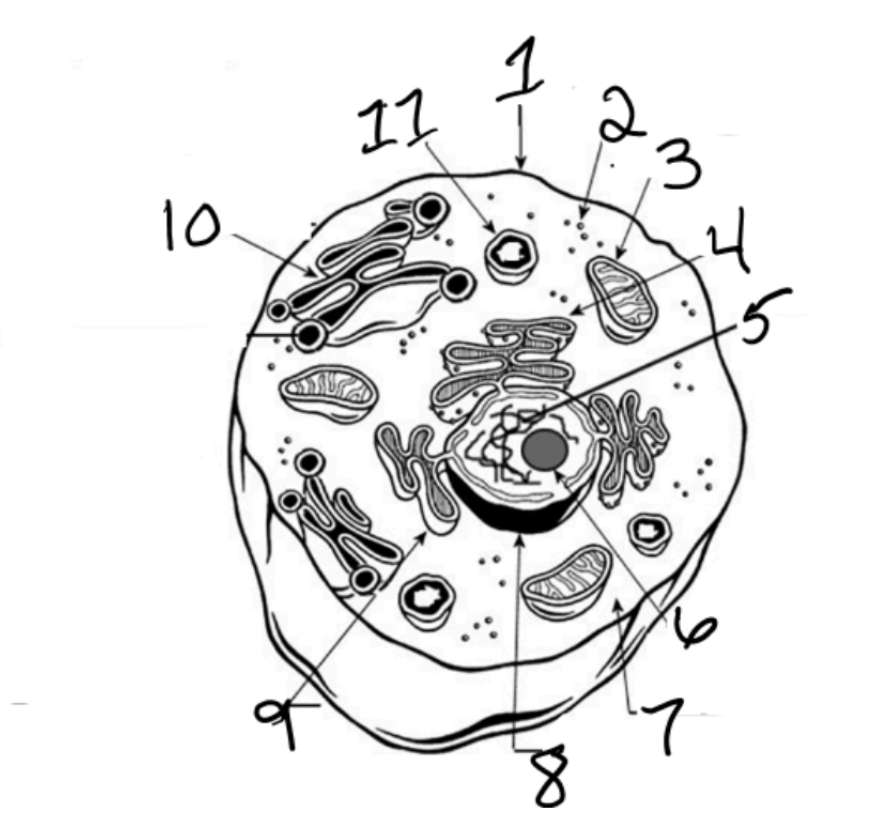
What is #2
Ribosome drawing

What is #3
Mitochondria Drawing

What is #4
Rough ER drawing

What is #5
Chromatin drawing

What is #6
Nucleolus drawing

What is #7
Cytoplasm drawing

What is #8
Nuclear membrane drawing

What is #9
Smooth ER drawing

What is #10
Golgi body drawing

What is #11
Lyssosome drawing
Cell membrane
Allows some things into the cell but not others (selectively permeable)
Cytosol/Cytoplasm
Jelly like liquid inside cell, center of metabolic activities, distributes materials in cells
Cilia
Helps cell interact with the outside environment (movement)
Centrosome
Helps with cell replication (mitosis)
Centrioles
Produces spindle fibers during mitosis
Cytoskeleton
Allows for structure
Ribosomes
Small RNA containing particles that synthesize proteins
Mitochondria
Location of ATP production for cellular energy. (Cellular respiration)
Nucleus
Genetic activity center, contains DNA, contains chromatin and nucleolus
Nucleolus
Dense body in the nucleus that produces ribosomes
Nuclear membrane
Separates nuclear contents from cytoplasm, controls what gets in and out of nucleus
Nucleoplasm
Cytoplasm inside the nucleus
Chromatin
Loosely coiled fibers containing DNA and protein within the nucleus
Endoplasmic Reticulum (Rough and Smooth)
Site for protein synthesis, can be absent of ribosomes
Golgi Body
Structure responsible for packaging and exporting proteins
Lysosome
Membranous sac that contains digestive enzymes, breaks down large waste molecule (intra-cellular digestion)
Vesicles
Membranous sac formed by pinching off pieces of the plasma membrane. Moves materials too large to pass through the membrane on their own
Where is DNA found in the cell?
In the nucleus
What is the difference between Chromatin and Chromosomes?
Chromatin is loose uncoiled form of DNA proteins in a cell during normal activities, Chromosomes are the same just tightly packed into a compact structure for cell division

What is A
Extracellular
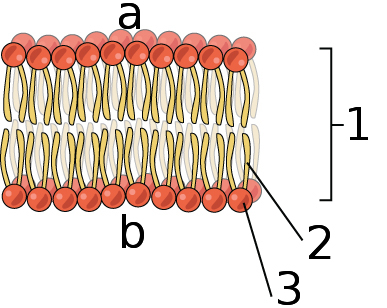
What is B
Intracellular

What is 1
Phospholipid bilayer

What is 3
Hydrophilic head (Phos head)

What is 2
Hydrophobic tail (Fatty acid)
Hydrophobic
Afraid of water
Hydrophilic
Water loving
What part of the cell is composed of the phospholipid bilayer
The cell membrane
Hypertonic solution
More solute outside the cell, cell shrinks
Hypotonic solution
More solute inside the cell, cell grows
Isotonic solution
Same amount of solute inside and outside of cell, cell stays the same
Longest human cell
Sciatic nerve
Biggest diameter
Fertilized ovum
Longest life
Stem cells, immune, neurons, oocytes
Shortest life
Epithelial skin cells, gastric epithelial cells, sperm cells
Passive transport def
Movement of molecules form high concentration to low concentration across cell membrane without help.
Passive transport examples
Simple and facilitated diffusion, osmosis
Simple diffusion
Passive transport. Small molecules move directly through phospholipid bilayer. Fats, oxygen, CO2
Facilitated diffusion
Passive transport. Molecules move through membrane proteins from high to low concentration. Glucose enters through a transport protein
Osmosis
Diffusion of water across a selectively permeable membrane. Water enters or leaves a cell
Active transport def
Movement of substances across membrane using ATP (energy) against concentration gradient, Low to High
Active transport examples
Solute pumping, bulk transport, endocytosis, exocytosis
Solute pumping
Active transport. Moves substances through membrane against concentration gradient, Low to High concentration. Sodium Potassium pump.
Bulk transport
Active transport. Large substances enter or exit cell through cell membrane. Endo/Exo cytosis
Endocytosis
Enters the cell, white blood cells (fighting a bacteria), iron, phagocytosis
Exocytosis
Exists the cell, mucuous and hormones
Epithelial tissue structure and function
Tightly packed together in sheets/layers. Protection, absorption, secretion, excretion
Epithelial tissue example
Inside mouth and cheek, lining hollow organs
Connective tissue structure and function
Mostly extracellular fibers and minerals. Provides support, coordinates activities between muscles and bones. Movement
Connective tissue examples
Blood, cartilage, fat tissue (adi pose), bones
Muscle tissue structure and function
Long stringy cells, multi nucleated, that are capable of shortening/contracting. Movement of bones, internal organs, blood, some glands
Muscle tissue examples
Skeletal, smooth, and cardiac
Nervous tissue structure and function
Made of many different cells with irregular shapes. Receives and transmits electrical signals for communication and control. Communication, coordination, regulation of activities and function
Nervous tissue examples
Brain, spinal cord, nerves, receptors, supporting cells

What is this
Epithelial tissue/cells

What is this
Muscle tissue/cells

What is this
Sperm cells

What is this
Red blood cells