Econ 302 Chp 7/8 Quiz
 Call Kai
 Learn
 Practice Test
 Spaced Repetition
 Match
 Flashcards
 Knowt Play
1/54

There's no tags or description
Looks like no tags are added yet.
55 Terms

The growth rate of output decreases

be unchanged; steeper
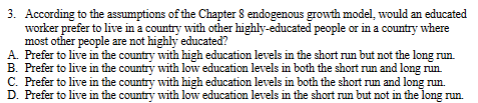
Prefer to live in the country with high education in both the short run and long run

population growth rate plus the depreciation rate

All of these statements are supported by the data

Increase the equilibrium size of the population and have no effect on the equilibrium level of consumption per worker

Knowledge is not in limited supply

The industrial revolution added capital to the production function which is not in fixed supply

The standards of living of a country depend on the savings rate and population growth

the direct contribution of labor and capital

The graph of ln(Ct) to shift down and get steeper

Widening of the income distribution
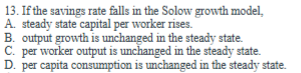
output growth is unchanged in the steady state

greater, lower, shorter

Thomas Malthus
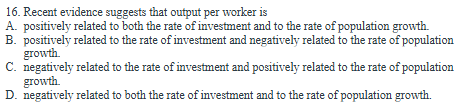
positively related to the rate of investment and negatively related to the rate of population growth

Shift consumption path down, but pivot it upwards

a long-run equilibrium
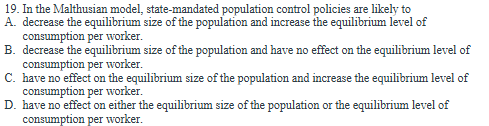
decrease the equilibrium size of the population and have increase on the equilibrium level of consumption per worker

higher population and lower per-capita production

decrease death rates and also decrease birth rates

more capital

it is constant

technological change

the marginal return of capital is decreasing

increases output per worker and increases capital per worker

constant

higher population growth

consumption per worker

increases output per worker and increases capital per worker
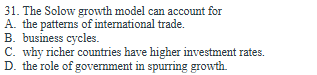
why richer countries have higher investment rates

converging in the rich countries, but not converging in the poor countries

higher

Differences in the size of populations

a downward shift in the Consumption growth path

accumulating human capital

explaining the importance of history on economic growth

investment

Current costs are incurred for future benefits

people

nonrivalry

there are constant returns to scale

differences in per capital incomes across countries persist forever

Brazil, Russia, India, China, and South Africa

individual household choices affect the incomes of other households around them

all of these things

lower

differences in human capital across countries can persist

both consumption and human capital grow at the same rate

better school material

because there is a positive externality from schooling

b

Lower output

decrease; decrease

x/d