Module 6 - Fat crystallization [nog niet af]
 Call Kai
 Learn
 Practice Test
 Spaced Repetition
 Match
 Flashcards
 Knowt Play
1/13

There's no tags or description
Looks like no tags are added yet.
14 Terms
Fat crystallization - General examples

Fat crystallization - Fat crystallization - Content
Introduction
Primary crystallization
Fat crystallization - Fat crystallization - Introduction
Oil consistency
triacylglycerol (TAG) composition, consisting of complex mixtures of fatty acids (FA)
minor hydrophobic components
minor amphiphilic components
Different physical properties
melting behaviour
spreadability
firmness
Influences
processing conditions such as
temperature
cooling rate
shear
→ affect crystallization behaviour and resulting structure
3 most used fats
palm oil
milk fat
palm kernel oil
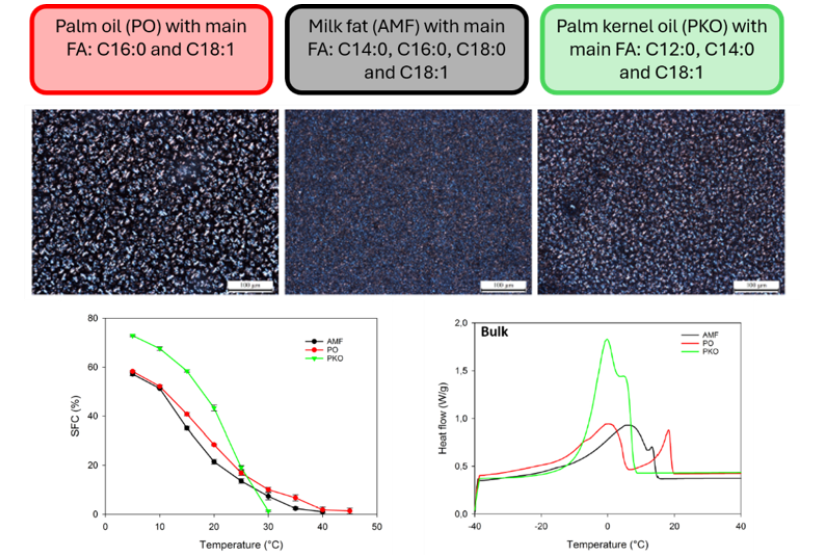
Fat crystallization - Fat crystallization - Introduction: Structure fat crystal
solid highly ordered arangement of TAGs formed during crystallization
molecules are packed in a repeating three-dimensional lattice → different optical properties in different directions → visualised with polarized light microscopy
Fat crystallization
Nucleation: TAG aggregate until a critical size
Crystal growth: further attachment of TAG to those crystalline surfaces

Fat crystallization - Fat crystallization - Primary crystallization
Driving force
Nucleation
Crystal growth
Polymorphism
Fat crystallization - Fat crystallization - Primary crystallization: Driving force (1)
difference in chemical potential µ between the liquid and solid phase (supercooling) causing supersaturation
µ = Gibbs free energy per molecule
High temperatures → all TAGs are dissolved
Crystallization
Cooling → temperature difference is created by which the solubility of high-melting TAGs decrease → concentration exceeds saturation concentration → system = supersaturated → crystallization starts

Driving force
Supercooling | Supersaturation |
thermodynamic driving force | compositional driving force lower melting TAGs = solvent higher melting TAGs = solutes |
cooling → thermal Brownian motion of TAGs is reduced → interaction forces between TAGs (VDW-force) exceed their kinetic energy | cooling → solutes become supersaturated (c_solutes > c_saturation) |
Driving force = based on Tm - Tc | driving force = based on the supersaturation ratio of the solutes |
increased driving force → increased nucleation rate → reduced crystal size
driving force differs amongst polymorphic forms
Fat crystallization - Fat crystallization - Primary crystallization: Nucleation (2)
° once sufficient driving force is created
= TAGs organize themselves in nanoscale crystalline aggregates
nuclei can only continue to grow to macroscopically large crystals if the so-called critical nucleus size is exceeded
Types of nucleation
Primary homogeneous nucleation:
°without the mediation of any foreign particles + at a higher driving force
natural bulk fats = omnipresence of impurities
Primary heterogenous nucleation
° by the presence of foreign particles + at lower driving force
crystallizer walls, blades and impellors, minor polar lipids like mono- and diacylglycerols + dust particles = catalytic impurities
Secondary nucleation
small pieces of crystal are removed from the growing crystal surface
larger than the cricial nucleus size → grow to larger crystals
Fat crystallization - Fat crystallization - Primary crystallization: Crystal growth (3)
° continuous attaching and detaching of TAGs molecules across the crystal surface
melt growth = in the case of pure TAGs where growth continues until all the TAG molecules are incorporated in the crystals
3 kinetic processes
Transportation:
°concentration gradient transfers TAGs towards a crystal surface → convection or diffusion
only significant in solution growth where there is a concentration gradient of the high-melting TAG in the solvent of low-melting TAGs
Incorporation
TAGs diffuse over the crystal surface until they find a kink site where they can attach
crystal with rough surface + large number of kink sites → TAGs can be quickly incorporated into the crystal
A proper conformation is required for the TAGs to be included in the crystals → anisotropy slows down the incorporation
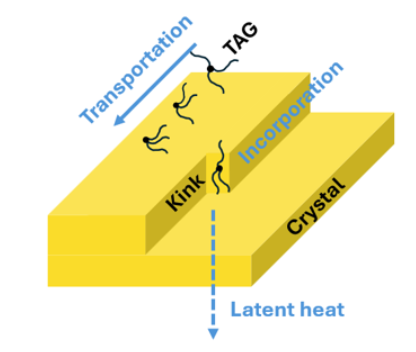
Latent heat
= excess heat released during crystal growth
crystallization = exothermic process
the latent heat is released at the crystal surface → local temperature near the growth interface ↑ → degree of supercooling/supersaturation ↓ → crystal growth rate ↓ → impact further structure formation of the fat
Fat crystallization - Fat crystallization - Primary crystallization: Polymorphism (4)
= the ability to form different crystal structures with distinct physical properties but resulting in an identical liquid phase upon melting
physical properties
melting temperature
crystallization temperature
melting heat
crystallization heat
Subcell packing
subcell = the smallest repeating unit associated with the fatty acid chains in a crystal structure, defined by cross-sectional packing arrangement of the zigzag hydrocarbon chains, which is characterized by the distances between adjacent chains
Polymorphs
alpha-polymorf = hexagonal subcell packing
beta’-polymorf = orthorhombic subcell packing
beta-polymorf = triclinic subcell packing
alpha to beta: packing density ↑ → stability ↑ → melting point ↑

Gibbs free energy (G)
= thermodynamic potential of a certain polymorphic form
alpha to beta: Gibbs free energy ↓ → stability ↑
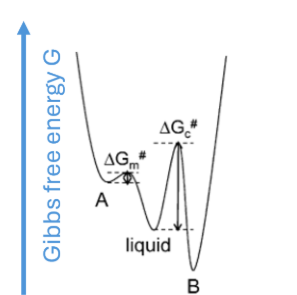
Activation energy for nucleation (ΔG )
= the energy required to initiate nucleation in a certain polymorphic form
alpha to beta: energy for nucleation ↑ → amount of energy required to initiate nucleation ↑


Fat crystallization - Fat crystallization - Primary crystallization: Polymorphism (4): Polymorphic transitions
Transitions into more stable polymorph structures
Solid-state transition | Melt-mediated transition | |
When | when the least stable polymorph is stored at a temperature below its melting temperature | when the least stable polymorph is melted upon heating and then transformed into a more stable polymorph |
Driving force | the activation free energy barriers related to the molecular structural changes required to go from the less stable to the more stable polymorphs |
|
 |  |
Examples
chocolate gloss: time-temperature profile + shear → beta_V polymorph
storage: solid-state transformation occurs towards the unwanted beta_VI polymorf → fat bloom
Fat crystallization - Fat crystallization - Primary crystallization: Polymorphism (4): Slow cooling vs fast cooling
Slow cooling | Fast cooling |
cooling rate ↓ → degree of supercooling ↓ → crystal growth > nucleation → smaller number of large crystals 1 | cooling rate ↑ → degree of supercooling ↑ → nucleation > crystal growth → larger number of smaller crystals |
formation of more stable beta polymorph earlier in the crystallization process | formation of less stable alpha polymorph which gradually transforms into the more stable beta polymorphs upon isothermal storage |
 |  |
Fat crystallization - Effect of processing conditions on fat crystallization
Temperature
T is increased above its melting temperature at the final stage of the production process where towards the end there will be a step involving cooling the food to ambient, refrigerator or even freezer temperatures
crystallization is induced during cooling, but continues during further isothermal storage
low cooling rates | high cooling rates |
degree of supercooling ↓ + driving force for nucleation ↓ → crystallization begins at higher temperatures + low nucleation rate → few number of nuclei → more time to arrange into energetically favorable crystal structures → stable beta promoted → CNP have more time to grow → larger length, width, thickness
| degree of supercooling ↑ + driving force for nucleation ↑ → crystallization begins at lower temperatures + high nucleation rate → high number of nuclei → wider variety of TAGs crystallize simultaneously → more mixed crystals → metastable alpha favored → CNP have limited growth → smaller length, width, thickness
|
spherulitic morphology | needle-like morphology |
Shear
increases nucleation rate while simultaneously disrupting crystal size distribution
accelerate polymorphic transformations toward more thermodynamically stable forms
when the applied shear rate exceeds a critical threshold → formation of a continuous 3D fat crystal network is inhibited → preventing development of a fully interconnected crystalline structure
Fat crystallization - Oleogelation
Semisolid fats
= mixture of more saturated an more unsaturated TAGs
partially crystalline at T relevant to food processing and consumption
3D fat crystal network that entraps liquid oil
→ adverse health effects associated with saturated fats
Oleogelation
= aims at converting liquid oil into gel-like material without modifying the chemical characteristics of the oil
Approaches
1) Direct dispersion approach
Structuring agents (e.g., waxes, fatty acids, fatty alcohols, monoacylglycerols) are directly dispersed in oil above their melting temperature and then cooled
Gelation occurs through crystal nucleation, growth and network formation that immobilizes the oil.
Influenced by
Solubility: To achieve a good gelation, a gelator must neither be too soluble nor insoluble in a solvent to ensure a proper balance of gelator-gelator and gelator-solvent interactions. Hence, not only the composition and molecular structure of the gelator but also the type of liquid oil (i.e. the solvent) will determine the gel properties.
Cooling rate: In line with TAG crystallization, higher cooling rates result in a network of homogenously smaller crystals and thus, an oleogel with a higher firmness. However, the influence of the cooling rate appears to be highly dependent on the chemical composition and molecular structure of the oleogelator.
Shear: High shear rates do not allow the development of an appropriate 3D gel network due to crystal breakage. Low shear rates prior to crystallization (at T > crystallization temperature) might align the gelator molecules allowing improved gelation during subsequent cooling.
2) Indirect method (using water-continuous emulsions as templates)
Hydrophilic polymers are first hydrated in water and used to stabilize concentrated oil-in-water emulsions
After strengthening the interfacial layer and removing water, a dried structure remains that physically traps oil, yielding structured oil systems such as powders, gels or soft solids.
3) Oil sorption approach
Oil structuring is achieved through adsorption or absorption of liquid oil into highly porous food-grade materials
The absorbed oil is confined within the porous network, and subsequent shearing can produce oleogels containing very high oil levels.
4) Structured biphasic systems
Water-oil systems with gel-like viscoelastic behavior in which structuring originates from either the water phase, the dispersed phase, or interfacial layers
Examples include structured emulsions, oil-bulking systems, and gel-filled emulsions.

Example: monoacylglycerols as gelator
In mixtures of monoacylglycerols (MAGs) and liquid oil, MAGs are able to self-assemble into an inverse lamellar phase. Upon cooling, a sub-α polymorph (orthorhombic) is created. Both the inverse lamellar phase and the sub-α crystal transform into a β polymorph upon storage.

This study investigated crystallization of 10% MAG in liquid oil under both static and dynamic (i.e. application of shear) crystallization. The polarized light microscopy images show that the high shear and cooling rate during the dynamic production (pictures at the right) resulted in the presence of smaller crystals compared to the static productions in the absence of shear and at lower cooling rates (pictures at the left). It is also shown that the type of MAG influences the crystal size where c18:0 MAG create larger crystals than a mixture of C18:0 and C16:0 MAG.
Fat crystallization - Crystallization in complex systems
zie module → wel te kennen, maar ik had geen tijd meer!