DNA + RNA
 Call Kai
 Learn
Learn Practice Test
 Spaced Repetition
 Match
Match Flashcards
 Knowt Play
1/101

There's no tags or description
Looks like no tags are added yet.
Name | Mastery | Learn | Test | Matching | Spaced | Call with Kai | Chat |
|---|
No analytics yet
Send a link to your students to track their progress
102 Terms
DNA/RNA
polymers of nucleic acids
carriers of genetic info
nucleic acids
composed of a 5-carbon sugar, nitrogenous base, and phosphate group
RNA (ribonucleic acids)
contains the sugar ribose
DNA (deoxyribonucleic acid)
contains the sugar deoxyribose
nitrogenous bases
order of these along the length of DNA and RNA dictate the order of amino acids in the different proteins
pyrimidine or purine
types of nitrogenous bases
pyrimidine
single 6-membered ring, containing two nitrogen atoms and is planar
purine
contains two rings , and is not quite planar having a slight pucker between two rings
pyrimidine and purine
these are relatively insoluble in water (hydrophobic)
adenine
guanine
types of purines
cytosine
uracil (RNA)
thymine (DNA)
types of pyrimidine
adenine

guanine

cytosine

uracil
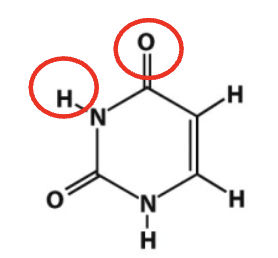
thymine

nucleosides
consist of a nitrogenous base and sugar (no phosphate group)
adding -idine to root name of pyrimidine (cytidine, uridine, thymidine) or -osine to purine (adenosine and guanosine)
if sugar is deoxyribose, deoxy- is added to the front
how nucleosides are named
glycosidic bond
nitrogenous base is attached to the C1 carbon of ribose/deoxyribose via a ? bond
nucleotides
have nitrogenous base, sugar, and phosphate group
C5 carbon of the sugar
where phosphate group is located on nucleotide
2 phosphates (diphospate)
3 phosphates (triphosphate)
1 phosphate
types of phosphate groups a nucleotide can have attached
nucleoside name + number and position of phosphate groups
how to name nucleotides (ex. adenosine-5’-triphosphate)
nucleotides with a triphosphate group
NTPs
nucleotide with a diphosphate
NDPs
NDPs and NTPs
nucleotides that are relatively strong polyprotic acids
can dissociate 3 and 4 protons from their phosphate groups
mononucleotides
can dissociate 2 protons from the phosphate group
stable complexes
resulting phosphate anions form ? with divalent cations such as Mg2+ and Ca2+
Mg2+
most nucleotides in the cell exist primarily as ? complexes
ATP (source of energy)
this molecule bonds between phosphates groups in nucleoside 5’-triphosphates
nucleic acids
polymers of nucleotides linked by phosphodiester bonds
phosphodiester bonds
bonds between nucleotides
nucleotides
have a phosphate bonded to C5 and OH on C3
nucleotides
bonded by phosphodiester bond between the C3 OH of one nucleotide to the C5 phosphate of the next nucleotide
phosphate group on C5 —> 5’ end
OH group on C3 —> 3’ end
direction of nucleic acids
structure of DNA or RNA strand
consists of sugar-phosphate backbone, with bases protruding from backbone
genetic info
the order of bases encodes the ?
5’—>3’ end
DNA and RNA sequences are always written down in the ? direction
order of bases
p
notations for DNA and RNA sequences can list the ? or can have a ? in between to designate phosphate groups
DNA
double stranded → made of sugar-phosphate backbones on the outside with bases buried in the center
hydrogen bonded
bases from each strand are ? bonded to each other
stacking (mostly Van der Waals)
each base pair in a double stranded DNA has ? interactions with top and bottom neighbors
thymine (T)
adenine (A) bases pairs with ?
guanine (G)
cytosine (C) base pairs with ?
Watson-Crick base pairs
A-T and C-G
three H bonds
number of H bonds between C and G
2 bonds
number of H bonds between A and T
helical structure
two strands of DNA form a ?
amino acid sequences
sequence of the bases along with the length of DNA encodes the ? of the protein
number of base pairs
DNA size is usually given by the ?
anti-parallel
two strands of DNA have a ? orientation
5’ end
3’ end
one strand of the ? (P) at the top and ? (OH) at the bottom, other strand is the opposite orientation
hydrogen bonding
hydrophobic effect
stacking forces
forces that stabilize the double helix
H bonds
large number of these bonds between all the bases that stabilize the double helix
hydrophobic effect
the bases are hydrophobic, so being “buried” in the core is energetically favorable which stabilizes helix
stacking forces
bases in double stranded helix are stacked on top of each other, leading to stabilization in helix due to attractive Van der Waals forces (induced dipole interactions)
major and minor grooves
types of grooves in DNA
antiparallel
in order for bases to pair in double stranded helix, the strands need to be ?, giving sugars on the two strands opposite orientations
angle
major and minor grooves
two sugar-phosphate backbones are not directly across the helix from each other, but are rather at an ? —> causes the backbones of the two strands to be closer together on one side and farther apart of the other strand —> results in ? and ?
B, A, and Z
different double-stranded conformations of DNA
B-DNA
most prevalent form of DNA in solution
simple right-handed helix
helix repeats every 10 bp
forms major and minor groove
A-DNA
usually forms when DNA is dehydrated
found in double-stranded RNA and in some RNA-DNA hybrids
forms right-handed helix, making 1 turn every 11 bp
shorter and wider compared to B-DNA
bases are tilted and not perpendicular to the helix axis as in B-DNA
major groove: extremely narrow and deep
minor groove: very broad and shallow
Z-DNA
forms left-handed helix
was discovered using DNA that has the sequence CGCGCG
phosphates of the backbone form a “zigzag” pattern
methylation of C can favor changing DNA from B to Z form
major groove: flattened out
minor groove: extremely narrow and deep
role is still uncertain —> there are some viral proteins that bind Z-DNA and are necessary for pathogenesis
stem-loop structures
single-stranded nucleic acid can fold back on itself
stem-loop structures
ssDNA can form these types of structures but it is more often found in DNA, which is usually single stranded
stem-loop structures
bases in single stranded RNA pair to form ?
mismatched or unmatched bases
loops or bulges in stem-loop structures are made of ? bases that loop out
ribosomal RNA
found in ribosomes forms many stem-loop structures
denaturation by heat
heat disrupts base-pairing in DNA (melting)
as DNA melts and the bases unstack, the UV absorbance increases
melting temp (Tm)
increase in midpoint of absorbance
Tm
is dependent on the % GC and % AT content
denaturation by pH extremes
at pH values >10, bases become unprotonated, destroying their base pairing ability and denatures the DNA
low pH (<2.3) also denatures and depurinates DNA
reannealing
when strands reassociate after denatured DNA is removed from the denaturing conditions
process consists of strands finding the complementary strand and base pairing with it
renaturation rate
dependent of DNA concentration and time
a lot of times reassociation is imperfect and the sequences must dissociate again and pair properly
renaturation
the process occurs more quickly if the temp is warm enough to promote diffusion of the DNA molecules, but not hot enough to cause melting
rate of renaturation
an indication of sequence complexity
faster
DNA with more repeated DNA will renature ? than DNA with more unique sequences
faster
shorter strands of DNA (less bair pairs) will renature ? than longer strands of DNA (more base pairs)
hybrid duplexes
DNA from different species can form ?
DNA sequence or relatedness of two species
the amount of hybridization between two species is a measure of ?
messenger RNA (mRNA)
synthesized during transcription when an RNA copy is made of a sequence of DNA bases, which then directs the synthesis of a polypeptide chain (protein)
ribosomal RNA and transfer RNA
synthesized by transcription of DNA but they are not translated into proteins
rRNA and tRNA
types of RNA that fold into complex secondary and tertiary structures by intramolecular base-pairing interactions
prokaryotic mRNA
may encode several polypeptides
eukaryotic mRNA
encodes only one polypeptide which can be spliced into several versions
more complex than prokaryotic ones
have intervening non-coding regions (introns) that must be spliced out before translation + polyA tails and 5’ cap
synthesized in nucleus and move out to the cytoplasm for translation
introns
non-coding regions in mRNA that must be spliced out before translation
introns
polyA tail
5’ cap
components of eukaryotic mRNA
nucleus
where eukaryotic mRNA is synthesized
cytoplasm
where eukaryotic mRNA is translated
ribosomes
translate mRNA into proteins
composed of 2 subunits of different sizes (large and small) that can dissociate from each other
proteins and rRNA
each subunit in ribosomes consist of an assembly of ? and ?
rRNA
more than 80% of total cellular RNA is ?
tRNA
small RNAs that carry amino acids to the growing polypeptide chain on the ribosome
anticodon
determines which amino acid a tRNA carries
amino acids
these are attached to tRNAs by aminoacyl-tRNA syntheases
aminoacyl-tRNA syntheases
enzymes that attach tRNAs to amino acids
tRNA molecules
form a cloverleaf secondary structures with 4 or 5 segments
acceptor stem
structure on tRNA where the amino acid is linked to the tRNA
loop and stem of anticodon
stem-loop segment on tRNA
seven unpaired bases are on the ? and 3 are on the ?
acceptor stem
anticodon stem and loop
D-stem and loop
T-stem and loop
variable loop
structures on tRNA