Section 8: Acids and Bases, pH and Titrations
 Call Kai
 Learn
 Practice Test
 Spaced Repetition
 Match
 Flashcards
 Knowt Play
1/41

There's no tags or description
Looks like no tags are added yet.
42 Terms
Acid and Base Proton Acceptors / Donators
An acid donates a hydrogen ion (H⁺).
A base accepts a hydrogen ion (H⁺).
Dynamic equilibrium
Some chemical reactions can occur in both directions.
⇌ Forward and reverse reactions.
At dynamic equilibrium, both reactions happen at the same rate, so the amounts of substances remain constant.
Acid base reaction in water
Arrehenius theory
Acid: Increases H₃O⁺ concentration in water.
Base: Increases OH⁻ concentration in water.

Bronstead lowry theory of an acid and a base
Acid = H⁺ donor.
Base = H⁺ acceptor.
Importance of bronstead lowry theory
This is particularly important because a base does not need to contain OH⁻.
Ammonia (NH₃) does not contain OH⁻, but it has a lone pair of electrons on nitrogen.
That lone pair allows ammonia to accept H⁺.

Amphiprotic
Water is amphiprotic, meaning it can either donate or accept H⁺ depending on the reaction.
Lone Pairs
The H⁺ brings no electrons, so the base must supply the electron pair for the new bond.
Conjugate pairs
A conjugate pair consists of two substances that differ by exactly one H⁺.
Acid and Base (conjugate pairs)
Acid: The proton donator
Base: The chemical that gets protonated in the future
Conjugate acid and bases
Conjugate Base: The deprotonated proton donator
Conjugate Acid: The chemical after protonation
Recognising acids and bases from their chemical formulas

Strong & Weak Acids and Base
Strong acid: transfers all of H⁺ to water
Weak acid: some molecules transfer H⁺
Strong base: supplies all of it OH⁻ ions
Weak base: only some reacts with water to produce OH⁻
Strength and concentration
Strength: how readily an acid donates H⁺ or a base accepts it.
Concentration: how much substance is present per litre.
PH
pH describes the concentration of hydronium ions, H₃O⁺.
- More H₃O⁺ means lower pH.
- Less H₃O⁺ means higher pH.
pH calculation
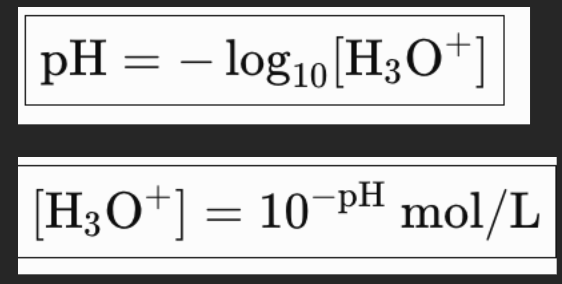
Calculate the pH of a solution from C/V/N
Find the concentration of moles
0.015/3 = 0.005 mol per litre
Calculate hydronium concentration; how much does it ionize in water
HCl + H2O -> H3O+ +Cl+
1M HCl produces 1M H3O+
Calculate the amount of moles of hydronium per litre
0.005 mol of H3O+ per litre
4. Substitute concentration of hydronium ions into –log10[H3O+]
pH = -log₁₀(0.00500) = 2.301
That is pH
Acid Base Reaction
An acid base reaction involves the transfer of a proton, H+.
Water can either give one or receive on, forming a hydronium ion.
Water acting as an acid or a base
When water changes from H2O to OH- it has lost a proton.
It is therefore an acid.
Dilutions involving pH
Convert pH to hydronium ion concentrations
c₁ = 10-1.2 = 6.31 × 10⁻² mol/L
c₂ = 10-3.5 = 3.16 × 10⁻⁴ mol/L
Rearrange to find the volume of stock solution needed to be added to increase the pH.
V₁ = c₂V₂ / c₁
V₁ = (3.16 × 10⁻⁴ × 2 litre) / (6.31 × 10⁻²)
V₁ ≈ 0.0100 L ≈ 10 ml
Neutralisation
In neutralisation, acid and base consume on another through chemical reaction, forming water.
Spectator Ions
Species that are charged, not H3O+ or OH-.
They remain dissolved and form another chemical.
Anti-acids
Identify the ratio of neutralisation agent to acid
Mg(OH)₂ + 2HCl → MgCl₂ + 2H₂O
Use the 1:2 mole ratio
Convert base mass to moles
n(Mg(OH)₂) = m / M = 0.400 / 58.32
= 6.86 × 10⁻³ mol
Use 1:2 mole ratio
Industrial Scale Neutralisation
Calculate hydronium concentration from pH
Find the ratio of hydronium to anti acid
Apply it to the moles of hydronium present, to find the anti acid required mass
Calculation of returning pH to original
Calculate concentration of hydronium ions.
Calculate the difference in concentration moles of hydronium
Use final volume, to find the amount of moles of hydronium
Calculate the ratios (be wary of bicarbonate reactions)
Apply that to the neutralisation agent.
Protonation
Protonation means gaining H⁺
Deprotonation
Losing a H+
Indicators
An indicator is a dye whose forms have different colours. It changes colour if it get’s protonated or deprotonated.
Indicator Abbreviation
HIn = Indicator with it’s proton.
In- = Indicator after losing it’s proton.
Change in colour due to change in light absorption.
Acid Rain
Carbon dioxide dissolves in water and forms carbonic acid. Carbonic acid creates hydronium ions. This is why the usual clean-rain model is around pH 5.6, rather than 7.

Extra acidity from combustion emissions
2SO₂ + O₂ + 2H₂O → 2H₂SO₄
4NO₂ + O₂ + 2H₂O → 4HNO₃
Sulfur dioxide and nitrogen oxides can undergo reactions with oxygen and water. The slide gives these overall reactions:
Effect of acid rain
Effect | Why it matters |
Loss of soil nutrients | Acidity can promote leaching of Ca²⁺ and Mg²⁺ from soil. |
Aquatic harm | Acidification can mobilise dissolved Al³⁺, which harms fish and other aquatic life |
Damage to carbonate materials | Limestone and marble react with acid. This consumes carbonate and can wear away buildings or stonework |
Neutralisation | Carbonate minerals and added lime consume acidity by the same proton-accepting |
Limestone uses in neurtalisation
Limestone reduce soil acidity also explains why acidic rain can damage carbonate stone. Both involve carbonate accepting H⁺.
Buffers
A solution that prevents pH change when a small amount of acid or base is used.
Buffers explanation
It contains it contains a weak acid and its conjugate base.
When an acid is added, the conjugate base (A-) accepts the H+, converting H3O to H20
When a base is added the weak acid donates H+ converting OH- to H2O
For example: acetic acid (weak acid) acetate (weak base)
CH₃COO⁻ + H₃O⁺ → CH₃COOH + H₂O
CH₃COOH + OH- → CH₃COO⁻ + H2 O.
Titration Calculation
Find the moles of the acid or base in the flask + indicator.
Find the ratio of the acid and the base via the equation (balanced equation coefficients)
Apply the ratio to the moles of acid to the volume of acid / base used in the burette, to find the number of moles of acid/basein the burette .
Number of moles in burette / volume of burette
That is the Concentration
Equivalence
The balanced equation’s required reacting amount has been added. It doesn’t mean pH = 7
The correct mole ratio has reacted.
Factors affecting equivalence volume and pH
Equivalence volume depends on the number of moles and reaction ratio.
Equivalence pH depends on the chemical species remaining in solution; conjugate bases can donate OH-.
Endpoint
You observe the indicator colour change and stop.
Fast jump in pH near equivelence
Near equivalence, the acid and base have almost exactly neutralised each other (buffer region end)
So an insignificant amount of additional titrant changes which species is in excess
Before and after equivalence in relation to the fast jump in pH
Excess acid controls pH
Excess base controls pH
Logarithmic:
PH is logarithmic, so the change in H3O+ concentration leads to a large change in pH.
Buffer region
A relatively flat region before the steep rise.
This happens because a weak acid and its conjugate base are both present, allowing the solution to resist changes in pH.
Weak acid donates H+ to neutralise OH-
Conjugate base accepts H+, neutralising H+.
Second stages
Once the weak acid has converted mostly into CH3OOO-, less H+ are being donated, and more are being accepted by the conjugate base.
This causes the pH to rise above 7.