SLH 350 Test 2 PPTs 4-6
 Call Kai
 Learn
 Practice Test
 Spaced Repetition
 Match
 Flashcards
 Knowt Play
1/85

There's no tags or description
Looks like no tags are added yet.
86 Terms
Lecture 15
ECOG and Invasive Electrophysiology
Low spatial resolution
We can see overall brain structure (at different scales), but not single neurons
Low spatial resolution looks like…
a blurry photo
High spatial resolution
can see single neurons or small groups of neurons in specific brain areas
HIgh spatial resolution looks like…
a high-def camera/TV
Some methods have very good spatial resolution (you can see individual neurons), but
you can only see a few neurons at a time.
Some methods have pretty good (medium to high) spatial resolution, but
you can see the whole brain
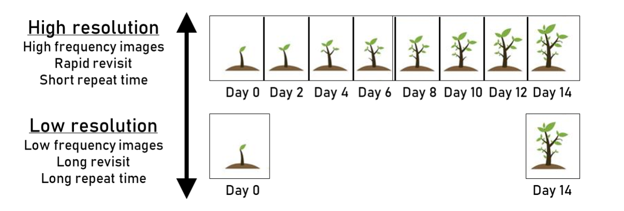
Low temporal resolution
We can only get a snapshot of brain processes every few seconds, minutes, or hours
Like timelapse, only one photo every X seconds

High temporal resolution
We can see changes that are milliseconds apart (like in the action potential!).
Like high-speed video, many frames per second.
Spatial and temporal resolution are…
Relative! There is no one best method for everything
Invasive EP/NP (Electrophysiology/Neurophysiology)
Invasively record from neurons using an electrode (generally made from wire or from glass).
Invasive EP/NP requires…
some kind of surgery
Invasive EP/NP is usually done in animal models, or in very limited circumstances
on people (for example, in tissue that will later be resected in a surgery).
Invasive EP/NP records…
action potentials
Invasive EP/NP measures
either cell voltage or currents flowing through the cell.
Invasive single-unit electrophysiology
measures one neuron
Invasive multi-unit electrophysiology
Measures approximately tens of neurons at a time.
Invasive electrophysiology has _____ spatial resolution and _____ temporal resolution
high, high
glass electrodes from electrophysiology
These glass electrodes would be used for intracellular recordings (e.g., "patch clamp").
Whole-Cell Intracellular Recordings (Single Unit)
The electrode is filled with some solution (usually with the same concentrations as intracellular fluid).
The electrode is advanced into the brain tissue until contact is made with a cell.
The researcher applies suction to suck up some of the plasma membrane into the pipette, then records action potentials from a single neuron.
Electrodes for Extracellular (Multi-Unit) Electrophysiology
Can also record from the outside of the cell with a metal electrode:
Sometimes one piece of metal.
Sometimes four wires twisted together.
Measures multiple neurons at once.
Single neuron recordings in humans
Neuropixels probes
Electrocorticography (ECoG)
A grid of electrodes is placed on the surface of the brain to localize seizures in people with drug-resistant epilepsy.
Each electrode signal in ECoG records from hundreds to thousands of neurons near that electrode. This signal is called the
local field potential (LFP)

ECoG has _______ spatial resolution and ______ temporal resolution
medium-high, high
ECoG comparison to multi- and single-unit recordings
ECoG has similar temporal resolution to single- and multi-unit recordings.
ECoG has worse spatial resolution.
ECoG ethical disclaimer
ECoG is done for clinical purposes only, with patient consent research studies have been conducted.
Research studies depend on electrode coverage.
Some Experiments on Speech/Language Function
"Brain-to-text": Many groups are working on using ECoG, Utah arrays, or noninvasive EEG/fNIRS to decode thoughts in people who cannot speak.
Recordings from the superior temporal gyrus during speech listening — how does the brain represent speech features?
Lecture 16
EEG and MEG
What does EEG stand for?
Electroencephalography
What Does EEG Measure?
Electrical activity of neurons produces currents spreading through the head.
Presynaptic currents (axon, axon potential) are generally
not measurable by EEG
Post synaptic currents (dendrites, excitatory post-synaptic potential (EPSP)) are generally
measurable by EEG
The post-synaptic currents reach the surface of the scalp, in the form of
voltage changes and magnetic fields
Measuring voltage changes at the scalp is called…
electroencephalography (EEG)
The voltage changes detected by EEG are generated by
approx 500,000 to 1 million neurons
Recording EEG
metal discs or cup electrodes
When recording EEG, the discs (or cup electrodes) may be applied directly on the head or…
as a net, or with a cap
When recording EEG, the tech may use conductive gel or saline to
get better conductivity through the scalp
We cannot read a ____ EEG, it must be filtered and any _____ removed
raw, noise
Is EEG invasive?
no, it is non-invasive
Is EEG cost effective?
yes
EEG has ____ temporal resolution
hihg, you can look at things that happen quickly (milliseconds apart)
EEG is used clinically for…
sleep studies, epilepsy studies, hearing screenings (evoked potentials/auditory brainstem response)
EEG is used for research in
language, vision, cognition, etc.
EEG has _____ temporal resolution, but _____ spatial resolution
high, low
EEG has great timing, but poor
localization (where in brain)
EEG evoked potentials are used in
Universal newborn hearing screening (ABR = auditory brainstem response).
EEG can be used to examine specific components related to
early sensory processing versus later "cognitive" components.
EEG can be used clinically to monitor
seizure activity in epilepsy, as well as monitoring normal function
Event Related Potentials (ERP)
One method of EEG analysis, also called evoked potential
ERP event related =
happens in response to a stimulus (visual, auditory, motor, etc.)

In ERPs, the stimulus is repeated a bunch of times, then
the response to the stimulus is measured and recorded
ERPs can do this for any stimuli, like
tones, speech sounds, faces, etc.
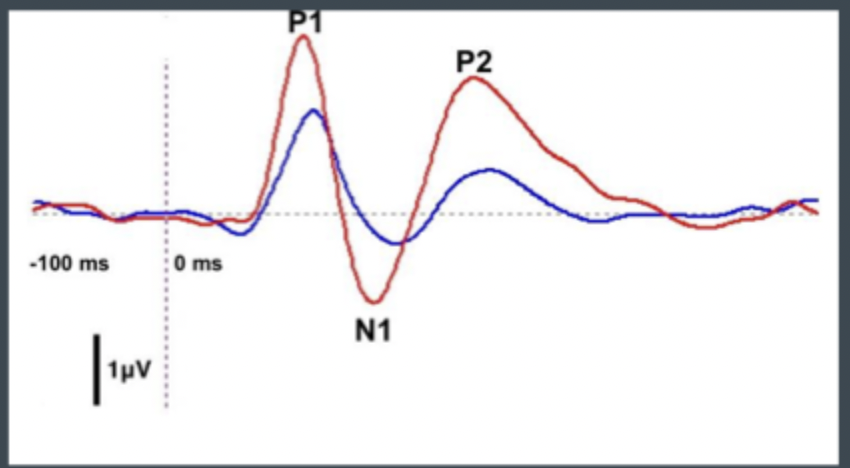
Visual ERPs Are Larger in People With Hearing Loss
Larger responses to visual stimuli for the hearing-loss group (red) versus controls (blue).
Participants had adult-onset mild-to-moderate hearing loss.
MEG stands for
Magnetoencephalography

MEG measures
tiny magnetic fields generated by neurons' electrical currents.
MEG uses SQUIDs
superconducting quantum interference devices
MEG has ______ temporal resolution, and _______ spatial resolution
high (milliseconds), medium-high

MEG is great at capturing…
eural activity in the sulci, but not the gyri, due to the physics of the magnetic field.
MEG has better spatial resolution than EEG because
magnetic fields are not blurred by the skull.
MEG and EEG have similar
temporal resolution
MEG is sensitive to activity in
sulci, but less so in gyri.
True or false: MEG systems are very expensive and must be housed in special rooms.
True
SQUIDs must be kept cool with
liquid helium, which is expensive and rare, although new tech is being developed
Clinical Uses of MEG
Motor mapping before surgery
sensory mapping before surgery
language mapping before surgery
Research uses of MEG
Many! (like EEG) generally questions that need high temp res and benefit from higher spatial res
Analyses That Work for Both EEG and MEG
Event-related potentials (ERPs).
Spectral analysis (examining EEG/MEG in particular frequency bands associated with neural oscillations).
Time-frequency analysis.
Spectral Analysis
examining EEG/MEG in particular frequency bands associated with neural oscillations
Spectral analysis filters…
EEG or MEG into different neural oscillation bands
In Spectral Analysis, different bands are associated with
different cognitive tasks and states of arousal
Frequency bands in Spectral analysis
delta, theta, alpha, gamma
Delta bands
0-4 Hz, slow fluctuations, approx. word level rate
Theta bands
4-8 Hz, syllabic rate
Alpha bands
8-12 Hz, associated with attention
Gamma Bands
30-100+ Hz

Time-Frequency Analysis looks at
timing and spectral content at the same time
Time-Frequency Analysis may see an activity
in a task localized to a certain band
Time-Frequency Analysis example
English and Mandarin speakers listened to Mandarin Chinese sentences played at a regular rate of 4 words per second (4 Hz).
Each two-word pair was a noun phrase or verb phrase.
Each four-word utterance was a sentence.
MEG was recorded.

Time-Frequency Analysis experiment findings
The brain tracked sentence structure only when participants understood the language.
EEG or MEG? A researcher wants to study speech-sound discrimination in awake, active six-month-old infants in a relatively naturalistic room setting, on a limited research budget.
EEG
EEG or MEG? A researcher needs to precisely localize the cortical source of an auditory response to within a few millimeters to distinguish activity in neighboring auditory regions.
MEG
EEG or MEG? A clinical team wants a bedside-compatible tool to monitor a patient's brain activity continuously overnight.
EEG
EEG or MEG? A research team is building a large, multisite study and needs equipment that is relatively inexpensive and easy to transport between testing locations.
EEG
Lecture 17
FMRI and FNIRS