HA EXAM 3; MSK, Neuro,
 Call Kai
 Learn
 Practice Test
 Spaced Repetition
 Match
 Flashcards
 Knowt Play
1/88

There's no tags or description
Looks like no tags are added yet.
89 Terms
MSK
Past Medical History:
Past Surgical History:
Family History:
• Fractures? • Injuries? • Falls? • Degenerative disease? • Stroke? • Infections? • Parathyroid problems? • Tumors or cancer?
• Joint replacement (ORIF, TKA)? • Surgical repair (ACL, Meniscus)? • Spinal surgery?
• Any immediate family members with muscle, joint or bone problems? • Autoimmune conditions
Joints
Muscles
Bones
• Pain • Stiffness • Swelling • Heat • Redness • Limitation of movement
• Pain(cramps) • Spasm • Weakness
• Pain • Deformity •Trauma
⚬ Fractures
⚬ Dislocations
⚬ Sprains/Strains
Localized pain
monoarticular
trauma
Diffuse pain
Polyarticular
Migratory
Pattern of involvement
Systemic pain
Problems with joints, muscles, and bones
Fever, chills, rash
SLE, Fibromyalgia
Moderate to severe muscle pain of the neck, shoulders, or proximal thigh is associated with fibromyalgia. Pain or tenderness upon palpation of at least 11 out of 18 trigger points located on the back of the neck, upper chest, trunk, low back, and lower extremities is consistent with fibromyalgia. Palpation will often result in burning and gnawing pain

Inspect muscle tone:
when does denervation occur?
when does atrophy occur?
when a nerve supplying a muscle is damaged or cut
when a healthy muscle is not used due to inactivity, casting, or bed rest
Inspect muscle tone:
spasticity
rigidity
flaccidity
Spasticity: a form of hypertonia that is velocity-dependent. The faster you move the joint, the stiffer the muscle feels
Rigidity: A form of high muscle tone that is independent of speed.
Flaccidity: A state of very low muscle tone where muscles feel loose, limp, or floppy.
flaccid-floppy
Muscle strength: 5/5
Normal - complete ROM, full resistance
4/5
Good - complete ROM, moderate resistance
3/5
fair - complete ROM
2/5
poor - complete ROM with joint support, cannot perform against gravity
1/5
Trace - muscle contraction detectable, no movement of joint
0/5
Zero - no visible muscle contraction
What is the most common muscuoloskeletal complaint?
Back pain ~ abnormal finding
most vulnerable part of the skeleton is L5-S1
What is the leading cause of injury-related death for people 65 and older?
percentage of hip fractures associated with falls
falls are associated with
Falls
95%
poor balance, prior falls, poor muscle strength, unfamiliar environment, aging
Fall assessments
functional status
prior falls
Timed Up and Go test: quick clinical tool used to measure an individual's functional mobility, balance, and risk of falling
Stand up from the chair on the cue "Go".
Walk the 3-meter distance at a normal, safe pace.
Turn around at the line/marker.
Walk back to the chair at a normal pace.
Under 10 seconds: Normal mobility and a low risk of falling for healthy adults.
11 to 20 seconds: Within normal limits for frail or disabled older adults, but may indicate a moderate risk of falling or functional decline.
12 seconds or more (for older adults): Generally flagged by guidelines like the CDC STEADI initiative as an increased risk for falls, signaling a need for further evaluation.
30 seconds or more: Indicates a high risk of dependence and severe mobility impairment.
Cycle of Falling
as a nurse what should you review
what annual screenings
what should you check for fall prevention
Falls place the patient at risk of serious injury
medicines that may cause balance problems
annual vision and hearing checks
home safety for fall prevention

The Three Core Steps: STEADI(help prevent falls in 65 and older)
Stopping Elderly Accidents, Deaths, and Injuries
Screen: Check all older adults to see who is at risk for a fall.
Assess: Find out what specific issues cause the risk, like weak legs or poor balance.
Intervene: Use proven steps to lower the chance of a fall.
Pregnant Women
Increased joint mobility from increased hormone production
Increased mobility of pelvic joints causes a change in posture
Lordosis to compensate for an enlarging uterus
Infants
Fetus forms a cartilaginous skeleton by 3 months
All muscle fibers are present at birth but lengthen with growth
Bone growth continues until the age of 21
Barlow Maneuver
Tests for Developmental Dysplasia of the Hip
May hear a “pop” with hip dislocation
Ortolani Maneuver
Done at each visit until age 1
Tests for Developmental Dysplasia of the Hip
Allis Test
Check for hip dislocation by comparing leg lengths
School Age Children
Genu valgum(knock knees-deviation toward the midline) or Genu varum(bow legs-deviation awat from the midline)
Pes planus (flat feet)
Pathological pronation
Toeing In (pigeon toes)
Walking on lateral side of foot
Radial head subluxation (Nursemaid’s Elbow)
Adolescents
Growth hormone, adrenal androgens, and testosterone (in boys), contribute to growth spurts
Bone growth continues until the age of 21
Kyphosis is common in adolescents because of poor posture
Sports-related injuries
Older Adults
Decreased bone density
Increased boney prominences
Cartilage degeneration
Joint stiffness
Muscle atrophy
Postural changes: Hyperkyphosis
Functional assessment
Subjective Data
HPI
• Any seizures - ask: how long do the seizures last, do they have seizures often, or is this a sudden onset, what may have caused the seizure
• HA - headache, oldcarts
• Problems with gait coordination - is this new onset
• Weakness • Numbness - new onset or something over time
• Head injury - any symptoms associated with head injury like headaches, photophobia, LOC
• Dizziness
• Syncope
• Tremors
• Problems speaking or swallowing
Are these things new or something youre used to
PMH
• Trauma
• Concussions - did you lose consciousness, if so for how long, have you had multiple
• Dizziness/vertigo - may be chronic, or new onset; figure out what is going on
• Seizures
• Tremors
• Meningitis - viral or bacterial(long-term complications much more difficult to treat) case
• Deformities
• Cardiovascular, circulatory problems, HTN, aneurysm, CVA/Stroke ~ blood to the brain
if something is going on in the heart-usually manifests to the brain as well
• Neurological disorder, brain surgery, residual effects
FH
• Neurological disorders
• Parkinson’s
• Alzheimer’s Disease
• Dementia
• Multiple Sclerosis
• Amyotrophic LateralSclerosis-(ALS) – LouGehrig’s Disease
• Stroke/CVA/TIA
A lot of these are genetically correlated and may have some genetic predispositions.
Social History
Environmental hazards - chemical exposure, pollution
• Occupational hazards - people who have to work at heights on ladders, athletes
• Ability to care for themselves - ADLs
• Sleeping and eating patterns
• ETOH
• Use of street drugs - if someone is intoxicated, their neuro assessment may be scewed; do not judge, just need to know. Can also cause long-term complications and brain damage
History of Older Adults: ADLs
• Feeding• Continence• Transferring• Toileting• Dressing• Bathing
activities older adults may struggle with if they have some degeneration in the brain
History of Older Adults iADLs
can they care for things to keep the household going
Using the telephone
Shopping•
Preparing food
Housekeeping
Doing laundry
Using transportation
• Handling medications•
Handling finances
OBJECTIVE DATA
Mental Status Assessment
• Judgment
• Abstraction
•Memory-cognitive
• Level of consciousness
• Completed through entire exam
might not need to ask; gathering info as you speak to them
COGNITIVE ABILITIES: JUDGMENT & INSIGHT
Judgment: evaluate their responses to social, family, and work situations
family input can provide additional judgment assessment
Normal: client responds and acts appropriately in situations requiring judgment.
Impaired judgment may result from frontal lobe damage, dementia, psychosis, or mental disability.
Insight: ability to realistically understand oneself assessed through discussion of health status, symptoms, life changes, and coping
Lack of realistic self-awareness may appear in bipolar disorder (euphoric stage), anxiety, or depression; drawing tasks may also reveal insight.
CALCULATION AND ABSTRACT REASONING
• Calculation: add 3 repeatedly starting from 100; serial 7s ⚬ Dyscalculia~parietal lobe
normal: fewer than 4 errors in under 90 seconds
may accompany aphasia and is linked to depression, anxiety, dementia, mental disability, or focal lesions (commonly dominant parietal lobe).
• Abstract reasoning: ask client to explain proverbs, fables, or metaphors
abnormal concreteness: dementia, schizophrenia, frontal tumors, and low intelligence
MEMORY and COGNITIVE
• Assess immediate recall ⚬ Give three items to remember and repeat after 5 minutes
—→ if they fail give a recognition list (numbers remembered over numbers given: 1/3)
• Long-term memory assessment ⚬ Personal or general facts
Memory = hippocampus and temporal lobe
When a patient is "A&O x 4," they are fully aware of four key areas:
• Person: Knowing their own name and recognizing who they are.
• Place: Knowing where they are (such as a specific hospital, room, city, or state).
• Time: Knowing the current time, day of the week, date, month, or year.
• Situation (or Event/Purpose): Understanding why they are there or what just happened to them
A&O x2 specify which ones they are missing
ATTENTION
• Read 2 to 6 numbers aloud and ask client torepeat them forward and backward⚬ Normal: Can repeat 5 correctly
Provide a new series if the client misses; stop after two errors of the same length.
• Serial 7s or 3s for concentration(subtract 7 from 100)⚬ Normal: Can recite to at least 40s to 50s in 1min
Impaired performance may indicate short attention span, dementia, neurological injury/disease, mental disability, or post-COVID cognitive effects.
Level of Consciousness
⚬ Alert: Patient can look and fully respond to stimuli - looking at you
⚬ Lethargy: Drowsy but opens eyes, responds to questions, then falls asleep - might fall asleep, but you will wake up easily
⚬ Obtunded: Opens eyes, responds slowly and is somewhat confused - starting to have some confusion
⚬ Stuporous: Arouses from sleep after painful stimuli. Verbal responses are slow or absent. Lapses into unresponsive state after stimuli. - takes more effort to get them to open their eyes, confused; when you stop stimulating them, they fall right back to sleep
⚬ Comatose: Remains unarousable with eyes closed even with painful stimuli - do not respond to a sternal rub start with a verbal stimulus, then progress to the stimulus to see their LOC
Cranial Nerves; be able to identify them by name, number, and function

Cranial Nerve 1
• olfactory
Not routinely tested
• Normal: ⚬ Patient identifies common odors accurately
• Test if: ⚬ Reports loss of smell ⚬ Head trauma ⚬ Suspected intracranial lesion•
May also be decreased in cigarette smoking, chronic allergies and cocaine use
Cranial Nerve 2-
Optic
⚬ Visual acuity and Visual fields
Color: Ishihara plates
■ Assesses color vision ■ Identifies color blindness visual fields
⚬ Tests peripheral vision
■ Ask patient to look directly at you ■ Wiggle one finger in each of the 4 quadrants ■ Ask patient to identify which finger is moving
Pupillary reflexes ⚬ Consists of DIRECT(shine light in left eye make sure it conflicts) & CONSENSUAL(shine light in left eye and see if right pupil constircts, because they are connected; normal finding both pupils should constrict at once) reflexes
⚬ Carries sensory nerve information to the brain, while CN3 is responsible for the motor movement of pupil and eye
2 takes sensory to the brain, 3 is the nerve that constricts the eye
⚬ PERRLA - Pupils are equal, round(before shine light take a look at the pupils to see if they are equal and round), reactive to light, and accommodation(move light towards their face and further away- eyes should move inward to focus on the object)

Cranial Nerves 3, 4, & 6
• Oculomotor
• Trochlear
• Abducens
• Cardinal fields of gaze
⚬ Tested together
⚬ Conjugate movements of the eye
⚬ H-Pattern vs Star Pattern
⚬ Can perform convergence test if not performed with CN 2
dont need to each of the muscles, but know they work together

Cranial Nerve 5:
Trigeminal
• Three branches of the trigeminal nerve:
⚬ Ophthalmic ⚬ Maxillary ⚬ Mandibular
Sensory supply to the face(can they feel? have them close their eyes, touch them with a cotton ball, all parts of the face) • Test along all three branches⚬ Light touch (cotton whisp)⚬ Sharp vs dull(paper clip)
Corneal reflex⚬ Do NOT perform in class/lab ⚬ Blink response ~ might need to use, but not common, if they are blinking you do not need to test it
Motor supply to the muscles of mastication • Masseter • Temporalis • Buccinator • Zygomaticus
⚬ Palpate masseter & temporalis ⚬ Ask patient to “clench teeth”

Cranial Nerve 7:
Facial
Innervates the muscles of facial expression: Tell patient: “We are going to make some funny faces now”.
• Tell patient: ⚬ “Raise your eyebrows” - consider their baseline
• Tell patient: ⚬ “Make a mad face”⚬ “Close your eyes, keep them closed, don’t let me open them(we do not do this as often)”
• Tell patient: ⚬ “Puff out your cheeks”
• Tell patient: ⚬ “Smile & show your teeth”

Cranial Nerve 8:
Vestibulocochlear Nerve
Innervates the hearing apparatus of the ear
acuity: whisper test
conductive vs sensorineural hearing: webber and rinne(air vs bone) tests
vestibula—>balance
cochlear—>hearing
Whisper Test:
Stand 45 degrees behind patient
Have patient cover opposite ear
Approximately 2-3 feet away
Whisper three numbers or a word
(i.e. 727, 813) or (Apple, Ball)
Ask patient to repeat
Cranial Nerve 9: Cranial Nerve 10: (Tested Together)
CN 9: Glossopharyngeal Nerve: Sensory supply to the soft palate
• CN9: Special sensory: Taste to posterior 1/3 of tongue - gag reflex
• CN 10: Vagus Nerve: Motor supply to pharynx ⚬ “Say AAAHHH”⚬ Uvula & soft palate rise to midline (CN10) No deviation of uvula
Cranial Nerve 11:
Spinal Accessory Nerve
Test strength of sternocleidomastoid (SCM) and trapezius muscles
⚬ Ask patient to turn head against resistance (SCM) ⚬ Ask patient to shrug shoulders against resistance (trapezius)
Cranial Nerve 12:
Hypoglossal Nerve
Test tongue strength
⚬ Ask patient to stick their tongue out⚬ Observe for deviation (weak muscles)⚬ Hold tongue to cheek against resistance
tongue deviates to the weak side
Big concern is aspiration, choking, impaired swallowing
DEEP TENDON REFLEXES
• Brachioradialis(flexion and supination of the forearm is normal, exagerated=wrist/finger flexion, forearm adduction. Radial nerve: C5-C6
• Biceps(normal=bicep contraction and elbow flexion, use thumbs for this reflex). musculocutaneous nerve: C5-C6
• Triceps(Normal response: triceps contraction and arm extension; mediated by the radial nerve (C7–C8)).
• Patellar. Femoral nerve: L2-L4. quad contraction and leg extension
Incorporate Deep tendon reflexes into assessment because nerves going down the spine are attached, degenerative conditions might affect DTR, ecclampsia affects
Absent or decreased deep tendon reflexes indicate:
disruption of the reflex arc; causes include deep coma, sedation, hypothyroidism, drugs, infections, increased intracranial pressure, or spinal shock.
Cerebellar Function
• Rapid rhythmic alternating movements ⚬ Pat knees with both hands ⚬ Play the piano ⚬ Touch thumb to finger tips on each hand (precision finger tap)
• Accuracy of movements ⚬ Finger and nose ⚬ Nose to finger (Point to Point) ⚬ Heel to shin
Think about balance and coordination of movements

Cerebellar Function Balance
⚬ Sternal nudge-can hold balance(have someone stand up, give them a little push, see if they can hold themselves up)
⚬ Romberg Test (stand with feet together and eyes open and then closed) - positive test: abnormal: can not hold balance
⚬ Positive test is when patient begins to sway which indicates cerebellar ataxia(issues with coordination and movement), vestibular dysfunction, sensory loss
Cerebellar Function: Gait
⚬ Tandem walking(heel to toe) ■ Weight transfer ■ Stride
• Note any abnormality ■ Shuffling ■ Loss of arm swing
CORTICAL SENSATION
stereognosis
Graphesthesia
Two-point discrimination
Extinction
• Stereognosis-ability to identify objects by touch AND manipulation(close your eyes, put something in your hand; you should be able to identify the object. should be an easy object to recognize)
ABNORMAL: astereognosis: unable to recognize those objects by touch; due to parietal lobe or sensory cortex dysfunction
• Graphesthesia-ability to recognize numbers, letters, or shapes drawn on the skin (draw number in their hands, ask them to identify the number)
ABNORMAL: graphanesthesia: unable to recognize the drawing despite intact peripheral sensation—indicates parietal lobe dysfunction.
• Two-point discrimination: ability to distinguish two closely spaced points on the skin; abnormal requires greater distances between the two points; parietal lobe lesions
• Extinction- touch identical sites on opposite sides of the body at the same time- can’t feel—→parietal lobe lesions
Know how to grade muscular response

5
Normal- active movement against resistance without any fatigue
4
Actie movement against gravity and some resistance
3
active movement agianst gravity
2
active movement with gravity eliminated
1
barely detectable flicker or trace of contraction
0
no contraction detected
ABNORMAL FINDINGS: Significant Changes in Neuro Status
• Acute change in mental status - if infection has progressed, they may be agitated - also hypoxia, lack of O2 to the brain—→irritability, TBI; they were pleasant and now they are acting agitated, confused
• Seizure activity - new-onset seizure activity is not normal
• Onset of posturing -
• Change in reactivity or size of pupils - tells you a lot
• Progressing weakness or paralysis
• Changes in vital signs(BP and HR)
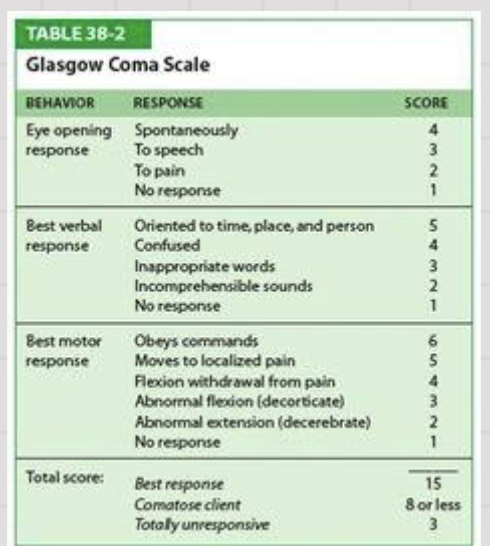
Glascow Coma Scale(GCS)
Objective assessment that defines the level of consciousness
Best response is a 15; which is good
The lowest score possible is a 3; no such thing as a zero
Eye opening: probably at a 4 right; we open them spontaneously
opens to speech=3, opens to pain = 2, no repsonse = 1
Verbal response: AO x3 =5
confused but speech is clear= 4, speech is clear but is confusing=3, slurred speech/muttering=2, no response=1
Motor response: obeys commands = 6(able to squeeze hands if you ask)
moves to localized pain(you pinch them and they flinch and they try to remove the stimuli)=5, flexion withdrawal from pain(feel pain but can’t get rid of the stimulus or move away)=4, etc.
13-15 mild
9-12 moderate
3-8 severe
Risk Factors for CVA:
look over these as it gets closer
foramen ovale is a whole in the heart
Age >55
Male, Black
Hypertension, Diabetes mellitus
Cocaine use, Cigarette smoking, IV drug or alcohol abuse
Hyperlipidemia, CAD, PAD, Atherosclerosis, Atrial fibrillation and flutter
History of cerebral aneurysm, Family history of stroke
Sickle cell disease
Severe anemia, Physical inactivity, Obesity
Oral contraceptive use, especially in women over age 35 who smoke and have hypertension,
Patent foramen ovale, Previous stroke, TIA (transient ischemic attack)
Previous myocardial infarction
ABNORMAL FINDINGS; Posturing
⚬ Decorticate rigidity - turn towards the core; problems with cervical spine or cerebral hemisphere
⚬ Decerebrate rigidity - turn away from the core; usually symptoms are worse; problem with midbrain or pons
■ More ominous sign – could be related to a lesion in the brainstem
ABNORMAL FINDINGS; Meningitis
• Kernig’s Sign:
⚬ Resistance to straightening, pain down posterior thigh is a positive sign
- lying down flat, flex knee and hip to 90 degrees and try to flex leg; pain=positive sign(bad), freely without pain(negative, good)
• Brudzinski’s Sign:
⚬ Severe neck stiffness causes a patient's hips and knees to flex when the neck is flexed
- flex head up(if they pull the knees up—>positive sign, bad
SPECIAL POPULATION CONSIDERATIONS: Aging Neurological Considerations
• Reduced fine motor coordination and agility
• Neuron loss resulting in loss of muscle tone and facial tone
• Neuron loss resulting in reduced muscle strength
• Slower reaction time
Everything is slower; coordination, strength, reaction time
Medications may impair gait
Proprioception declines: general feel for surrounding; spacial awareness; more risk for bumping into things, and falls
Shuffling may occur
Reduced DTR
Parkinson’s Disease
A loss of dopamine-producing neurons in the substantia nigra and basal ganglia, resulting in a motor-tract disorder.
• Resting tremor
• Bradykinesia
• Cogwheel rigidity
• Loss of balance
• Anxiety & depression
• Urinary incontinence
• Widespread cognitiveimpairment
Cognitive impairment is not…
normal aging
change in cognition is related to something; dementia, alzheimer’s, and Parkinson’s are not part of normal aging
USPSTF RECOMMENDATIONS; Grade B Recommendations:
The USPSTF recommends screening for anxiety disorders in adults, including pregnant and postpartum persons.
The USPSTF recommends screening for depression in the adult population, including pregnant and postpartum persons, as well as older adults.
Female Genitalia
• Mons pubis
⚬ Firm pad of tissue covering the
symphysis pubis
• Labia majora
• Labia minora
• Clitoris
⚬ Small erectile body, homologous
with the male penis
• Vestibule
• Urethral meatus
• Paraurethral (Skene) glands
• Vestibular (Bartholin) glands
⚬ Secrete a clear lubricating
mucous
Internal genitalia
• Vagina
• Cervix
• Uterus
• Fallopian tubes
⚬ Two trumpet-shaped tubes,
extending from the uterine fundus
• Ovaries
⚬ Develop eggs and the female
hormones
Infants and Adolescents
Puberty – estrogens stimulate the growth of cells in the reproductive tract
⚬ Development of secondary sex characteristics
⚬ Breast development is first sign of puberty
⚬ Tanner’s staging
⚬ Earlier onset of puberty = concern is that girls are entering puberty before
emotionally ready
⚬ Earlier menarche may increase risk for some reproductive cancers
⚬ Education
■ Body changes
■ Safe exploration
■ Self identity
⚬ Be direct and use correct terminology
The Pregnant Woman
• Greatest change is in the uterus
• Urinary frequency
• 20-24 weeks, uterus is oval shaped and reaches almost to the liver
• Risk of yeast infections increases with changes in pH
Sexual Identity
• Important to gain trust to gain understanding of health maintenance, risks, and sexual behaviors
• Same-sex partners may not be eligible for health insurance coverage
• Risk of cervical cancer is underestimated due to lack of perceived need for screening
• Sensitivity and understanding is important for LGBTQ+ individuals for health promotion
building trust is very important
The Aging Woman
Menopause – cessation of menses. Rapid decrease in female hormones.
⚬ 48- 51: typical age range
■ Effects of menopause
• Vaginal infections – pH becomes more alkaline
• UTI’s - manifest as altered mental status as one of the first symptoms
• Dyspareunia – pain with intercourse
• Lowered libido
Perimenopause (40-55 yo)
■ Hot flashes
■ Mood swings
■ Menstrual irregularity
Terminology
• Dysuria- painful urination
• Nocturia
• Hematuria
• Dysmenorrhea - painful menses
• Polymenorrhea - menstruation less than 21 days
• Oligomenorrhea –infrequent bleeding
• Metrorrhagia – intermenstrual bleeding
• Postcoital bleeding
• Postmenopausal bleeding
“What was the first day of your last menstrual period?”
Gravida
Para
number of pregnancies
number of births
Inspection: Abnormal Findings
• Ecchymosis - from trauma: abuse, very concerning finding
• Edema
• Broken skin
• Rash
• Redness
• Discharge from meatus or vaginal introitus
• Hemorrhoids - veins
• Rectocele
• Cystocele
• Uterine prolapse
Urinary Incontinence
Types:
Stress
⚬ Leakage of small amounts of urine during physical movement (coughing, sneezing, exercising)
Urge
⚬ Leakage of large amounts of urine at unexpected times, including during sleep.
Overflow
⚬ Unexpected leakage of small amounts of urine because of a full bladder.
If someone is incontinent, they are at a high fall risk because they will be running to the bathroom.
Health Promotion: Pap Smear
*Will not be performing pelvic examinations*
What are we screening for?
• Atypical cells
• Human Papillomavirus (HPV)
• Vaginal smears if suspect drainage or lesions
Human Papillomavirus (HPV)
• HPV causes almost all cervical cancers, as well as vulvar, vaginal, anal, and oropharyngeal cancers in females, and most oropharyngeal, anal, and penile cancers in males.
• As of 2020, Gardasil 9 is the only HPV vaccine in the U.S.
⚬ Prevents infection by 4 types of HPV, plus 5 other high-risk types = 90% of cervical cancers altogether
• The American Cancer Society recommends for both boys and girls to receive 2 doses between 9-12 years of age. **Vaccine produces strongest immune response in preteens**
⚬ Teens and young adults 13-26 years of age should get the vaccine as soon as possible (if not already vaccinated).
⚬ Not recommended to be effective for individuals older than 26 years of age
Look at the risk factors and USPSTF recommendations
Adolescents Males
• First sign of puberty is enlargement of the testes, followed by pubic hair growth, and then increase in penis size
⚬ In the US, average age of 10 (Caucasian and Hispanics) and 9(African American)
⚬ Tanner Staging
• Earlier onset of puberty throughout the years, possibly related to chemical exposure, diet changes, less physical activity
• Emotional and psychological maturity may not match physical maturity changes
Gender Identity
• Adolescence is a time of sexual expression and/or experimentation
• Do not make assumptions of gender or sexual orientation based on clothing, hairstyle, physical appearance, etc.
• As clinicians, it is crucial to have an open, accepting attitude to provide factual and confidential care
• Youth experience: discrimination, bullying, and homophobia
• Increase for high-risk behaviors, drug behaviors, and mental health concerns
Adults and Aging Adults
• Natal males do not experience a definite end to fertility as natal females do, although there is a definite decline
• Erectile dysfunction
⚬ Psychological causes : Stress, anxiety, fatigue
⚬ Physical causes: Diabetic neuropathy, CV disorders, Spinal cord injury
⚬ Non-physical causes-Medications: anti-hypertensives
• Enlarging prostate: Hematuria, UTIs, Nocturia
• Decreasing testosterone levels-Fatigue, Decreased libido and sexual function, Decrease in penis size
⚬ Polyuria
⚬ Oliguria
peeing to much
not peeing enough
Familial Testicular Cancer
most common form of cancer in young men ages 15 to 35
• 1 percent of all cancers in men
• More common in White males than in Black males
• Risk factors for testicular cancer include:
⚬ Un-descended testicle (cryptorchidism)
⚬ A prior history of cancer in one testicle
⚬ Family history of testicular cancer
Inspection of the Penis
• Balanitis - swelling of the head(glans)
• Phimosis: foreskin can not be pulled back to expose the glans
• Paraphimosis: foreskin can not be pulled forward to cover the glans
• Chordee: congenital condition that causes the penis to bend, curve, or twist
Inspection of the Urethral Meatus
• Urethritis
• Epispadias: opening on top of penis
• Hypospadias: opening on bottom of penis
• Abnormal meatal positions
Inspection of the Scrotum
• Enlargement or masses
• Hydrocele
• Spermatocele
• Varicocele