Drug-drug interactions
 Call Kai
 Learn
 Practice Test
 Spaced Repetition
 Match
 Flashcards
 Knowt Play
1/29

There's no tags or description
Looks like no tags are added yet.
30 Terms
What is a drug interaction?
Occurs when the effect of 1 drug is altered by taking another drug, chemical or food
Implications of drug interactions
BNF focuses on interactions and classifies them as:

Examples of drug interactions
Drug-food interactions: grapefruit and pills mix warning
Drug-herbal medicine interaction: St John’s wort blights contraceptive
Risk factors for experiencing drug interactions
Age
Sex
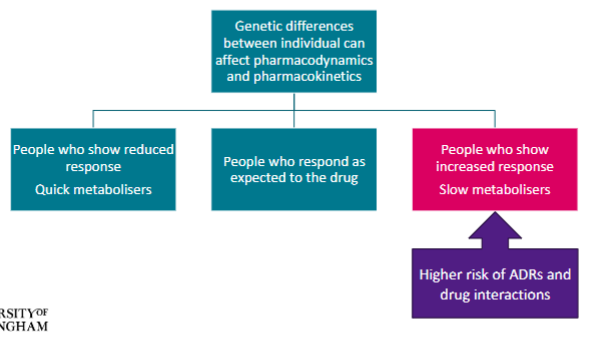
Genetics
Co-morbidities
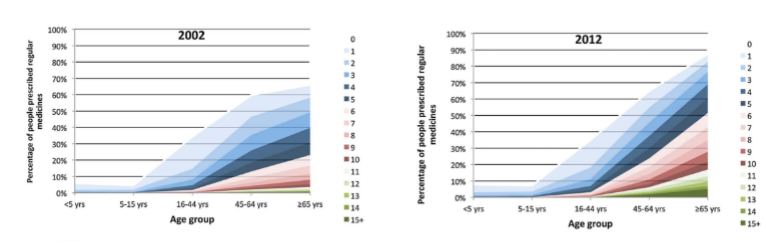
Number of medicines taken
Lifestyle factors e.g. diet, smoking, illicit drugs
Risk factors - preterm neonates

Risk factors - older age

Risk factors - sex
Women are more prone to drug interactions than men
Possible reasons are:
Reduced body weight
Reduced organ size
Greater proportion of body fat
Gastric pH is lower
Gastric emptying time is slower
Hormonal changes during the menstrual cycle
Risk factors - genetics
Risk factors - co-morbidities
Co-morbidity:
The simultaneous presence of 2 or more disease or medical conditions in patient
Why does this cause more drug interactions:
Physiological changes due to the diagnosed conditions
Polypharmacy due to drugs prescribed for multiple conditions

Risk factors - number of medicines taken (diagram)
Risk factors - diet (examples)

Risk factors - smoking
Smoke from tobacco can induce cytochrome P450 enzymes
This results in medicines being metabolised more quickly
If a person stops smoking this can affect their response to a particular dose

Risk factors - illicit drugs
Most information about opioid and benzodiazepine interactions due to their therapeutic use
For other illicit drugs interaction data mainly from case reports or small studies
Some illicit drugs are ‘cut’ with other substances that could also interact
Illicit drugs may be fake and not contain what the person thinks they do

What is pharmacogenomics?
The study of how a patient’s genome can influence how they respond to medicines. Variants in an inidividual’s genome can increase the functioning of medicines or make them effective
Mechanisms - classification

Mechanisms - pharmacodynamic interactions
Direct effect at receptor
Interference in biological or physiological process
Additive or opposite pharmacological effect
Usually predictable as they occur between drugs that have the same or opposite mechanisms of action

Mechanisms - pharmacokinetic interactions
An alteration in the absorption, distribution, metabolism or excretion of a drug due to another drug/chemical/food

Mechanism - absorption
Drugs that alter gastric pH (e.g. PPIs or H2-antagonists) can affect the absorption of other drugs

Mechanism - absorption

Mechanism - active transport pumps
Drug interactions occur when these pumps are inhibited or induced
Affects absorption, distribution and excretion of drugs
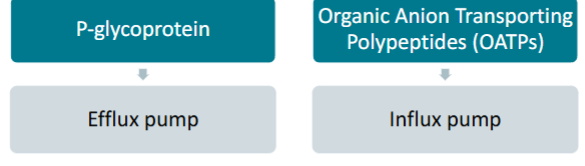
P-glycoprotein - efflux pump
Present throughout the body
In the gastrointestinal system, has major role in absorption of drugs
Transmembrane efflux transporter which pumps drugs back into the gut lumen decreasing absorption
Transports drugs of many classes e.g. digoxin, calcium channel blockers, macrolide antibiotics

Organic anion transporting polypeptides (OATPs)
Membrane-influx transporters
11 subtypes - OATP1B1, 1A2, 1B3 and 2B1 are most studies
Can be genetic variation in activity of OATPs
These subtypes are primarily involved in drug uptake in the GI system and liver

Mechanisms - distribution
Many drugs are transported by protein-binding
Albumin is most important in this process
Drugs bind competitively to albumin and can displace drugs with lower affinity to the binding sites

Mechanisms - first pass metabolism
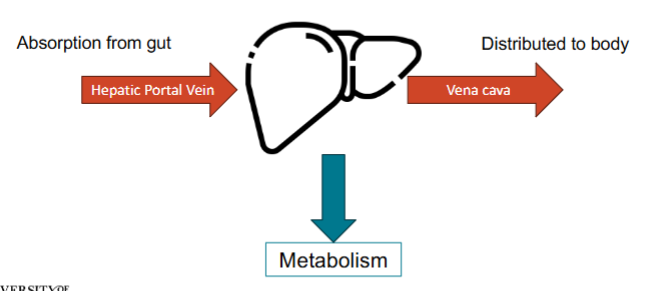
Mechanisms - cytochrome P450 system
Major role in biotransformation of drugs
Usually occurs in the liver
Catalyse oxidation
Chemical/physical alteration of drug
Creates metabolites or converts prodrug to active drug
Produces more water-soluble compounds for renal excretion
Common pathways mean potential drug interactions

Mechanisms - cytochrome P450 examples

Mechanisms - cytochrome P450 inhibitors
Occurs within hours to days
Duration of inhibition related to half-life of drug
Ability of drug to bind to CYP enzyme that affects metabolism
Can be dose dependent:
Sertraline 50 mg = mild inhibitor of CYP2D6
Sertraline 200 mg = potent inhibitor of CYP2D6
Inhibition of CYP → co-administered drugs can accumulate → toxicity?

Mechanisms - cytochrome P450 inducers
Time lag for inducer to occur - days to weeks
Can be dependent of half-life of drug:
Rifampicin = inductions can occur within 24 hours of adminitration
Phenobarbital = induction can take up to a week after administration
If inducer stopped, inductive effect lost in days
May need higher doses of other drugs (when co-administered)
Caution when stopping enzyme inducers as plasma concentrations of other drugs could increase - toxicity possible
Cytochrome P450 Interaction - Voriconazole
Voriconazole inhibits CYP3A4, CYP2C9 and CYP2C19
Contraindicated with certain other CYP3A4 substrates (e.g. terfenadine, ivabradine,etc) → voriconazole increases concentrations of other drugs → prolonged QTc interval/risk of torsades de pointes
Contraindicated with drugs that induce CYP3A4 (e.g. rifampicin, carbamazepine, etc) as these drugs reduce voriconazole concentrations
Specific dosing in SmPC:
Phenytoin and rifabutin - higher dose of voriconazole required
Efavirenz – higher dose of voriconazole required and reduced dose of efarirenz required
Tacrolimus – tacrolimus dose reduced to one third of normal when taken with voriconazole
Mechanisms - excretion
Excretion mainly through:
Kidneys - renal tubular excretion
Liver - biliary excretion
Interactions can occur if both drugs competing for the same excretion pathway
