BI203-- membrane physiology: passive transport
 Call Kai
 Learn
Learn Practice Test
 Spaced Repetition
 Match
Match Flashcards
 Knowt Play
1/18

There's no tags or description
Looks like no tags are added yet.
Name | Mastery | Learn | Test | Matching | Spaced | Call with Kai | Chat |
|---|
No analytics yet
Send a link to your students to track their progress
19 Terms
what part of the cell is crucial for maintaining homeostasis
cell plasma membrane
what is cell plasma membrane composed of?
lipids and proteins
what is the basic structure of a lipid bilayer?
75% phospholipids
20% cholesterol
5% glycolipids

phospholipid structure
polar head (electrically charged)
two nonpolar fatty acid tails (electrically neutral)
bilayer arrangement as lipids are amphipathic (polar head hydrophilic and non polar tails hydrophobic)
hydrophobic regions cluster together exposing polar end to either extracellular or cytosol fluid

glycoproteins
polar on carbohydrate head and non polar on their tail
only found on extracellular membrane (asymmetric)— important cellular functions
cholesterol
mildly amphipathic and found interspersed between other lipids

two kinds of membrane proteins +functions
integral: extend through lipid bilayer and not easily removed
peripheral: associated with polar heads of lipids or integral proteins and can be removed easily
functions: transport, receptors, self recognition
integral membrane proteins
some attach to lipids in bilayer
polypeptide chain traverses lipid bilayer
the portion within bilayer consists primarily of hydrophobic amino acids
portion of polypeptide that project out from bilayer tend to have high percentage of hydrophilic amino acids
those that project into aqueous surroundings of vell are usually glycoproteins— with many hydrophilic sugar residues attached to part of polypeptide exposed at surface of cell
some transmembrane proteins that span the bilayer several times form hydrophilic channel through which certain ions and molecules can enter or leave cell
peripheral membrane proteins
do not penetrate hydrophobic core of the membrane
often found in association with integral membrane proteins
can be removed from membranes by means that do not require the disruption of the membrane structure

plasma membrane — fluid mosaic model (image)
.

membrane transport
small non charged (non poalr) lipid soluble materials can cross the lipid bilayer easily
macromolecules, ions and charged (polar) molecules need specialised proteins
membrane slectively permeable
passive transport (no cellular energy)
active transport (cellular energy)
passive transport (diffusion)
diffusion: random mixing of particles that occur in a solution because of the particles
in solute/solvent mixture both substances and liquid undergo diffusion
solute diffuses from area of high concentration to area of lower concentration e.g. crystal dye diffusion
in a cells case ( a membrane is present)— if the concentration of O2 in extracellular fluid greater than the cytosol, O2 will diffuse into cell— similarly CO2 will diffuse out
diffusion across plasma membrane will only occur for small, non charged (non polar) lipid soluble molecules (e.g. O2, CO2, oestrogen)

factors influencing diffusion rate across membranes
concentration gradient: greater the diff in concentration gradient between two sides of membrane→ higher rate of diffusion
temperature: higher rates of temperature lead to higher rates of diffusion
molecular mass: larger the mass of diffusing particle the slower the rate of diffusion
surface area: larger membrane surface area leads to faster diffusion rates (e.g. Lungs)
diffusion distance: greater the distance the slower the rate if diffusion (e.g. Pneumonia)
facilitated diffusion
molecules (e.g. glucose) transported across membrane by special carrier proteins
facilitated diffusion: net movement is down a concentration gradient and is passive
molecule to be transported attaches on binding site on protein carrier
carreir protein changes conformation, exposing boung molecule to other side of membrane (lower concentration side)
bound molecule detaches from carrier
carrier returns to its original conformation (binding site on higher concentration side)

diffsuion of ions across membranes— facilitated diffusion
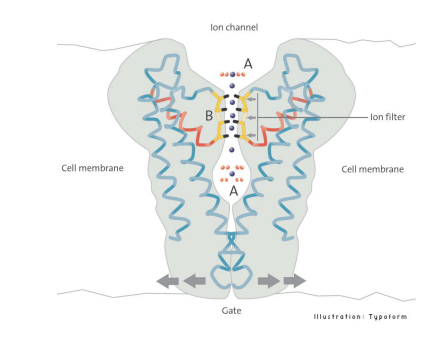
Na+, K+,Cl-,and Ca2+ diffuse through ion channels
when ion channels are open they allow specific ions to move across plasma membrane down their electrochemical gradient
ions move from where they are more concentrated to where they are less concentrated
positively charged cations move toward negatively charged area and negatively charged anions move towards positively charged areas
as ions move the constitute a flow of electrical current that can alter membrane potential
presence of ion channels in plasma membrane of neurons and muscle fibres gives these cells the property of electrical excitability
ion channels open/close due to ion gates
4 types of ion channels
leakage channels: randomly open/close— more K+ than Na+— K+ membrane permeability higher
voltage gated channels: open in respones to change in membrane potential
ligand gated channels: open in response to ligand/chemical stimulus e.g. binding of neruotransmitter acetycholine at certain synapses opens channels that admit Na+ and Ca+ and initate a nerve impulse or muscle contraction
mechanical gated channels: open or close in response to mechanical stimulation e.g. auditory receptors and touch receptors
osmosis
net diffusion of water through a membrane
occurs when water is mroe concentrated on one side of a membrane— moves down its concentration gradient
more dilute solution— higher concentration of water molecules and lower concentration of solute
aquaporins— protein molecules in phospholipid bilayer— transport water across membrane— increases rate of tranpsort of water

osmosis— solution cencentration types
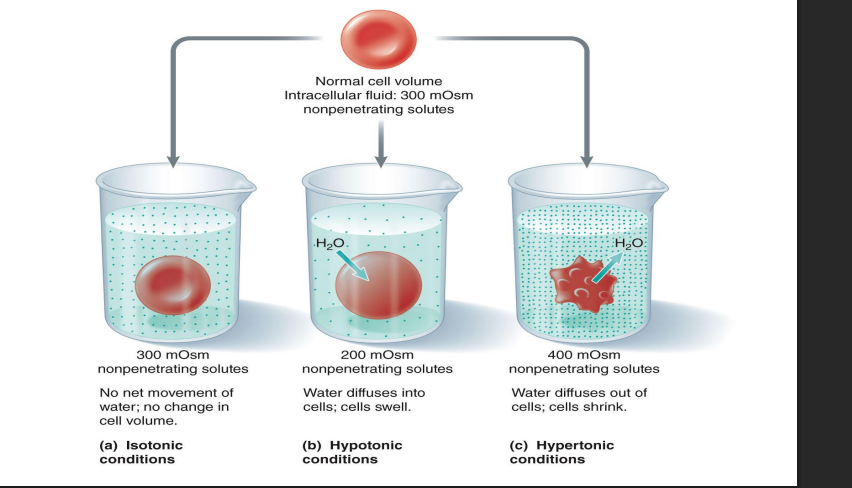
osmolality: total solute concentration of a cell (osm/L)— typical osmolality of animal cell ~300 mOsm (milliosmoles)
hypertonic solution: >300 mOsm: cell loses water and shrinks
hypotonic solution: <300 mOsm: cell gains water and expands
isotonic solution: ~300 mOsm: no net movement of water
tonicity: measure of solutions ability to change volume of cells by altering their water content
osmosis in organisms
osmoconformers: organisms isotonic with environment (marine invertebrates)
osmoregulators: organisms that need to maintain constant osmolaity different from that of surroundings
Salmon(salt water):
to offset dehydrating effects they drink loadsss of water
kidneys urine production rates dramatically drop and urine is as concentrated as kidneys can make it
Salmon (fresh water)
salmon doesnt drink at all
kidneys produce large volumes of dilute urine ( to cope with all the water thats diffusing into salmon)