Unit 9 Viruses Pt 1
 Call Kai
 Learn
 Practice Test
 Spaced Repetition
 Match
 Flashcards
 Knowt Play
1/47

There's no tags or description
Looks like no tags are added yet.
48 Terms
Where did the word Virus come from
Came from a Latin word meaning POISON
What was said about the first virus
First described as infectious fluid
Wendell Stanly isolated TOBACCO MOSAIC VIRUS (TMV) the first discovered virus
What’s the common saying about virus
All living things can be infected by viruses, but each virus is very specific for what they infect.
One virus per organism.
What do virus and bacteriophages infect
Virus infect animals/plants
Bacteriophages are viruses that infect bacteria
Virus characteristics
small
acellular (no plasma membrane)
contains RNA/DNA surrounded by a protein coat
no inherent metabolism, but can greatly affect the metabolism of the host cell
unable to replicate on their own
Viruses are in their own category, not quite living not quite non living
What are viruses classified as
Obligate (must) intracellular (inside cell) parasite (replicate in cell)
Characteristics of virus sizes.
viruses have various sizes in NM
Use TEM to size viruses
Small viruses usually contain RNA
Bigger usually contain DNA

What is the structure of a virus called
A virion
It is a complete, fully developed, infectious viral particle that is a vehicle of transmission from one host cell to another
Its the outside of the cell

What does a virion contain (information wise)
nucleic acids
Either DNA or RNA (never both)
Either single stranded or double stranded
Can be linear or circular
single molecules or multiple pieces/segments
What are the different types of genomes that a virus has
dsDNA
ssDNA
dsRNA
ssRNA
ds = double strand
ss = single strand
What does a virion contain (protection wise)
capsids
Its a protein coat surrounding the nucleic acid
Made of capsomeres (protein subunits)
arrangements vary and usually characteristic for their type

What are naked viruses (nonenveloped)
They are virions with just a capsid and nucleic acid
What are enveloped viruses
They contain a protein and lipid layer surrounding the capsids
What do enveloped viruses contain
They are sometimes formed from viruses leaving the host cell
Some contain SPIKES which are carbohydrate protein complexes that are used to attach to host cells
What do enveloped viruses mostly infect
They infect ANIMAL cells because they lack a CELL WALL
This allows them to leave the cell easier by budding.
So naked viruses are more exclusive to organisms with cell walls
Do virions have enzymes
First assumed that they did not have any
Now there are known virions with enzymes
What do virion enzymes do
Some are associated with the envelope or capsid but most are within the capsid
Those within the capsid are usually involved in nucleic acid synthesis
Ex. neuraminidase, reverse transcriptase
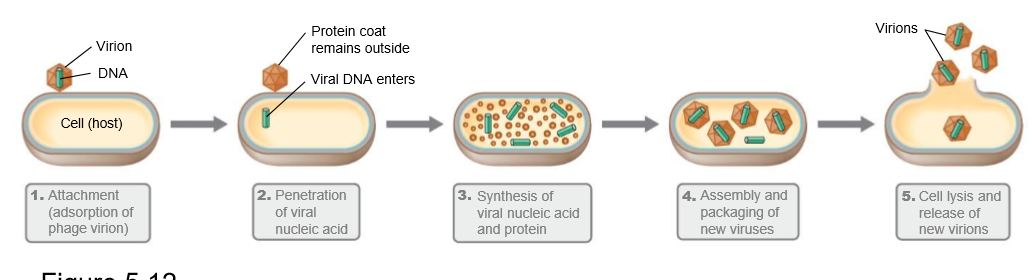
How does the general virus life cycle go
A virion goes to a cell.
It inserts the DNA from the virion
The host cell replicates the viral DNA
The cell recreates more virions
The cell lysis and releases new virions.
What are the stages in the virus growth curve
Latent period
Eclipse
Maturation

What happens in the latent period
No infectious particles OUTSIDE the cell.
It initially only has the particles in the cell.
This includes the eclipse phase and the first part of maturation phase

What happens in the eclipse phase
After injection of the viral DNA.
Virus begins the process of replication, nucleic acid is naked within the cells.

What happens in the maturation phase
New virus particles get assembled from replicated nucleic acids and new capsid structures.

What happens after maturation.
The particles begin to be released from the cells
Most phages have proteins that act as a molecular clock to time the lysis of the cell with the completion of new particle assembly.

What is the one step growth curve structure
Its a single large event which produces the structure.
Its the ASSEMBLY AND RELEASE

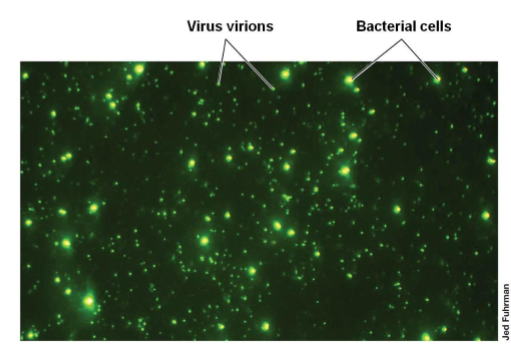
How can you count or observe viruses.
They are very small, but some can be counted using a microscope (fluorescence microscopy, TEM)
Attaches to and fluoresces the nucleic acids in the structures.
How can you observe viruses from their detrimental effects on hosts.
Viruses are very small
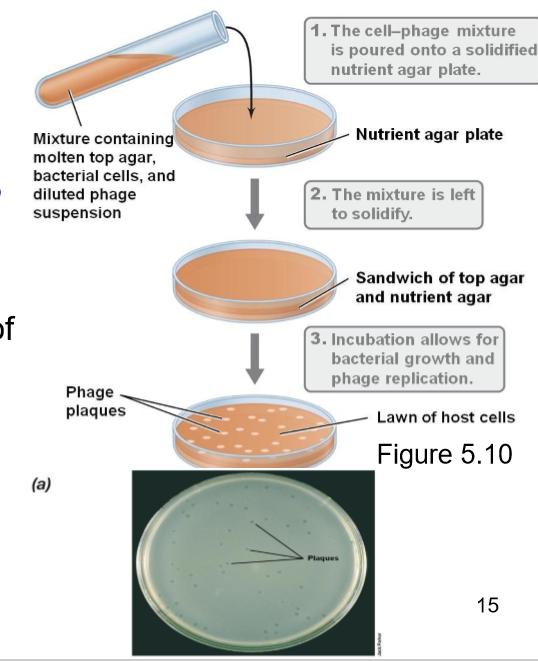
You can spot them indirectly by observing the damage (growth inhibiton) or death (lysis) they cause to host cells
What is Plaque when observing viruses.
Viruses are mixed with a continuous layer of hosts cells (Lawn) on a medium like agar
The virus causes lysis or growth inhibition
This leaves a small visible clear spot called a Plaque
What causes the Plaque in observing viruses
An original infection of one cell is produced by one virus
The viruses produced keep infecting neighboring cells
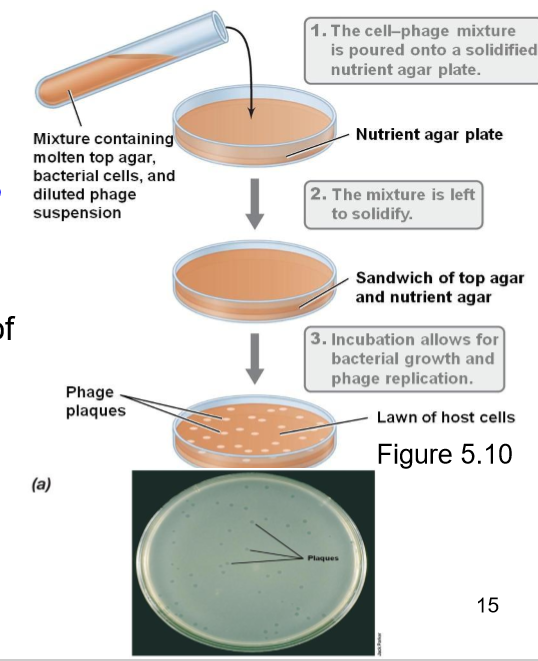
What is the unit for the concentration of active viruses
plaque-forming units (PFU)
What is lytic replication
The lytic cycle is once the virus particles are replicated, the host cell dies (lysed) to release viruses.

What is burst size
The number of viruses released per cell
300-500 typically is the burst size
Do viruses have motility?
They don’t have motility, they just float
What are the stages of the lytic cycle
Attachment
Penetration
Synthesis
Assembly
Release
What happens in ATTACHMENT stage of lytic cycle
Virus/host is specificity is partially controlled by virus attachment to cell surface receptors.
Receptors can be proteins, glycoproteins, lipids, lipoproteins etc.
A cell with the appropriate receptor for virus entry is SUSCEPTIBLE
After entry, only PERMISSIVE cells replicate virus.
Permissive means if the cell can replicate the virus.

What happens in PENETRATION stage of lytic cycle
Some virus only inject nucleic acid (Virus > nucleic acid > new viruses)
Some also inject proteins (Virus > mRNA > proteins (capsid) > new viruses)
Others enter the cell completely and the capsid breaks down to expose the nucleic acid.

What happens in SYNTHESIS stage of lytic cycle
Viral nucleic acids and proteins are made (via transcription and translation) by HOST CELL MACHINARY (DNA/RNA polymerase)
The host cell uses the viral nucleic acids to make new viruses in the order below.
Early = replication proteins (to replicate nucleic acids. Or copying the viral genome)
Middle and late = structural proteins (the capsid etc.)

What happens in ASSEMBLY stage of lytic cycle
Viral pieces are then assembled to create complete virions
Its self assembled and doesn’t really use host.
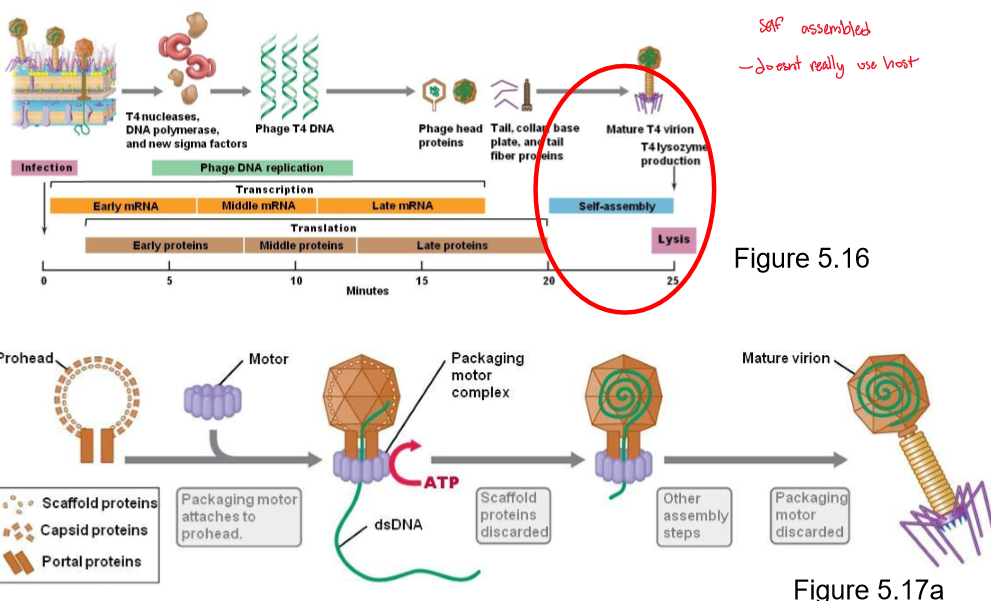
What happens in RELEASE stage of lytic cycle
Viruses escape from the host cell
This can occur through cell lysis
Once the cell has died, the organic material in the cell is released too.
What are the two pathways that a virus can go once entering a cell
Lysogenic or Lytic pathway

The definition of Lysogeny
Phage DNA is incorporated into host cell DNA
What is the lysogenic pathway
Replication genes are not expressed and the DNA integrates into the cells genome.
The viral DNA is INTEGRATED into host DNA (becomes a PROPHAGE) and the viral DNA is replicated with the host DNA at cell division
There are various condition that can INDUCE the prophage to enter the lytic pathway.

What are the stages for replication of ANIMAL viruses
Attachment: Virion attaches to host cell
Entry*: Enter the cell
UNCOATING*: DNA is uncoated
Biosynthesis: Viral DNA is replicated, and some viral proteins are made
Maturation: Virions mature
RELEASE*: Virions are released

How does animal viruses enter
Endocytosis (For naked/nonenveloped viruses)
Fusion (for enveloped viruses)
How does Endocytosis work for entering animal cells (Naked/nonenveloped)
Virus is taken in through a vesicle, as if the cell is eating it
The virus then escapes from the vesicle leaving a free capsid (The capsid is free in the cell cytoplasm)

How does Fusion work for entering the animal cells (enveloped)
The envelope merges with the plasma membrane of the host cell
Leaving a free capsid in the cytoplasm

What is UNCOATING in animal viruses
The separation of the viral nucleic acid from the protein capsid
The capsid is either digested or released into the cytoplasm.
This exposed the viral nucleic acid
How does the RELEASE work in animal viruses
Viruses escape from the host cell
This can occur through budding
Budding (enveloped viruses) use the host membrane to reform envelope, may or may not cause cell death. This happens one virus at a time
For an example explain how Influenza gets replicated.
