IDCHI - lecture 5
 Call Kai
 Learn
 Practice Test
 Spaced Repetition
 Match
 Flashcards
 Knowt Play
1/49

Earn XP
Description and Tags
Attitudes
50 Terms
What is an attitude, defined by Eagly and Chaiken (1993)?
An attitude is a psychological tendency expressed by evaluating a particular entity with some degree of favour or disfavour.
In simpler terms, an attitude is an evaluation of something.
Attitude objects can include people, groups, objects, behaviours, political issues or abstract ideas.
Attitudes can be positive, negative or neutral.
They vary in strength, meaning someone can hold a weak or strong attitude.
Attitudes can be specific (e.g. towards a particular university) or general (e.g. towards education).
Important: An attitude is an evaluation, not automatically a behaviour. Liking something does not necessarily mean someone will act in favour of it.
Explicit vs Implicit attitudes
Explicit attitudes: Conscious evaluations that individuals can directly report. They are measured using questionnaires, rating scales and self-report.
Implicit attitudes: Automatic evaluations that are measured indirectly through spontaneous responses. They may operate outside conscious awareness or control.
For example, someone might explicitly report having no preference between two social groups, but an implicit measure might reveal a stronger automatic association with one group.
Remember:
Explicit = what I consciously say I think.
Implicit = automatic evaluation inferred from my responses.
The three-component model of attitudes - Eagly and Chaiken (1993)
The model proposes that attitudes involve three interconnected components:
Affect: Emotional reactions towards an attitude object.
Behaviour: Actions or behavioural tendencies towards the object.
Cognition: Beliefs, thoughts and knowledge about the object.
For example, someone who dislikes statistics might:
Feel anxious when thinking about statistics (affect).
Avoid attending statistics lectures (behaviour).
Believe that statistics is difficult to understand (cognition).
Together, these components contribute to an individual's overall attitude.
Breckler (1984) investigation and main findings
Breckler investigated the three components of attitudes using participants' attitudes towards snakes.
While in the presence of a real snake, participants indicated:
Whether snakes were kind or cruel (cognition).
Whether snakes made them feel anxious or happy (affect).
Whether they liked handling snakes (behaviour).
Findings:
Moderate correlations were found between the three components.
This demonstrated that affect, behaviour and cognition are related but relatively independent.
Conclusion: Attitudes are multidimensional and cannot necessarily be understood through only one component.
Are the three components of attitudes always equally important?
No. The relative importance of affect, behaviour and cognition varies depending on the individual and the attitude object.
For example:
Someone might base their attitude towards a university mainly on emotional feelings.
Another person might focus on practical considerations, such as its academic reputation.
Lavine et al. (1998) investigated affective-cognitive ambivalence in political attitudes.
Ambivalence occurs when someone's emotions and beliefs disagree.
For example, someone may hold positive beliefs about a political candidate but experience negative feelings towards them.
When affect and cognition conflict, emotional responses can have a stronger influence on overall attitudes.
This may be because emotions provide a quicker way of making evaluations than effortful cognitive processing.
Individual differences and the formation of attitudes
Individuals differ in their preferred thinking styles and how they evaluate attitude objects.
Some people rely more heavily on emotions and intuition.
Others prefer analytical thinking and factual information.
These preferences influence whether affect or cognition plays a greater role in their attitudes.
For example, someone deciding whether they like a film might rely on how it made them feel, whereas another person might consider its storyline, acting and cinematography.

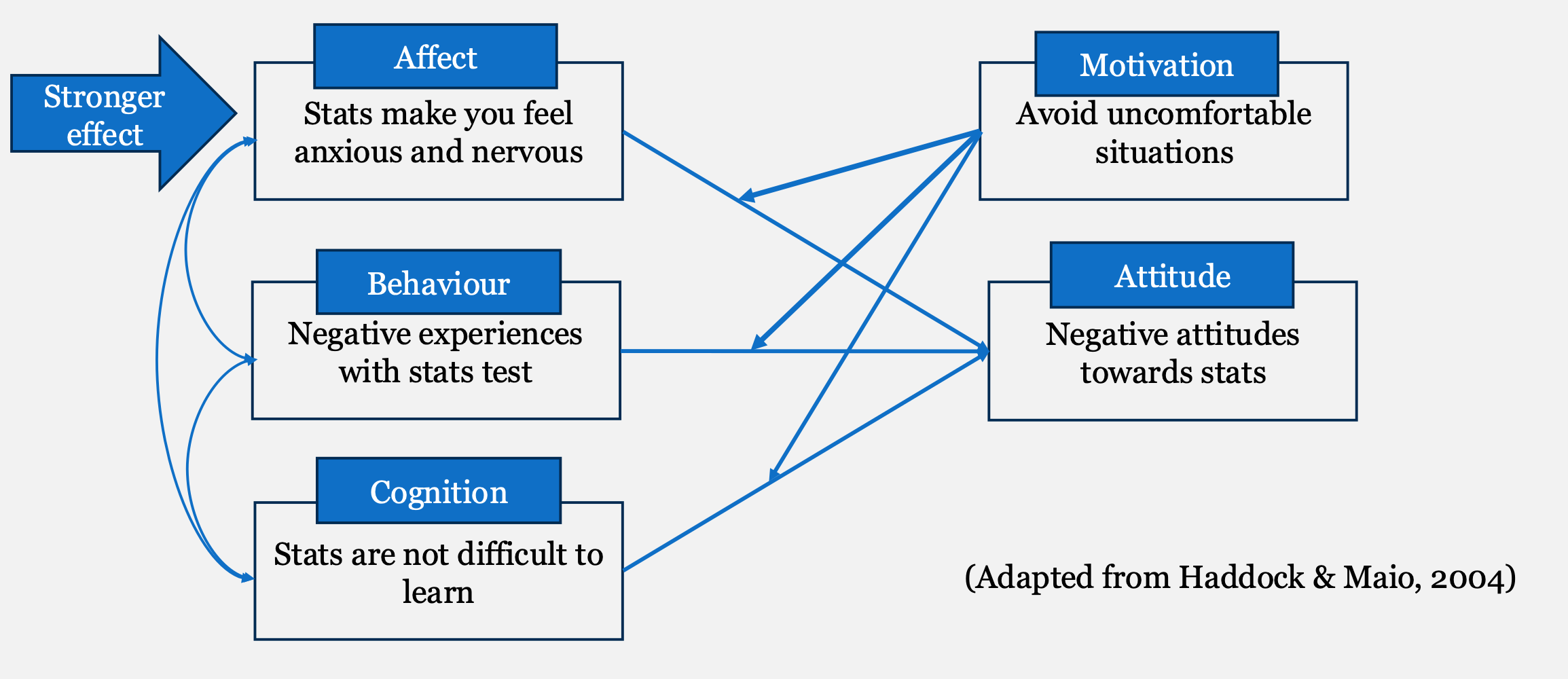
The Function-Structure Model (FSM) of attitudes
Adapted from Haddock and Maio (2004)
Proposes that the three components of attitudes are connected to different psychological functions and motivations.
For example, consider a student who dislikes statistics:
Affect: Statistics makes them feel anxious.
Motivation: They want to avoid uncomfortable situations.
Behaviour: They have negative experiences with statistics tests.
Cognition: They believe statistics is not difficult to learn.
Attitude: They nevertheless develop a negative attitude towards statistics.
The model suggests that the different components interact and can have different levels of influence on overall attitudes.
The three functions of attitudes, proposed by Smith et al. (1956)
Smith and colleagues identified three important functions:
Object-appraisal: Attitudes help individuals evaluate objects and understand whether they are beneficial or harmful.
Social-adjustment: Attitudes help individuals behave appropriately within social groups and maintain relationships.
Externalisation: Attitudes help protect the self by expressing or managing internal psychological conflicts.
These functions explain why attitudes are useful in everyday life.
The functions of attitudes, proposed by Katz (1960)
Katz identified four main functions:
Knowledge function: Helps individuals organise information and understand the world.
Utilitarian function: Helps individuals gain rewards and avoid negative consequences.
Ego-defensive function: Protects individuals from uncomfortable thoughts, feelings or threats to their self-esteem.
Value-expressive function: Allows individuals to express their personal values and beliefs.
Katz's model expands on earlier explanations of why individuals develop and maintain attitudes.
What are the Need for Affect and Need for Cognition, and how do they influence attitudes?
These are two psychological tendencies that influence how individuals approach information.
Need for Affect: The extent to which individuals approach or avoid situations that produce emotional experiences.
Need for Cognition: The tendency to seek out and enjoy effortful cognitive activities, such as analysing information and solving problems.
Haddock and Maio (2004) proposed that attitudes are formed partly to satisfy these needs and achieve cognitive simplicity.
For example:
Someone with a high Need for Affect may rely on their emotional reactions when evaluating something.
Someone with a high Need for Cognition may prefer analysing evidence before forming an opinion.
van Giesen et al. (2015) and the influence of thinking styles on attitudes
Their research examined how individuals' preferred thinking styles influence attitude formation.
Main findings:
For unfamiliar objects, individuals tend to rely more heavily on affect than cognition.
For familiar objects, individuals with a high Need for Cognition rely more on cognitive information.
Individuals with a high faith in intuition rely more on affective information.
Conclusion: Individual differences in thinking styles influence how people form attitudes, and their influence depends partly on familiarity with the attitude object.
The holistic/contextual approach to understanding attitudes proposed by Albarracin and Shavitt (2018)
They argue that attitudes cannot be fully understood in isolation because they develop within three interconnected contexts:
Personal context: Individual values, goals, emotions, language and development.
Social context: Relationships, communicators, social networks, social media and culture.
Historical context: Generational differences and wider political, economic and environmental events.
For example, attitudes towards climate change may be influenced by personal environmental values, conversations with friends and wider political events.
Conclusion: Attitudes are shaped by the interaction between individuals and their personal, social and historical environments.
Measuring attitudes
The two main approaches are:
Attitude surveys: Directly ask individuals to report their attitudes.
Implicit measures: Indirectly assess attitudes through automatic responses and associations.
Both approaches provide useful information, but they measure different aspects of attitudes and have different strengths and limitations.
Self-report scales
Self-report scales ask individuals to evaluate an attitude object using numerical responses on one or multiple questionnaire items.
For example, participants might rate their agreement with the statement:
"I enjoy studying psychology."
Strengths:
Economical and relatively inexpensive.
Easy to administer.
Can produce reliable and valid measurements.
Limitations:
Demand characteristics: Participants may change their responses because they think they know what the researcher expects.
Impression management: Individuals may provide socially desirable answers to create a positive impression.
Participants may not always be aware of their own automatic attitudes.
Implicit measures of attitudes
Implicit measures were developed to assess automatic evaluations that individuals may not consciously recognise or be willing to report.
Greenwald and Banaji (1995) proposed that implicit attitudes can exist outside conscious awareness and control.
They may influence automatic reactions towards attitude objects.
They are particularly useful when:
Attitudes are socially sensitive.
Individuals may be unwilling to report their attitudes honestly.
Social desirability or impression management may influence questionnaire responses.
The Implicit Association Test (IAT)
Proposed by Greenwald et al. (1998).
It measures the strength of automatic associations between concepts by examining how quickly individuals categorise information.
It typically involves associations between:
Attitude objects: For example, different social groups.
Evaluative attributes: For example, pleasant and unpleasant words.
The underlying assumption is that strongly associated concepts should be easier to categorise together.
How does the IAT work?
The IAT uses categorisation tasks in which participants respond to different combinations of concepts using designated keys.
For example, participants might be asked to categorise:
Group A and pleasant words together.
Group B and unpleasant words together.
The pairings are then reversed.
The logic:
Stronger automatic association → easier pairing → faster response.
Weaker automatic association → more difficult pairing → slower response.
The difference in reaction times between the two combined tasks provides an indication of the strength of the automatic associations.
The four broad categories of associations that the IAT can measure
The IAT can measure:
Attitudes: Associations between concepts and positive or negative evaluations.
Stereotypes: Associations between social groups and particular traits.
Self-concepts/identities: Associations between the self and particular traits or groups.
Self-esteem: Associations between the self and positive or negative evaluations.
An example is the Gender-Career IAT, which examines automatic associations between gender and career-related concepts.
IAT vs self-report measures
Main finding: Self-report was generally the stronger predictor of behaviour overall.
IAT: r = .274
Self-report: r = .361
However, the relative predictive ability depended on the topic and type of behaviour.
IAT was particularly useful for socially sensitive attitudes, impression management and spontaneous or non-verbal behaviours.
Self-report was more useful when individuals could accurately report their attitudes and the behaviour was deliberate or controlled.
Incremental validity
Incremental validity refers to the additional predictive information a measure provides beyond another existing measure.
Research found that the IAT and self-report each explained unique variance in behaviour.
This means:
Self-report predicted some aspects of behaviour that the IAT did not.
The IAT also predicted some aspects of behaviour that self-report did not.
Therefore, using both measures can provide a more complete understanding of attitudes than relying on either one alone.
Social sensitivity
Social sensitivity refers to the degree to which individuals worry that their responses will influence how others perceive them.
For example, someone might avoid reporting a negative attitude towards a particular social group because they do not want to appear prejudiced.
As social sensitivity increases:
Individuals may be more likely to engage in impression management.
Self-reports may become less accurate.
The predictive ability of self-report measures may decrease.
This is one reason why implicit measures can be particularly useful.
LaPiere (1934) investigations and findings
LaPiere conducted one of the earliest studies examining whether attitudes accurately predict behaviour.
Method:
He travelled across the United States with a young Chinese couple.
They visited numerous hotels, restaurants and other establishments.
The couple was generally accommodated during their visits.
Several months later, LaPiere contacted the establishments by letter and asked whether they would accommodate Chinese guests.
Findings:
The couple had generally been served when visiting establishments in person.
However, the overwhelming majority of written responses indicated that Chinese guests would not be accommodated.
Conclusion: There was a substantial discrepancy between reported attitudes and actual behaviour.
This demonstrated that attitudes do not always translate directly into behaviour.
Are attitudes good predictors of behaviour?
Albarracín et al. (2018) reviewed evidence showing that attitudes are meaningfully associated with behavioural outcomes.
However, the strength of this relationship depends on several factors, including:
How specific the attitude is.
Whether the attitude is accessible.
Social expectations and norms.
An individual's perceived ability to perform the behaviour.
Therefore, attitudes influence behaviour, but they are not the only determining factor.
The Theory of Planned Behaviour (TPB), proposed by Ajzen (1991)
It explains how attitudes and other psychological factors influence behavioural intentions and actual behaviour.
It proposes that three main factors determine behavioural intentions:
Attitude towards the behaviour: Whether an individual evaluates performing the behaviour positively or negatively.
Subjective norms: Whether an individual believes important others expect them to perform the behaviour.
Perceived behavioural control: Whether an individual believes they have the ability and resources to perform the behaviour.
These three factors influence behavioural intention, which predicts actual behaviour.
Perceived behavioural control can also directly influence behaviour when it reflects actual control.

Behavioural intention vs Actual behaviour in TPB
Behavioural intention: An individual's motivation or plan to perform a particular behaviour.
Actual behaviour: Whether the individual actually carries out that behaviour.
For example, a student may intend to study for three hours every day but fail to do so because they lack time or become distracted.
Therefore, having a positive attitude and strong intention does not guarantee that behaviour will occur.
How has the Theory of Planned Behaviour been applied in research?
Niepel et al. (2018): Applied the TPB to understand and predict students' academic performance, considering factors such as academic attitudes, social expectations and perceived control.
Servidio et al. (2022): Applied the TPB to understand vaccination uptake, examining how attitudes, subjective norms and perceived behavioural control influence vaccination intentions and behaviour.
Attitude change and Persuasion
Attitude change: Movement from one evaluative position to another, such as moving from a negative to a positive attitude.
Persuasion: The formation or change of attitudes through information processing in response to a message about an attitude object.
Persuasion can involve different levels of cognitive effort, ranging from relatively automatic processes to careful consideration of information.
Are attitudes stable or constantly changing?
There are three main perspectives:
Attitudes as stored memories: Attitudes are stored in memory and retrieved when needed. This suggests that attitudes should be relatively stable.
Attitudes as constructed in the moment: Attitudes are formed using currently available information, such as mood, situation and recently encountered information. This suggests attitudes can change frequently.
Hybrid perspective: Attitudes are partly stored in memory and partly constructed in the moment. This suggests they can be relatively stable while remaining open to change.
The extent of attitude change, according to Albarracín and Shavitt (2018)
Their review found that attitude-change interventions generally produce relatively small effects.
The average attitude change was approximately: d = 0.22
This represents a small effect size.
However, small effects do not mean attitudes cannot change. Even attitudes traditionally considered resistant to change can be influenced by appropriate interventions.
Why are some attitudes difficult to change?
One explanation is motivated cognition.
Individuals are more likely to maintain attitudes that are consistent with their:
Existing values.
Beliefs.
Personal goals.
People may also engage in defensive cognitive processes to protect their existing attitudes.
For example, someone who strongly supports a political position may require considerably more evidence before accepting information that contradicts their belief
Belief perseverance
The tendency to maintain beliefs even after the original evidence supporting them has been challenged or discredited.
One explanation involves mental models.
Individuals construct explanations about why something happened.
When new information appears, they may simply incorporate it into their existing explanation.
They may modify their original mental model rather than completely abandoning it.
Implication: Simply telling someone that their original evidence was incorrect may not change their belief.
Effective corrections may need to provide an alternative causal explanation that replaces the original one.
How can attitudes be changed through low cognitive effort?
Classical conditioning involves creating positive or negative evaluations by repeatedly pairing a neutral stimulus with an emotionally positive or negative experience.
For example, repeatedly associating a brand with enjoyable experiences may produce a more positive attitude towards that brand.
Razran (1940) and Classical Conditioning
Experiment
Participants were repeatedly exposed to different slogans.
Some slogans were presented while participants ate a free lunch.
Others were presented while participants inhaled unpleasant smells or sat in a neutral environment.
Findings:
Participants showed increased agreement with slogans associated with eating a free lunch.
They were unable to recall which slogans had been paired with which environments.
Conclusion: Attitudes can change through conditioning even when individuals are not consciously aware of the associations responsible.
The Message Learning Approach (Yale Model) of persuasion
Developed by Hovland et al. (1953)
It suggests that persuasion depends on four main factors:
Message source: Who communicates the information?
Recipient: Who receives the message?
Message: What information is being communicated?
Channel: How is the message delivered?
McGuire (1968) further proposed that persuasion involves four internal processes:
Attention.
Comprehension.
Rehearsal.
Yielding (accepting the message).
A limitation of this approach is that it lacks a single unifying theory explaining how these factors interact.
Dual-processing models of persuasion
Dual-processing models propose that persuasion can occur through two different levels of cognitive processing:
Effortful processing: Individuals carefully consider and evaluate information.
Effortless processing: Individuals rely on simpler cues, associations and mental shortcuts.
Two important models are:
Elaboration Likelihood Model (ELM; Petty & Cacioppo, 1986).
Heuristic–Systematic Model (HSM; Chaiken et al., 1993, 1995).
Both explain how people process persuasive messages differently depending on their motivation and ability.
The Elaboration Likelihood Model (ELM)
The ELM, developed by Petty and Cacioppo (1986), proposes that attitude change can occur through two different routes.
Central route:
Involves careful and effortful consideration of the message.
Occurs when individuals have high motivation and ability to process information.
Attitude change depends primarily on the quality and strength of the arguments.
Peripheral route:
Involves less effortful processing.
Occurs when individuals have low motivation or ability to process the message.
Attitude change depends more on peripheral cues, such as the attractiveness or credibility of the communicator.

Central vs Peripheral rout, in terms of attitude change
Central route | Peripheral route |
|---|---|
High cognitive effort | Low cognitive effort |
Careful evaluation of arguments | Reliance on simple cues |
Depends on argument quality | Depends on persuasive cues |
Requires motivation and ability | More likely with low motivation or ability |
Heuristic-Systematic Model (HSM) of persuasion
The HSM, developed by Chaiken and colleagues, proposes two types of information processing:
Heuristic processing: Effortless processing that relies on simple rules or mental shortcuts.
Systematic processing: Effortful processing involving careful consideration and evaluation of information.
For example:
Heuristic: "This information must be correct because it comes from an expert."
Systematic: Carefully examining the evidence and arguments presented by the expert.
The model suggests that individuals balance the desire to minimise cognitive effort with the desire to feel confident about their judgements.
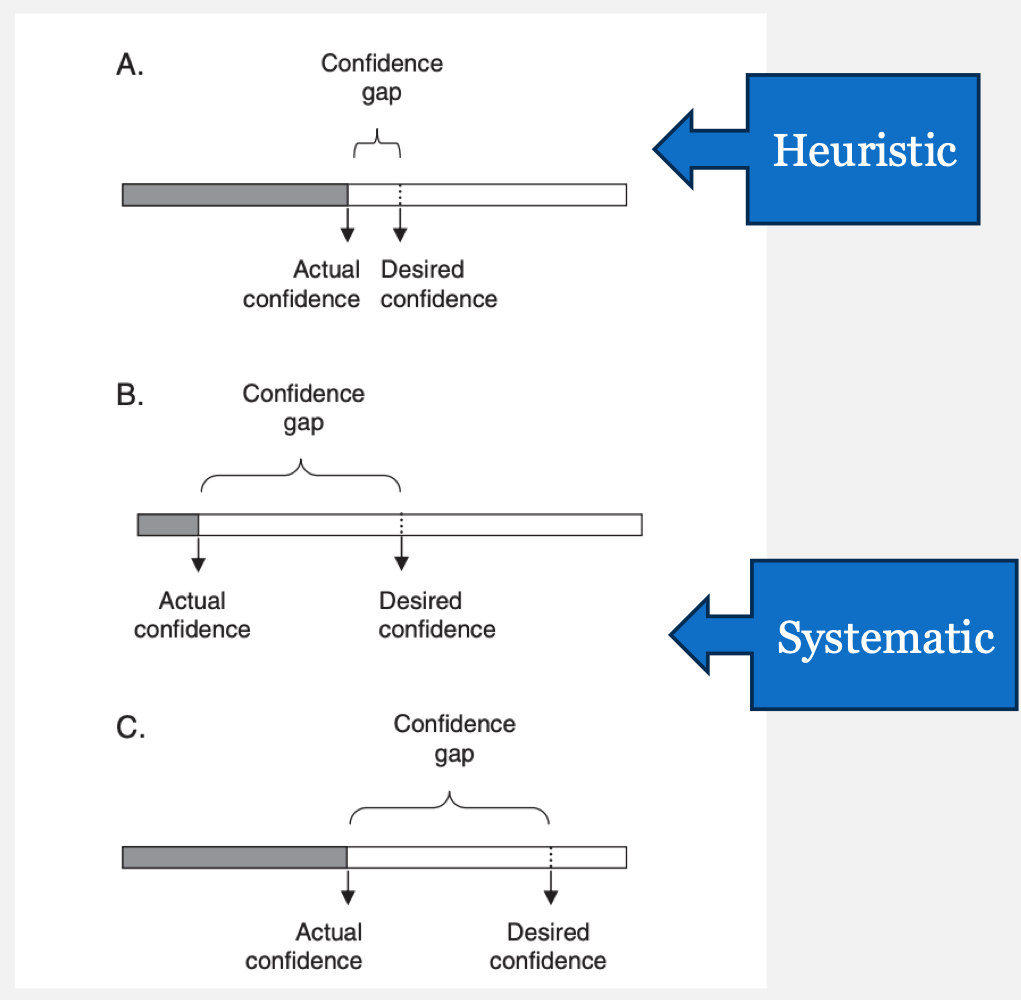
The three motivational forces influencing persuasion according to the HSM
The three motivational forces are:
Accuracy motivation: The desire to reach a correct and accurate judgement.
Defence motivation: The desire to protect existing beliefs and attitudes.
Impression motivation: The desire to form judgements that create or maintain a favourable impression of oneself to others.
These motivations influence whether individuals rely more heavily on heuristic or systematic processing.
What are the four principles of persuasion, proposed by Haddock and Maio (2007)?
They identified four important principles:
Extraneous information can influence persuasion: Information that is not directly related to the argument can still affect attitudes.
Motivation and ability increase the impact of information: Individuals who are motivated and able to process a message are more likely to be influenced by its content.
Congruence enables persuasion: Messages are more persuasive when they correspond with recipients' existing knowledge and goals.
Persuasion can occur without awareness: Individuals may develop or change attitudes without consciously recognising the processes responsible.
Resistance to persuasion, according to MMcGuire (1964)
Resistance to persuasion is the ability to withstand a persuasive attack.
It describes the processes that allow individuals to maintain their existing attitudes despite being exposed to information or messages attempting to change them.
The ABC model of resistance to attitude change
The ABC model describes three possible ways individuals resist persuasion:
A – Affect: "I don't like it."
B – Behaviour: "I won't do it."
C – Cognition: "I don't believe it."
For example, someone might resist a persuasive health campaign because they dislike its message, refuse to follow its recommendations or disagree with the information presented.
Fransen et al. (2015) and resistance to persuasion
Their framework distinguishes between the reasons people resist persuasion and the strategies they use.
Important reasons include:
Threats to personal freedom.
Forewarning that someone is attempting to persuade them.
Existing knowledge and attitudes.
Personal involvement and commitment.
Confidence in their existing attitudes.
Strategies include:
Avoidance: Avoiding persuasive information.
Contesting: Challenging the message through counterarguments.
Biased processing: Interpreting information in a way that supports existing beliefs.
Empowerment: Strengthening confidence in existing attitudes and preparing to resist persuasion.
Psychological reactance
It occurs when individuals feel that their freedom to make their own decisions is being threatened.
They may respond by:
Rejecting the persuasive message.
Strengthening their original attitude.
Doing the opposite of what the message recommends.
For example, someone who feels pressured to adopt a particular lifestyle may become more resistant precisely because they feel their freedom is being restricted.
Forewarning
Forewarning occurs when individuals are informed in advance that someone is attempting to persuade them.
This can increase resistance because:
Individuals become more alert to persuasive intentions.
They may prepare counterarguments.
They become more motivated to defend their existing attitudes.
For example, telling someone before a discussion that another person will try to change their political opinion may make them more resistant to the arguments presented.
Attitude Certainty, following strong and weak persuasive attacks
Attitude certainty was higher following a strong persuasive attack than following a weak attack.
This suggests that exposure to a strong opposing argument can sometimes strengthen confidence in existing attitudes.
One possible explanation is that individuals actively defend their beliefs when confronted with a particularly challenging argument.
This demonstrates that persuasion attempts do not always produce attitude change and can sometimes reinforce resistance.
Albarracín and Shavitt (2018) - influence of personal values and goals on attitudes
Their review highlights the importance of understanding attitudes in relation to people's personal values and goals.
For example:
Linking a specific persuasive message to someone's broader values can make the message more effective.
Activated goals can make related attitudes easier to remember and more resistant to change.
Emotional regulation and self-talk can influence attitudes towards particular activities.
Conclusion: Persuasion is more effective when messages are connected to what individuals personally value and want to achieve.
Albarracín and Shavitt (2018) - influence of social relationships and social networks on attitudes
Social selection: Individuals form relationships with people who already share similar attitudes.
Social influence: Individuals develop more similar attitudes because they influence one another through interactions.
Research by de Klepper et al. (2010), examining students at the Royal Naval Academy in the Netherlands, found that similarities in attitudes towards discipline were attributable to social influence rather than simply selecting friends with similar attitudes.
This demonstrates that attitudes can develop through social interaction.
How can emotions influence attitude formation and change?
Emotions can influence how individuals evaluate objects, situations and behaviours.
Albarracín and Shavitt (2018) discuss several examples:
Emotional regulation can reduce negative attitudes.
Positive self-talk can encourage more positive attitudes towards tasks.
Current emotional states can influence how information is evaluated.
This demonstrates that attitudes are not always based on rational evaluation; emotional experiences can also play an important role.
Cultural and historical contexts
Albarracín and Shavitt (2018) argue that attitudes are influenced by the wider cultural and historical environments in which people develop.
For example:
Different generations may develop different political and social attitudes.
Economic conditions can influence attitudes towards particular policies.
Political events and social movements can change how people evaluate social issues.
Cultural norms influence how individuals express and maintain their attitudes.
They also highlight that traditional Western theories may not fully explain how attitudes function in non-Western cultures, where social and normative influences can play a stronger role.