Pitt EMT exam 1
 Call Kai
 Learn
Learn Practice Test
 Spaced Repetition
 Match
Match Flashcards
 Knowt Play
1/107

There's no tags or description
Looks like no tags are added yet.
Name | Mastery | Learn | Test | Matching | Spaced | Call with Kai | Chat |
|---|
No analytics yet
Send a link to your students to track their progress
108 Terms
What does EMS stand for?
Emergency Medical Services
In 1966, the National Highway Safety Act charged which agency with the development of EMS standards?
Department of Transportation (DOP)
What is the chain of resources in the EMS system?
Patient > citizen calls 911 > 911 dispatcher > first responders > EMT > emergency department staff > allied health staff
Which communication system is able to identify the number and location of the phone from which a caller is calling 911?
Enhanced 911
What is the role of Emergency Medical Dispatchers?
Gather information from person experiencing emergency, and potentially provide assistance and instruction as needed prior to the arrival of EMS on scene
What factors might influence our decision-making skills?
Stress, mental state, personal interests, biases
What is the role of the medical director of an EMS system?
a physician that has ultimate responsibility for patient care aspects of EMS system
What is the difference between on-line and off-line medical control?
Offline control are standing orders and protocol which remain constant in each scenario.
Online control is when a medical director is contacted via phone or radio to ask for permissions
What role does quality improvement play in EMS?
Process of continuous self-review with the purpose of identifying & correcting aspects of the system
What are standard precautions?
Equipment and procedures that protect against the blood and body fluids of the patient
What are the four routes of infection?
Inhalation
Ingestion
Absorption
Injection
What are the four main infectious diseases of concern to EMTs?
Hepatitis B
Hepatitis C
Tuberculosis (TB)
HIV/AIDS
What is the Ryan White CARE Act?
Allows EMS providers the right to determine if they have been exposed to an infectious disease
(agency Control Officer gathers facts about exposures, and contacts EMS)
What are the three stages of stress?
1- Alarm (fight or flight)
2- Resistance (coping)
3- Exhaustion (loss of ability to adapt to stressor)
What are the types of stress reactions?
-acute stress reaction
-delayed stress reaction
-cumulative stress reaction
Acute Stress Reaction
-Often linked to catastrophe
-Occurs in EMTs and patients
-Signs and symptoms develop soon after
incident.
-Physical, cognitive, emotional, and
behavioral symptoms
-Normal reactions to extraordinary
situation
-May require professional intervention
Delayed stress reaction
Also known as PTSD
can be triggered by a specific event but psychological effects may not present until days, months, or even years later.
Characterized by nightmares, feelings of detachment, irritability, sleep difficulties, or problems with concentration.
intervention from mental health professional
cumulative stress reaction
This reaction, also known as, "burnout," results from sustained low-level stressors and develop over a period of years.
What does CISM stand for? What is its role in EMS?
Critical Incident Stress Management
-a comprehensive system that includes education and resources to both prevent stress and to deal with stress appropriately when it occurs
What are the 5 emotional stages of death and dying?
1. denial
2. anger
3. bargaining
4. depression
5. acceptance
Wheeled Ambulance Stretcher
EMT are responsible for lifting the weight of the patient when lowering/raising the stretcher

power stretcher
stretcher equipped with hydraulics that limit the effort needed from EMT to lift and lower patient

bariatric stretcher
used for obese patient
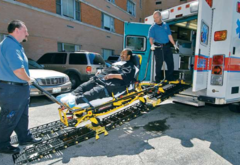
stair chair
-used to bring a conscious patient down to the waiting stretcher if the patient's condition allows him or her to be placed in a sitting position
-can be used to transfer a conscious patient up or down a flight of stairs

What is a contraindication for use of the stair chair in moving a patient?
Patient must be conscious
short spine board
Primarily for removing patients from vehicles when a neck or spine injury is suspected. A vest type can be used instead if necessary.

scoop stretcher
typically used on patients who have experiences suspected hip injury. By separating the stretcher it can be placed under the patient without having to reposition the patient much.

flexible stretcher
can be useful in restricted areas or narrow hallways

basket stretcher
A rigid stretcher commonly used in technical and water rescues that surrounds and supports the patient yet allows water to drain through holes in the bottom. Also called a Stokes litter.

recovery position
A side-lying position used to maintain a clear airway in unconscious patients without injuries who are breathing adequately.

shock position
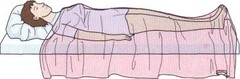
supine patient
What situations require an emergency move?
-Hazardous scene
-Care of life-threatening conditions that require repositioning
-The necessity to reach other patients.
(Try to move the patient in line with the long axis of the spine)
What situations require an urgent move?
-Required treatment can be performed only if patient is moved
-Patient's condition rapidly deteriorating
(Performed with precautions for spinal injury)
Non-urgent move
-Patient stable
-No immediate life threat
-Patient can be assessed, treated, and moved in normal way
(Take all required precautions not to aggravate existing conditions)
Requirements for patient refusal of care. (4)
patient is:
-Legally able to consent
-Mentally competent and oriented
-Fully informed of risks
-Sign release form
What is a DNR? What does it say?
Do not resuscitate order (DNR)
Legal document expressing patient's wishes if patient unable to speak for self
Expressed consent vs. implied consent
Expressed consent: Must be informed
-patient verbally gives consent
Implied consent: Assumed consent
-it is assumed the patient would agree to the measures within their best interest
What is the scope of practice?
Regulations and ethical considerations that define extent or limits of job duties
(what an EMT can do)
What is standard of care?
Care expected from EMT with similar training for patient in a similar situation
(how the EMT should preform their job)
What is the duty to act?
Obligation to provide care
While on duty, EMT obligated to provide care if no threat to safety
What must happen to prove negligence? (something was not done, or was done incorrectly)
-EMT had duty to act
-Breach of duty—EMT failed to provide standard of care expected or failed to act
-Proximate causation—patient suffered harm because of EMT action or inaction
Who can a patient's information be shared with without breaching confidentiality?
Can be shared with other health care personnel as part of patient's continuing care
(Otherwise must be obtained through subpoena)
Examples of evidence of a crime scene. (4)
-Condition of scene
-Patient
-Fingerprints and footprints
-Microscopic evidence
Anatomical position
To stand erect with arms at the sides and palms of the hands turned forward

Anatomical term for front & back
front: anterior
back: posterior
Anatomical term for above & below.
above: superior
below: inferior
Define medial & lateral.
Medial: toward the midline or median plane
Lateral: away from the midline or median plane
Position for the unconscious non-trauma patient to allow vomitus and secretions to drain from the mouth.
Recovery Position
Where does the upper airway begin? Where does it end?
Begins at mouth/nose
Ends at glottic opening
What happens at the alveoli? How are they able to perform this function?
-Tiny sacs in grape-like bunches at the end of the airway
-Surrounded by pulmonary capillaries
-Oxygen and carbon dioxide diffuse through pulmonary capillary membranes
What is the most common airway obstruction due to altered mental status?
poor muscle tone
Maneuvers to open airway
-Head-tilt, chin-lift maneuver
-jaw-thrust maneuver
Differences in pediatric vs. adult airway.
compared to adults, children have:
-Smaller mouth and nose
-Larger tongue
-Narrow, flexible trachea
What findings indicate airway problems? (6)
-Inability to speak
-Unusual raspy quality to voice
-Abnormal breathing sounds
(Stridor, Snoring, Gurgling)
-Absent or minimal chest movements
-No air felt or heard (air exchange below normal)
-Foreign bodies in airway
3 steps in caring for an airway
1. Make it
2. Check it
3. Keep it
2 types of airway adjuncts?
-Oropharyngeal airway (OPA) - Oral Airway
-Nasopharyngeal airway (NPA) - Nasal Airway
What are the 3 most important rules to suctioning the airway?
-Suction no longer than 10 seconds at a time
-Suction only as far as you can see
-Place tip or catheter where you want to begin suctioning. Suction only on the way out
Inhalation vs. Exhalation? vs ventilation?
-inhalation is an active process; occurs when diaphragm contracts; creates negative pressure which pulls air into lungs
-exhalation is a passive process; occurs when diaphragm relaxes; creates positive pressure which pushes air out of lungs
-ventilation: process of both inhaling and exhaling
Tidal volume vs. dead space volume vs. alveolar ventilation?
-Tidal volume: amount of air moved in one breath
-Dead space air: air moved in ventilation not reaching alveoli
-Alveolar ventilation:air actually reaching alveoli
External respiration vs. internal respiration?
-External respiration: diffusion of oxygen and carbon dioxide (exchange of gases) between alveoli and circulating blood.
What is hypoxia? What are signs of hypoxia?
low oxygen level in cells
signs: Shortness of breath, Increased respiratory rate and depth, Increased heart rate, abnormal skin color
What are the stages of respiratory compensation?
-Respiratory Distress
-Respiratory Failure
-Respiratory Arrest
What is respiratory distress?
Body compensating for a respiratory challenge and meeting metabolic needs
What is respiratory failure? What are the signs of respiratory failure?
Occurs when challenge overcomes compensation or compensatory steps can no longer continue
(Also known as inadequate breathing)
Signs:
-No or poor air movement
-Diminished or absent breath sounds
-Breathing rate too rapid, too slow, or irregular
-Patient unable to speak
-Unusual noises (wheezing, crowing, stridor, snoring, gurgling, gasping)
What is respiratory arrest?
When breathing completely stops.
Oxygen delivery devices: on-rebreather
best way to deliver high concentrations of oxygen to a breathing patient

Oxygen delivery devices: nasal cannula
Best choice for a patient who refuses to wear an oxygen face mask or for titration

Oxygen delivery devices: venturi mask
Delivers specific concentrations of oxygen by mixing oxygen with inhaled air

Oxygen delivery devices: partial rebreather
-similar to nonrebreather mask
-No one-way valve in opening to reservoir bag
-exhaled air mixes with supplemental oxygen

What are the 6 components of the scene size-up?
1. BSI
2. Scene Safety
3. Nature of Illness (NOI) / Mechanism of Injury (MOI)
4. Number of patients
5. Additional Resources
6. (C-spine Consideration)
You are approaching the scene of a motor vehicle crash. What is the EMT's first priority?
Ensure the safety of the scene. The EMT is their own number one priority.
What guidelines do you use to determine the danger zone?
emergency response guide (ERG)
What is the MOI? Why is it important?
Mechanism of Injury
-forces that caused the injury
this can tell us what types of injuries we may suspect within our patient. Additionally, we can have a focused idea of where the patient may have experienced impact/trauma
What are the three collisions involved in each motor vehicle crash?
vehicle to vehicle collision
human to vehicle collision
internals to human collision
What is the NOI?
Nature of Illness
-more commonly used to medical calls
also known as the chief complaint/why the patient called EMS
Primary Assessment Steps
1. Forming a general impression
-C-Spine Decision
2. Assessing mental status (AVPU)
3. Assessing airway
4. Assessing breathing
5. Assessing circulation
6. Determining patient priority
What is the importance of the primary assessment?
-determining immediate life threats
-determining patient priority
-assessing mental status
-assessing ABCs
What findings indicate a critical patient?
1. mental status
-unconscious patient is a high priority
2. results of ABCs
-if patient has obstructed airway, inadequate breathing, or poor circulation they may be a high priority patient
What is AVPU used for? What are its components?
AVPU is used to assess mental status of a patient
A: alert
V: responsive to verbal stimuli
P: responsive to painful stimuli
U: unresponsive
How do you determine P (in AVPU) in an adult? In an infant?
in adult: sternum rub or pinch their arm
infant: something with their foot
What are the ABCs?
airway (check for obstruction)
-make it, check it, keep it
breathing (check for inadequate breathing)
circulation (Assess pulse, Assess skin, Assess bleeding, Signs/Symptoms of shock)
ABC? Or CAB?
ABC - if patient has signs of life
CAB - if patient appears lifeless/no pulse
Components of circulation assessment. (3)
-Assess pulse
-is it within normal limits
-is it unusually fast or unusually slow
-Assess skin
-color, temperature, condition
-Assess bleeding
-check for major bleeding
-gross blood sweep
(check for Signs/Symptoms of shock)
Stable vs. potentially unstable vs. unstable
Stable: No threats to ABCs found, General impression not concerning
Potentially unstable: Potential for deterioration can indicate potentially unstable category
Unstable: Threat to ABC's
What is the importance of vital signs?
Outward signs of what is going on inside the body
-Identify important conditions or trends in patient conditions
What are included in vital signs?
1. Pulse (HR)
2. Respiration (RR)
3. Skin: color, temperature, and condition
4. Capillary refill (in infants and children)
5. Pupils
6. Blood pressure
7. Oxygen Saturation
What do we measure when checking for a pulse? (4)
1. Rate
2. Quality
3. Regularity
4. Equality (between central and peripheral)
What is the normal pulse rate for an adult?
Adults 60-100 beats per minute (bpm)
abnormal pulse descriptions
Thready—when pulse feels weak and thin
Bounding - when the pulse feels abnormally strong
What are the locations to check for a pulse? Central and peripheral.
central: Carotid, femoral
peripheral: radial, brachial, pedal
What is the normal respiratory rate for an adult?
(adult at rest) 12-20 breaths per minute
What are the 4 respiratory qualities?
Normal/Non-labored
Shallow (Abnormal Finding)
Labored (Abnormal Finding)
Noisy (Abnormal Finding)
Are pediatric pulse and respiratory rate higher or lower than an adult?
higher in pediatric patients
What are the four abnormal skin colors we typically see? What do they mean?
Cyanotic (blue-gray): lack of oxygen or extreme exposure to cold
Flushed (red): anxiety/stress
Jaundiced (yellow): liver malfunction
Mottled (blotchy): poor circulation
Blood pressure by palpation vs. auscultation.
palpation: feeling. gives only systolic number
auscultation: listening. gives both systolic and diastolic
Blood pressure normal range adults
Systolic no greater than 120 mmHg
Diastolic no greater than 80 mmHg
What determines whether you perform a rapid assessment or focused assessment?
Level of consciousness of patient
Important physical findings of secondary assessment
-Neck: JVD, medical identification devices
-Chest: breath sounds
-Abdomen: distention, firmness or rigidity
-Pelvis: incontinence of urine or feces
-Extremities: pulse, motor function, sensation, oxygen saturation, medical identification devices
PMH & HPI
past medical history
history of present illness
OPQRST. What are the letters and what does it tell you?
tells history of present illness (HPI)
Onset
Provocation/Palliation
Quality
Radiation
Severity
Time