Introduction to Forest Ecology, Forests as Ecosystems, and Case 1
 Call Kai
 Learn
Learn Practice Test
 Spaced Repetition
 Match
Match Flashcards
 Knowt Play
1/48

Earn XP
Description and Tags
Study Guide: Week 1 + Part 1 of Study Guide
Name | Mastery | Learn | Test | Matching | Spaced | Call with Kai | Chat |
|---|
No analytics yet
Send a link to your students to track their progress
49 Terms
Explain how forests are more than just trees
Forests are way more than trees, they are an incredible complex, physical environment that support many ecosystems living within the forest. Forests are plant communities dominated by trees.

Why is it important to consider both spatial and temporal scales in the study of forest ecology? Use the most recent glaciation event in North America as an example.
It is important to study both spatial and temporal scales in forest ecology, because forest distributions change over time.
Spatial scale: At a small scale, a forest may appear to be a collection of individual trees competing for light, water, and nutrients. At a larger scale, factors such as climate, soil, topography, and disturbance determine where different forest types occur.
Temporal scale: Short-term observations may show events such as tree growth, drought, fire, or insect outbreaks. Over centuries or thousands of years, forests can undergo major changes in species composition and geographic distribution.
During the Last Glacial Maximum, roughly 20,000 years ago, large portions of northern North America were covered by ice sheets, including the Laurentide Ice Sheet. Forests were therefore displaced southward into areas that remained ice-free. As the climate warmed and the glaciers retreated, forests gradually expanded and migrated northward into newly available habitats.
Explain the interdisciplinary nature of the field of forest ecology.
Forest ecology focuses on how the environment (living and non-living) shapes the abundance, distribution, and cooccurrence of organisms in forest ecosystems. Other ecological interactions, including competition, antagonistic / mutualistic interactions, and soils also determine forest development and persistence. Ecology is the interdisciplinary study of the relationships among populations of organisms and habitats and the flows of energy, nutrients, and other resources.
Why is the discipline of forest science so valuable to global society? Outline all the reasons that you are in the process of switching your major to Forest Science.
This area of science is fundamental for developing an improved understanding of ecosystem function and enhanced tools and techniques to restore and conserve our nation’s forest and grassland ecosystems. Forest ecologists study patterns and processes across a wide range of scales in space and time
What is the definition of a forest? Be sure to include how forest structure, function, and composition all relate to this definition.
A forest is land covering more than 0.5 hectares with trees taller than 5 meters and more than 10% canopy cover, or trees capable of reaching these thresholds. Forest structure refers to the physical arrangement and density of trees, while forest composition refers to the types of trees and other plants present, such as coniferous evergreen or broad-leaved deciduous trees. Forest function is related to how the forest community develops and operates, including how sufficient rainfall supports large plants and limits fire frequency. Together, the forest’s structure, function, and composition are influenced by environmental conditions such as temperature and precipitation.

What determines the distribution of biomes across the globe?
Climate. Mostly temperature and precipitation cycles.
Why do tree lines occur at high elevations?
Are a transition zone where conditions become too stressful for trees to maintain sustained growth and reproduction. The exact elevation varies with latitude, climate, slope, aspect, and local conditions. For example, tree lines generally occur at lower elevations closer to the poles and at higher elevations closer to the equator.
Describe the environmental transition from south to north in the state of Wisconsin and the resulting changes in forest community composition.
Wisconsin transitions from warmer, fire-influenced oak savannas and deciduous forests in the south to cooler northern forests. Southern forests are dominated by species such as white oak, red oak, shagbark hickory, and sugar maple, while northern forests historically contained sugar maple, yellow birch, hemlock, and white pine. Today, northern forests have more aspen and birch because logging became a major disturbance, while deer browsing limits hemlock regeneration. Overall, climate and disturbance patterns cause forest community composition to change from south to north.
How will climate change impact forest communities in the state of Wisconsin?
Wisconsin summers are going to begin to feel like “Arkansas” summer. Wisconsinites born in 2013 are more likely to experience these in their summers. Northern red oak trees are going to begin moving North. Northern red oak are going to disappear from Southern Wisconsin. Post Oak are going to travel upward and enter Wisconsin.
Why is forest ecology so important to study?
This area of science is fundamental for developing an improved understanding of ecosystem function and enhanced tools and techniques to restore and conserve our nation’s forest and grassland ecosystems.

What species is going to disappear in Wisconsin by 2100?
Birch wood, firn & Spurce.
What is ecology?
The study of relationships between living organisms and
their environments, the nteractions of organisms with one another, and how these relationships/interactions shape the abundance, distribution, and co-occurrence of organisms in nature.
Fill in the blanks. Ecology, like other sciences, is built upon the integration of ______ (observed relationships in the natural world), _____ (the causes of pattern), and ______ (the explanations of those causes).
Pattern
Process
Theory

Different warbler species are a great example of how patterns, processes, and ecological theories explain biodiversity.
Pattern: Different warbler species often occupy different parts of the same forest, such as different heights in the canopy. This reduces competition because each species uses slightly different resources.
Process: Resource partitioning and competition help determine where each species feeds and nests. Natural selection favors traits and behaviors that allow species to use different niches.
Theory: Warblers demonstrate the competitive exclusion principle and niche differentiation—species with very similar resource requirements may compete strongly, while species can coexist when they occupy different ecological niches.
Big idea: The warblers show that biodiversity isn't random. Competition and natural selection can lead to species specializing on different resources, allowing multiple closely related species to coexist in the same habitat.

Ecosystems are incredibly complex. What are outputs of this cycle?
By respiration, erosion, oozing of water are omitted
Plant physognomy changes across the globe. Two major patterns begin to emerge:
A north-South gradient in plant form due to temperature changes
2. Variation from West to East in response to changes in average precipitation. What is an example of the second pattern?
A. Moving from West to East, short-grass praries changes to mid-grass praries, which changes to tall grass praries once you reach Iowa
B. Further East, the communities become coniferous forests. Dominated by trees, but without a closed-canopy.
A.
Biomes
Major biogeographic regions that differ from one another in the structure of their vegetation and in their dominant plant species. Defined by the physiognomy of the
dominant or most obvious plants. While biomes are useful descriptive classifications, the boundaries are not always clear, and microsite variation may lead to overlap of different plant community types.

What major biomes are found in the US?
🌲 Coniferous forests — common in the northern U.S. and much of the mountainous West.
🌳 Temperate deciduous forests — common in the eastern and central U.S.
🌵 Deserts — primarily in the southwestern U.S.
🌾 Grasslands — especially the Great Plains and central U.S.
🌴 Tropical forests — found in southern Florida and Hawaii.
🌿 Mediterranean shrubland/chaparral — mainly coastal California.
❄ Tundra — found primarily in Alaska.
The northern forests used to contain: Mostly old-growth sugar maple, yellow birch, hemlock, white pine. They used to have blow-down and occasional fire
main disturbances. What is going on now in Wisconsin?
In Wisconsin, birch & Aspen dominate. Logging is a main form of disturbance. Deer prevent hemlock regeneration.
What are the three major organs of a tree, and what is the primary function of each?
Roots, stems, and leaves. Roots acquire water and nutrients and anchor the tree; stems provide support and transport materials; leaves perform photosynthesis and gas exchange.
What is the difference between xylem and phloem?
Xylem transports water and minerals, primarily from the roots toward the leaves. Phloem transports sugars and other products of photosynthesis from sources such as leaves to areas where they are needed or stored.
What is the main function of roots, and how do their structures help them perform this function?
Roots absorb water and nutrients and anchor the tree. Their branching structure and root hairs increase the surface area available for absorbing resources from the soil.
How do leaves allow trees to perform photosynthesis and exchange gases with the atmosphere?
Leaves contain cells that perform photosynthesis and have stomata that allow CO₂ to enter and O₂ and water vapor to leave.
What are stomata, and why might a tree close them during a drought?
Stomata are small openings in leaves that regulate gas exchange and water loss. A tree may close them during drought to reduce water loss, although this also limits CO₂ entering the leaf.
How does water move from the roots to the leaves through the xylem?
Water moves through xylem from the roots toward the leaves, largely because evaporation of water from leaves creates a pulling force that draws water upward through the tree.
A tree is experiencing a severe drought. How would drought affect its water transport and photosynthesis?
Drought can cause a tree to close its stomata, reducing water loss but also limiting CO₂ uptake. This decreases photosynthesis and can reduce growth; severe drought can also disrupt water transport through xylem.
Why might trees growing in deep shade have larger or thinner leaves than trees growing in full sunlight?
Larger, thinner leaves can help a shade-grown tree capture more of the limited light available under a canopy. Trees in full sunlight may have smaller or thicker leaves because they receive much more light.
How might flooding affect a tree's roots and its ability to acquire water and nutrients?
Flooding can reduce the amount of oxygen available in the soil, making it difficult for roots to carry out normal respiration. This can reduce root function and interfere with water and nutrient uptake.
What structural adaptations would you expect in a tree living in a very dry environment? Give two examples and explain how they help.
Possible adaptations include small/thick leaves, waxy surfaces, deep or extensive roots, and reduced stomatal water loss. These characteristics can help a tree conserve or access water in dry conditions.
Compare a tree growing in a dry environment with one growing in a wet environment. How might their root systems differ?
A tree in a dry environment may have deeper or more extensive roots to access limited water. A tree in a wet environment may have shallower roots because water is more readily available near the surface.
A tree has small, thick, waxy leaves. What type of environment would you predict this tree is adapted to, and why?
The tree is likely adapted to a dry environment. Small, thick, waxy leaves reduce water loss and help the tree conserve water.
A tree's stomata close during a hot, dry day. Explain one benefit and one cost of closing the stomata.
Closing stomata reduces water loss through transpiration. Cost: It also reduces CO₂ entering the leaf, which can decrease photosynthesis.
Explain how roots, stems, and leaves work together to allow a tree to acquire resources, transport them, and grow.
Roots acquire water and nutrients, which are transported upward through the xylem in the stem. Leaves use water and CO₂ to perform photosynthesis and produce sugars, which are then transported through the phloem to support growth and storage throughout the tree.
Which ones are not characteristics of a plant cell?
A. Cell Wall (rigid shape)
B. Numerous small vacuoles
C. Chlorplasts (autrotrph)
D. Lack centrosomes
E. Lack Lyosomes
B.
Plants have 3 main cell types; Parenchyma, Collenchyma and schlerenchyma. Which ones are dead at maturity?
A. Parenchyma
B. Collenchyma
C. Schlerenchyma
C.
Which cell types function to protect, support and conduct water movement?
A. Parenchyma
B. Collenchyma
C. Schlerenchyma
C.
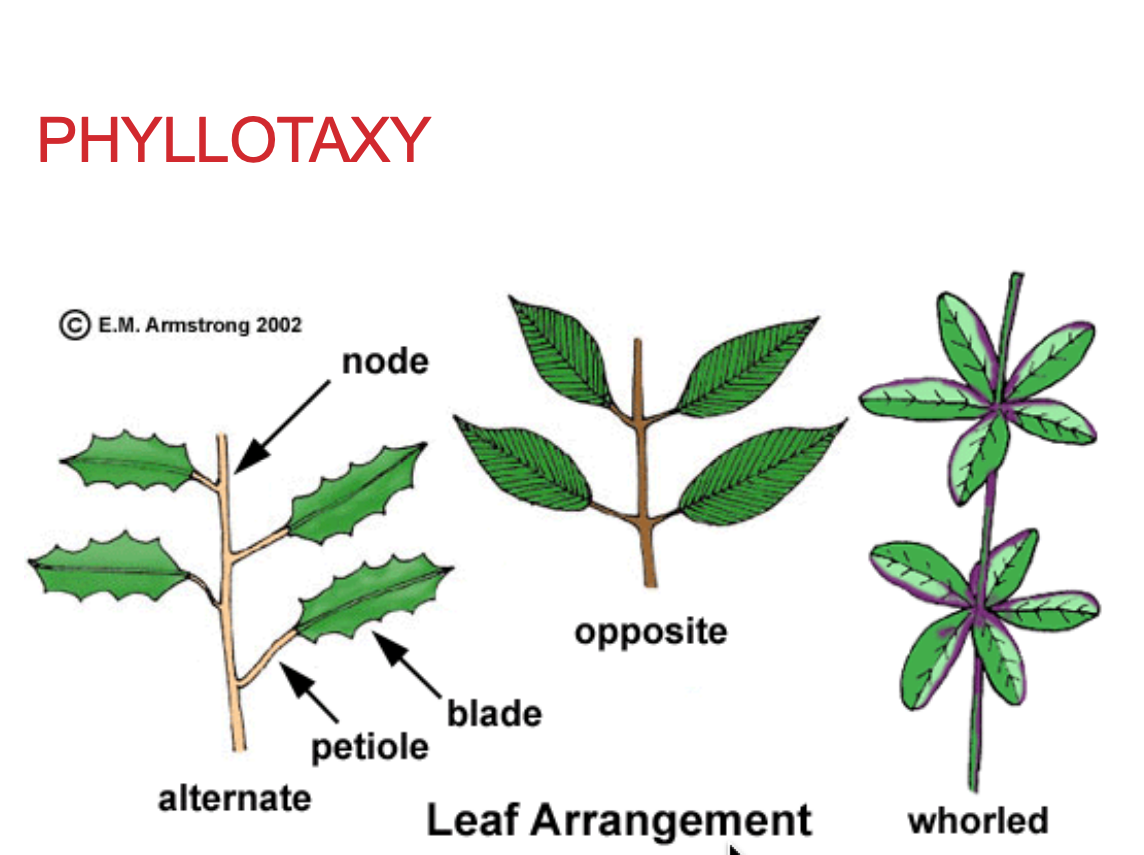
What is the definition of phyllotaxy?
It is the arrangement of leaves on a plant stem.

What are the 3 basic organs of a vascular plant? What types of leaves do they have?
Roots, stems and leaves. They have two types, simple and compound, which contain different phyllotaxies.

Label the parts of a leaf.

What is the definition of sapwood?
Live xylem tissue located just inside the phloem; the function is to transport water from the roots to the canopy
What is the definition of heartwood?
Dead xylem tissue that comprises the inner part of the stem; the function is support.
Which stem structure is responsible for secondary growth?
Vascular cambium.
Fill in the blanks: ____ produces ___ inwardly and phloem outwardly
Cambium, xylem
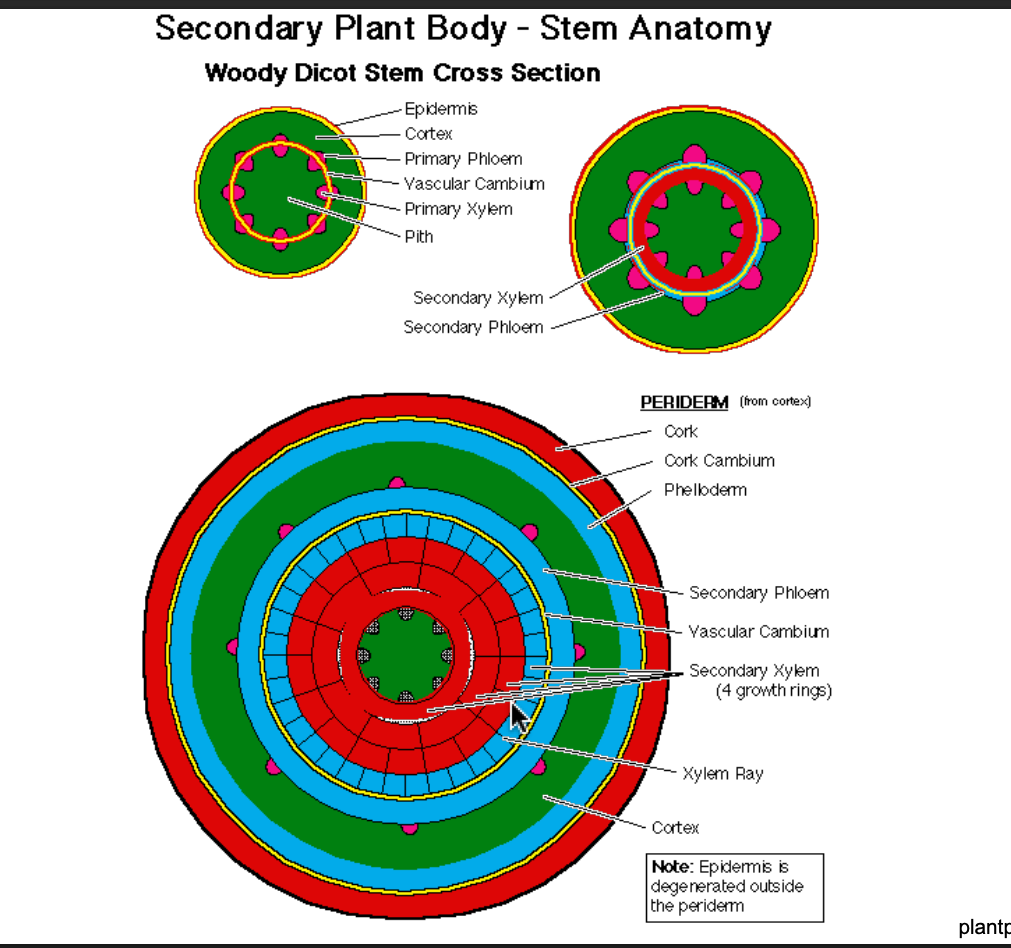
For stem secondary growth. What are the 2 secondary meristems?
The vascular cambium and the cork cambium
In general, canopy architecture is under strong genetic control. There are 2 major canopy forms: excurrent and decurrent. Which one contains terminal shoots which exert apical dominance over lateral shoots?
A. Excurrent
B. Decurrent
A
There are two types of xylem structure: 1. tracheids, built by gymnosperms 2. vessels, built by angiosperms.
Which characteristics are NOT associated with tracheids?
A. Larger diameter
B. Less susceptible to cavitation (the formation of air bubbles, or embolism, in the water column during water stress)
C. Faster H2O transport
D. More susceptible to rapid spread of pathogen
A, C, D
Vessels are more prone to embolism (blockages) and cavitation (sudden formation and collapse of low-pressure bubbles) than tracheids. How do ring porous vessel arrangements recover and deal with this?
Rely on early wood vessels for leaf flush. Are sensitive to late frost
What are two important differences between plant and animal cells?
Plant cells have a cell wall and a large central vacuole, which help provide structural support and maintain water balance. These features are important because plants cannot move, so they rely on cell structure and water pressure to maintain their shape and grow.
What plant tissues contain parenchyma cells?
The epidermis, Xylem, Phloem, ground tissue (especially in the pith and cortex), leaf mesophyll