HR Strategy and Strategic Planning
 Call Kai
 Learn
 Practice Test
 Spaced Repetition
 Match
 Flashcards
 Knowt Play
1/55

Earn XP
Description and Tags
Comprehensive vocabulary flashcards covering concepts, models, and processes in HR strategy and strategic management.
56 Terms
Strategy
A long-range (1 year at least) plan of action oriented to achieving defined goals, created and refined through a strategic planning process and implemented through strategic management.
Levels of Strategy
The hierarchy of strategic planning comprising organizational, business unit, and operational strategies, repeated at each level with increasing focus and specificity.

Organizational Strategy
Focuses on the future of the organization as a single unit
Business Unit
Address questions of how an where the organization will focus to create value
Operational Strategy
Reflects the way in which organizational and business unit strategies are translated into action at the functional level through functional strategies.
Strategic planning
the process of setting goals and designing a path toward a competitive position. The strategic plan helps create alignment of efforts and provides a layer of control.
Strategic management
includes the actions that leaders take to move their organizations toward the goals set in strategic planning and to create value for all stakeholders.
Critical Success Factors
Key organizational conditions required to execute strategy effectively, specifically alignment of effort, control of drift, and focus on core competencies.
Strategic Planning and Management Process
A four-phase cyclical management framework consisting of Formulation, Development, Implementation, and Evaluation.
Strategic planning and management are distinguished by the way assets, structure, and policies are focused and integrated to achieve goals.

Formulation
when leaders gather and analyze internal and external information to determine the organizations current position and capabilities, opportunities and constraints
Development
Development of strategic goals and tactics that will optimize success given the environment, opportunities, and constraints—the strategic plan.
Implementation
the process of management. This requires clear communication of objectives to teams, coordination and support of their efforts, and control of resources.
Evaluation
Evaluation of results, both continually, to make sure that activities maintain strategic focus and are effective and to determine the effectiveness of the strategy itself and the need for change or improvement.
Systems Thinking
Process for understanding how seemingly independent units within a larger entity interact with and influence one another.
Ex. Traditional problem-solving: We have high turnover, so hire more people. vs Systems thinking: Why are employees leaving, and how are different organizational factors contributing?
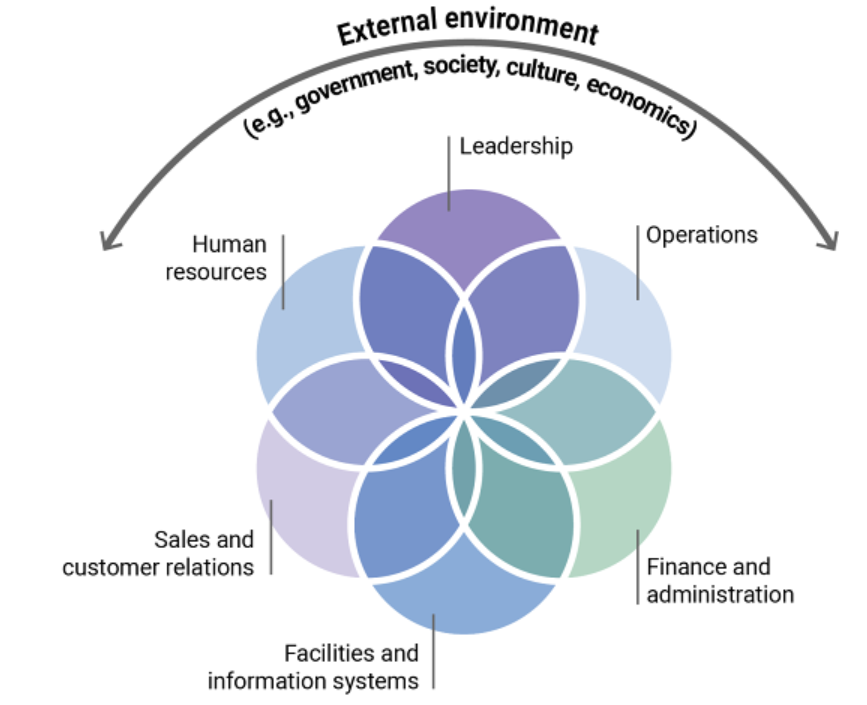
Environmental Scanning
A process of systematically surveying and gathering data, from both internal and external sources, that can be analyzed to identify opportunities and threats and strengthen strategic plans and goals.
PESTLE Analysis
Scanning process that searches for environmental forces in six distinct categories: Political, Economic, Social, Technological, Legal, and Environmental.

PESTLE Process
Assemble a list of possible events or trends that exist now or could materialize within a defined time frame.
Identify the potential impacts on the organization.
Research the impacts more thoroughly to understand possible causes, their dimensions, and connections with other events or trends.
Assess the importance of the possible impacts based on the strength of the data.

SWOT Analysis
A strategic assessment tool that uses data to evaluate internal capabilities (Strengths and Weaknesses) against external conditions (Opportunities and Threats) identified during environmental scanning.

Growth-Share Matrix
A portfolio analysis tool that assesses market share against market growth rate to determine where organizational value resides, categorizing units into Stars, Cash cows, Dogs, and Question marks.
Stars - high value
Cash cows - create value reliably but shows little opportunity for growth
Dogs - consume resources without offering strong value or future growth
Question marks - could be winners or losers/future is unclear

Scenario Analysis
compares the impact of environmental changes on organizational outputs to identify high-impact factors and apply risk management to strategy formulation.
Using different scenarios to assess potential outcomes and inform decision-making, allowing organizations to adapt strategies based on varying future conditions.
Mission
A concise statement specifying what an organization or function intends to pursue and its charted management course, providing focus and purpose for its strategy.
Vision
A statement outlining what the organization or function aspires to become in the future, providing motivation and unity.
General Goals
suggests how the organization will focus its resources
Values
The core beliefs that an organization or function supports through behaviors and actions, serving as guideposts for decision making.
Organizational Values
Are beliefs that are important to an organization and often dictate employee behavior.
Line of Sight
The direct connection established between broad organizational strategic goals and the lower-level goals, objectives, and daily work of functional units and individuals.
Value Drivers
The critical actions, processes, or results necessary to deliver a desired value. Ensuring an alignment of effort.

Balanced Scorecard
A performance metric that evaluates performance across four balanced perspectives: Finance, Customers, Internal business processes, and Learning and growth.
It provides organizations with feedback on how to make better decisions in the future.
Leading Indicators
Predictive performance metrics that describe forward-looking actions capable of altering future results and driving strategic success (e.g., employee satisfaction indicates retention rates and cost of hiring).
Lagging Indicators
Describes effects that have already occurred and cannot be changed. (e.g., employee turnover rate indicates lack of success in employee engagement).
SMARTER Performance Objectives
An objective-setting acronym outlining criteria for effective performance goals: Specific, Measurable, Achievable, Relevant, Time-based, Evaluated, and Revised.
Benchmarking
A five-stage process to measure performance: defining KPIs, measuring current performance, identifying benchmarks and securing data, identifying performance gaps, and setting objectives with support activities.
Strategic Fit
The consistency of an organization's strategy with its internal and external environments, existing when activities interact, reinforce one another, and are optimized toward strategic goals.
Creating Competitive Advantage
There are 2 ways an org can create competitive advantage, and both involve change.
External changes - Compete by adapting quickly to changes in the environment
Internal changes - Compete through change, innovation, and reinvention
Michael Porter’s Competitive Strategies
Cost leadership: Allows businesses to gain a competitive edge through lower prices, attracting price-sensitive customers (aldi, walmart, costco)
Differentiation: enables businesses to build brand loyalty and command premium prices, leading to higher profit margins (disney, rolex, apple)
Cost Focus: Provides businesses with a focused approach to serving niche markets, minimizing competition and maximizing profitability (temu, cheap corn stand)
Differentiation Focus: Allows businesses to cater to the unique needs of specific market segments, fostering customer loyalty (tesla, rolls royce)
Impact of Business Strategy on HR
Cost/Differentiation/Focus business strategy has an impact on HR strategy. Which can in turn influence the organizational strategy. (Talent management, compensation, employee engagement, inclusion & diversity)
What activities are we performing in our respective areas of HR that will support the achievement of our strategy.
Growth Strategy Options
Each strategy requires different levels of investment and offers different levels of control and return; risk involved, satisfy strategic goals
Joint venture, merger/acquisition, franchising, licensing, equity partnership, turnkey operation, greenfield/brownfield operation…
Greenfield Operation
A corporate growth strategy where an organization builds an entirely new enterprise from the ground up, requiring extensive HR work in staffing, risk analysis, and local compliance. (Starting from scratch)
Brownfield Operation
A corporate growth strategy that involves expanding, repurposing, or modifying existing operations or facilities.
Divestiture
A corporate growth and reorganization strategy that sheds or sells an unaligned business unit, subsidiary, or asset requiring HR to conduct due diligence, prepare leaders, and facilitate workforce transitions.
Identify the candidates(Business area)
Identify a target buyer
Restructure
Execute the deal
Implementation
Requires communicating the value of the strategies to all members and effectively managing the implementation of plans
Operational Budget
An ongoing budget allocation that finances the routine daily activities required to deliver standard HR services (e.g., talent acquisition costs, compensation, benefits).
Strategic Budget
A project-based budget allocation dedicated to funding initiatives that are directly aligned with strategic goals and competitive priorities (e.g., mentoring program creation).
Communication Strategy
Communication occurs in different ways and at different levels(Team meetings, formal communication)
the communication plan should include ongoing opportunities for feedback
Project Stages
3 stages:
Planning - define deliverables, project schedule, assembling team
Execution - communication, leadership backing, removing obstacles
Closing - assessment, team debrief, continuous learning

Gantt Chart
Represents the scheduling of tasks visually, showing the length and timing of specific activities. A primary way to communicate expectations to the team
Specialized Project Management Approaches
Lean Project
Six sigma
Agile
Critical chain project management
Kaizen
Design thinking
Lean project management
Focuses on eliminating waste by:
Maintaining a tight focus on the intended value of the project.
Empowering the team to make decisions.
Analyzing and solving problems rather than working around them.
Six Sigma project management
Refers to a level of quality so high that very few errors occur. It emphasizes focusing on projects with a quantifiable return of value, encouraging team commitment to quality and involvement in problem solving, measuring results in a manner that allows empirical analysis, and fact-based decision making.
Agile project management
Used when the assumptions on which a project is based are unclear or may evolve as project work proceeds. The project focuses on iterations of the deliverables—completing one iteration and then using customer input to plan the next iteration.
Critical chain project management
Used when resources cannot be increased to meet deadlines. For example, an HR department may be able to allocate no more than 10 hours per week of staff time to do project work. Project activities are scheduled accordingly.
Kaizen
Is a systematic approach for business improvement, requiring that all people and processes in an organization work to continuously improve.
Design thinking
Places the customer at the center of the project by understanding the in-depth requirements of the project’s intended end user or beneficiary. It focuses on empathy in order to ensure that the intended stakeholder receives value from the project.
Key Performance Indicators (KPIs)
Quantifiable measures of performance. Used to evaluate progress toward achieving strategic objectives or meeting predetermined performance standards.
Effectiveness
Efficiency
Impact
Evaluation
The systematic process of assessing the design, implementation, and outcomes of a project or program to determine its success and areas for improvement.
Essential for sound management, good governance, and continuous improvement
Communicating Strategic Results
Information must be presented efficiently and effectively
what I do make a difference?
Create a narrative supported by data