ENSC 003 Midterm 2
 Note
Note Call Kai
 Learn
Learn Practice Test
 Spaced Repetition
 Match
Match Flashcards
 Knowt Play
1/120

There's no tags or description
Looks like no tags are added yet.
Name | Mastery | Learn | Test | Matching | Spaced | Call with Kai | Chat |
|---|
No analytics yet
Send a link to your students to track their progress
121 Terms
Harvesting Trees
Similar to growing crops with four different types of cutting
Selective cutting
Cutting only healthy trees and leaving an unhealthy forest; leaving forest unmanaged
Selection cutting
Shelterwood cutting
Less desirable and dead trees are harvested so that by the time the younger trees are mature, the older ones can be harvested
Seed Tree Cutting
Removing all but a few trees that allows seeds to naturally regenerate
Clear Cutting
Severe form of forest cutting that removes all trees from the landscape which can be useful in disease and infestation cases; can be done in patches as well
Nitrogen immobilization
Leaving wood chips in clear cut areas so biome can eat carbon and nitrogen without the nutrient being lost
Consequence of Clear Cutting
Soil erosion and sediments washing into river
Why harvest trees?
Deforestation
Temporary or permanent clearance of large expanses of forest for agriculture or other use
Causes of deforestation
Fire
Clearing for agriculture
Construction of roads
Tree harvest
Insect and disease
Consequences of Deforestation
Decreased soil fertility
Uncontrolled soil erosion
silt build up behind dams, hydroelectric problems
Loss of CO2 sink
Formation of deserts
Extinction of species
Global climate change
Global Forestry Challenges
Over exploitation
Slash and burn for subsistence agriculture
Illegal timber harvesting
Climate change (beetle kills and forest fires)
Causes of Tropical Rain Forest Damage
Subsistence agriculture
Commercial logging
Cattle ranching
Mining and hydroelectric power as well
Boreal Forests
Comprise the world’s largest biome
Are currently the primary source of the world’s industrial wood and wood fiber
are harvested primarily by clearcut logging
Comprised of evergreen trees, such as spruce, fir, cedar, and hemlock
What is the percentage of carbon with Boreal forests?
13% of Earth’s biomass carbon and 43% of Earth’s soil carbon contained in forests which are released when thawed (CRITICAL FOR CLIMATE CHANGE)
Rangeland
Land that is not intensively managed and is used for grazing livestock
Rangeland Degradation and Deforestation
Overgrazing leaves ground barren
Animals exceed land’s carrying capacity
Land degradation
Natural or human-induced process that decreases future ability of land to support crops or livestock
Desertification
Degradation of once fertile land into nonproductive desert
Desertification
Process of conversion to desert
Agricultural land
300 million acres of prime farmland
Threatened by suburban sprawl
Wetlands
Lands that are usually covered with water for at least part of the year
Have characteristic soils (anerobic/grey soil), and water-tolerant vegetation
Benefits of wetlands
Habitat for migratory waterfowl and wildlife
Recharge groundwater
Reduce damage from flooding
Improve water quality
Produce many commercially important products
Human threat to Wetlands
Draining for agriculture or mosquito control
Dredging for navigation
Channelization
Construction of dams, sea walls, levees
Filling in for solid waste disposal, roads, residential / industrial development
Conversion to aquaculture
Where do wetland losses occur the most?
In the 48 united states, more than half of the historic wetlands are gone, mostly converted to cropland
Most of the loss has been since 1950
The greatest percentage declines have been in Ohio, Indiana, Iowa, and California
The greatest total acreage declines have been in Florida, Louisiana, and Texas
Clean Water Act of 1972
No net loss of wetlands in the U.S but contention on the definition of protected wetland between homeowners and scientists
Coastlines
Natural border of coast that can protect infrastructure
Coastal Wetlands
Provide food and habitat for many aquatic animals
Historically regarded as wasteland
Coastline Population
Overdeveloped
Suburban and Urban Land
Prior to World War II, jobs and homes were concentrated in cities.
During the late 1940s and 1950s, homes began to move from urban centers to the suburbs.
Suburbanites commuted to the city for work.
There is an urgent need for regional planning to determine where new development should take place and where it should not.
Metropolitan areas need to make more efficient use of land that has already been developed.
High density housing with jobs and shopping nearby is a good way to minimize the human footprint on the land.
Cities make up what percentage of the world’s total land area?
3%
World Food Security
Increase in population has not been matched as grain per person has not increased
Famine
Temporary but severe shortage of food
Emerging economies in Africa, Asia and Latin America are most at risk
More people die from starvation than famineFood
Kwashiorkor
Protein deficiency common in children
Characteristic swollen belly
Caused by fluid retention
What percentage of food do Americans waste?
40%
Food Production
Invest mostly in sugarcane followed by corn, rice, and wheat
What percentage of the calories consumed are animals in high-income countries vs. in developing countries?
Constitute 40% of the calories consumed in high-income countries
Only comprise 5% of calories consumed in countries with emerging economies
Inefficiency of eating meat
Calories of meat lost by the time the human is eating, meaning that it is better to eat primary producers/bottom of food chain/crops
Industrialized agriculture
Modern agriculture methods that require large capital input:
Energy
Fertilizer
Herbicide
Pesticides
Hybrid seeds
Irrigation water
Training and experience are needed to safely conduct industrialized agriculture
Less land and labor needed however degradation of the land can occur through chemical use
Subsistence agriculture
Traditional agricultural methods, which are dependent on labor and large amounts of land
Provides food for the farmer only meaning smaller yields
Energy inputs come from humans and animals
Large amounts of land may be used
Shifting cultivation, Slash and burn agriculture, Nomadic herding, Intercropping
Norman Bourlaug
Father of Green Revolution by developing high-yielding, short stemmed wheat which greatly improved wheat yields around the world
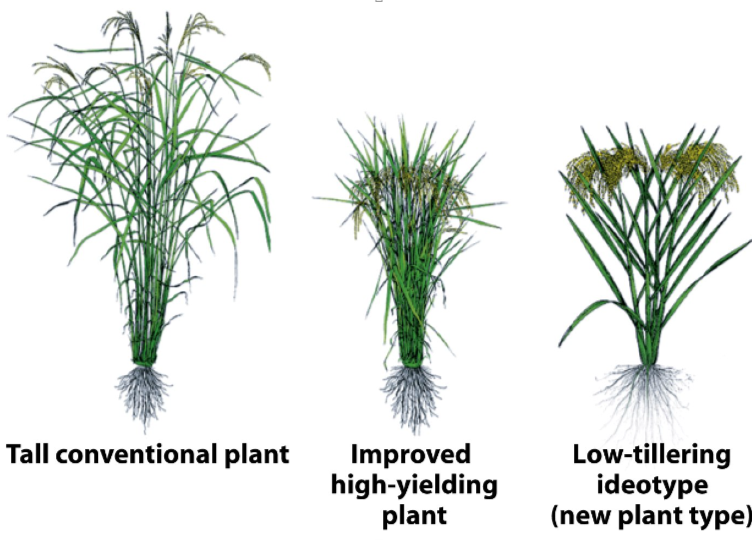
Which plant did Norman Bourlang develop?
The improved high-yielding plant
Green Revolution
Between 1950 and 1985:
Grain production tripled, from 600 to 1800 million metric tons due to the breeding of high-yielding varieties of wheat and rice.
Population increased from 2.5 to 4.9 billion.
Fertilizer and pesticide use increased greatly.
Genetic Engineering
Manipulation of genes by taking specific gene from a cell of one species and placing it into the cell of an unrelated species
Used to produce Genetically Modified (GM) food
Plants that are tolerant to insect pests, heat, cold, drought, or acidic soils
More productive farm animals
Examples: golden rice - rich in beta carotene (prevent Vitamin A deficiency in developing countries)
Are GMOS safe for human consumption?
Yes, determined to be safe but long-term effects are not known
Concerns about GMO seed or pollen spread
GMO labelling
Challenges of producing more livestock
Increasing livestock yields
Cloned and genetically modified animals
Hormone supplements
Antibiotics
Increased weight
Increased bacteria resistance: Bacteria that survives antibiotic can procreate with new genes that are stronger
Transgenic animals
Extra genes from another animal where genes of choice are manipulated, prepared and injected into the egg of an animal which is implanted into a surrogate
Ex:
Quicker growth of salmon
Self-healing catfish
Spider silk goats
Featherless chickens
Goats improved milk through rat protein
Benefits of the enviropig
Genetically modified pig from bacterium and mouse that releases less phosphorus through waste
How many tons of antibiotics are produced annually and what percentage of that is fed to healthy animals?
40% of the 25000 tons of antibiotics produced annually in the US are fed to healthy animals
Problems of Factory Farms
Growth Hormones
Injected or implanted _____ into animals to increase growth rate muscle mass and milk production
Trace amounts are found in meat and milk but considered safe for humans
However, pellet locations on animals are considered to have higher concentrations of drug
Livestock waste
Drugs can taint rivers and groundwater
Individual contributions to improve food issues
Reducing meat consumption
Eat animals that require less grain (chickens, fish, pork)
Support farmers that produce meat ethically
Mindful consumption
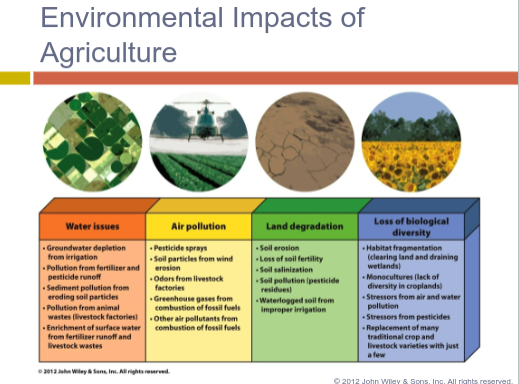
What are the environmental impacts of agriculture?
Water pollution by chemicals
Erosion and soil degradation
Soil and groundwater salinization
Air pollution
Climate change from land clearing
Deforestation
Habitat fragmentation and wildlife endangerment
Pesticide, antibiotic, and hormone residues in food
Aquifer depletion
Loss of genetic variation
Solutions to agricultural problems - sustainable agriculture
Agricultural methods that maintain soil productivity and a healthy ecological balance while having minimal long-term impacts
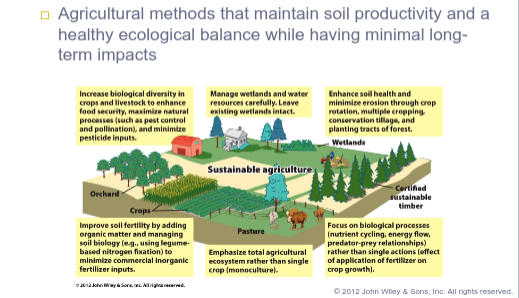
How can we reduce erosion and maintain fertility?
minimum tillage
contour plowing
crop rotation
How can we reduce chemical use?
introduction of predators (natural predator-prey relationship like ladybugs)
nitrogen-fixing crops (legumes)
crop breeding for disease resistance
use biodegradable chemicals
Integrated Pest Management
Limited use of pesticides with sustainable agriculture practice
Who owns the open ocean?
No nation lays claim to open ocean
Resource susceptible to overuse and degradation
Over harvesting fisheries
Many species are at point of severe depletion
62% of world’s fish stock are in need of management action
Sophisticated fishing equipment
Bycatch killed off
Purse Seining Process
Problems of bottom trawling
Deep trawling with nets held open by heavy doors bulldoze the seabed and catch sea life indiscriminately - more than 50% of catch is disgarded
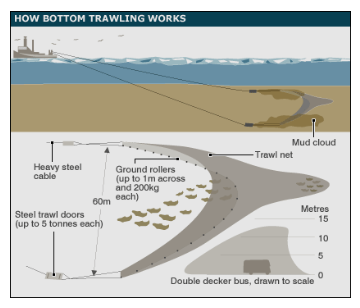
Bycatch
fishes, marine mammals, sea turtles,
seabirds, and other animals caught
unintentionally are called bycatchDumped back into ocean, dead
Bycatch makes up ~25% of all fishes
caught
Ocean Pollution
Dumping ground
Oil
Heavy metals
Deliberate litter dumping
Storm water runoff from cities and agricultural areas
Aquaculture
Growing aquatic organisms for human
consumption (fish farming)Great potential to supply food
Improvements for Aquaculture
As opposed to raising carnivorous fish such as salmon and stripped bass which require fish meal
Salmon eat 5kg of fish meal to gain 1kg of weight
Is it better to eat at the top or bottom of the food chain?
Bottom of the food chain
Layers of atmosphere
Exosphere
Thermosphere
Mesosphere
Stratosphere
Troposphere
Troposphere
Extends from the ground to 10 miles up
90% of all the air is in this first layer
Atmosphere as a Resource
Atmosphere Composition:
Nitrogen: 78.08%
Oxygen: 20.95%
Argon: 0.93%
Carbon Dioxide: 0.04%
Functions of atmosphere
Provides many ecosystem services:
Supports life with oxygen and carbon dioxide
Nitrogen needed for soil/plant/atmosphere cycle
Air Pollution
Chemicals added to the atmosphere by natural events or human activities in high enough concentrations to be harmful
Two categories:
Primary air pollutant
Secondary
Effects of Air Pollution
Low level exposure:
Eye irration
Inflammation of
Greater health risk to children who are more likely to develop asthma
Prolonged exposure can develop into chronic respiratory diseases
Air Pollutants in US
Major Drivers of Air Pollutants
Major classes of air pollutants
Particulate materials
Nitrogen oxides
Sulfur oxides
Carbon oxides
Hydrocarbons
Ozone
Particulate material
Thousands of different solid or liquid
Nitrogen Oxides
Gases produced by the chemical interactions between atmospheric nitrogen and oxygen
Can cause difficulty breathing
Can acidify precipitation through nitric acid
What is nitrogen oxide summed up into?
NOx which can be NO or NO2
NO (nitric oxide) produced during high temperature combustion (auto engines)
Emitted from soils
React with hydrocarbons (HC), oxygen, and sunlight to produce photochemical smog
What is sulfur oxides summed up into?
SOx
SOX is one of the most damaging air pollutants
SOX results from burning of fossil fuels that contain sulfur
SO2 causes eye and lung irritation at low
concentrationsSO2 can be deadly at high concentrations
Plants are very sensitive to SO2
SO2 is the main cause of acid rain
SOX is mainly emitted by coal-burning power plants (88%)
NO + HC
Peroxyacyl nitrates (PAN)
NO2 + O2 + sunlight
NO + O3 (Ozone)
Sulfure Oxides
Gases produced by the chemical interactions between sulfur and oxygen
Acidifies precipitation through sulfuric acid
Acid Rain
NO2 + H2O = HNO3 (Nitric acid)
Methyl red is a pH indicator
Yellow at pH > 7
Red in acid
Carbon Oxides
Carbon monoxide (CO) and carbon dioxide (CO2)
CO is an indirect greenhouse gas
CO2 is a greenhouse gas
Hydrocarbons
Diverse group of organic compounds that contain only hydrogen and carbon (ex: CH4 - methane)
Some are related to photochemical smog and greenhouse gases
Carbon Monoxide (CO)
CO results from incomplete combustion such as poor air supply or low burning temperature
CO attaches to blood cells more easily than O2
It causes headaches and dizziness at low concentrations
It is deadly in high concentrations because it reduces oxygen
transport in the bloodCO binds irreversibly to hemoglobin; O2 then unable to bind to hemoglobin.
It does not affect plants
It is mainly emitted by transportation (78%) and forest fires.
Tropospheric Ozone
BAD
Man-made pollutant in the lower atmosphere
Secondary air pollutant
Component of photochemical smog
Stratospheric ozone
GOOD
Essential component that screens out UV
radiation in the upper atmosphereMan-made pollutants (ex: CFCs) and N2O (from agriculture) can destroy it
Sources of Outdoor air pollution
Two main sources:
Transportation
Industry
Intentional forest fires are also high
Urban air pollution
Photochemical smog
Brownish-orange haze formed by chemical reactions involving sunlight, nitrogen oxides, and hydrocarbons
N2 + O2 + engine temp.
2NO (Nitric oxide)
NO is a colorless gas
Smog
2NO + O2 (air temp.)
2NO2 (nitrogen dioxide)
NO2 is a reddish-brown gas
Smog
Causes of Urban Air Pollution
Automobiles are major sources of pollutants.
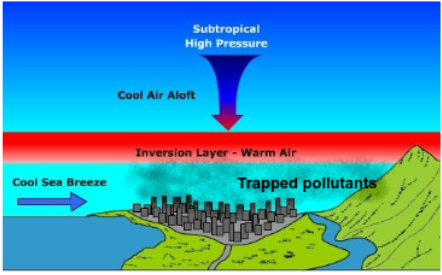
The pollutants are trapped in a layer of air next to the ground. A thermal inversion causes the air to be trapped.
A thermal inversion occurs when cold air near the ground is overlain by warmer air.
During the day, the air warms near the ground. At night, cool, dense air from the ocean slides inland, under the warm air. This sets up the inversion.
Inversion Layer
Warm air
Air Toxics
Lead, formaldehyde, radon and other
radioactive elements, hydrochloric acid, hydrofluoric acid, arsenic, asbestos, and synthetic organic chemicals
The Clean Air Amendment of 1990 lists more than 180 hazardous air toxics that are now regulated.
Since 1977 the lead concentration has dropped more than 97% due to the elimination of leaded gasoline.
Lead substantially reduces IQ, and causes hypertension in adults (high blood pressure).
Indoor Air Pollution
Pollutants can be 5-100x greater than outdoors
Radon, cigarette smoke, carbon monoxide, nitrogen dioxide, formaldehyde pesticides, lead, cleaning solvents, ozone, and asbestos
Most people are more exposed to air toxics indoors than outside
Controlling Air Pollution
Smokestacks with electrostatic
precipitator or scrubbersElectrode imparts negative charge on the
air pollutantsNegatively charged pollutants are then attracted to positively charged walls- fall into collector
Controlling Vehicle Emissions
The procedures that lower CO and VOC emissions (complete combustion, high temperatures) tend to raise NOX emissions
The best solution is the two-stage catalytic converter
Nitrogen oxides are converted in the first stage to N2 by removing oxygen
CO and VOC are removed in the second stage by oxidation to CO2 and H2O
Fine platinum particles catalyze the reactions
Alternative Car Fuels
Modern diesel engines
Alternative fuels: methanol and ethanol
Oxygenation of fuel
Electric cars
Hybrid cars
Fuel cell cars
Fuel Oxygenation
Blending gasoline with ethanol or methanol.
It is used to reduce CO levels by encouraging complete oxidation to CO2
It also reduces VOC emissions
Fuel is burnt less efficiently in a cold engine.
Oxygenates solve this problem