The Endocrine System and Hormonal Functions
 Call Kai
 Learn
Learn Practice Test
 Spaced Repetition
 Match
Match Flashcards
 Knowt Play
1/81

There's no tags or description
Looks like no tags are added yet.
Name | Mastery | Learn | Test | Matching | Spaced | Call with Kai | Chat |
|---|
No analytics yet
Send a link to your students to track their progress
82 Terms
Homeostasis
The maintenance of a stable internal environment within the body.
Nervous System
A system that provides rapid response to change through electrical/chemical signals relayed through neurons.
Endocrine System
A system that provides sustained response to change through hormonal signals relayed through the bloodstream.

Negative Feedback
A process that returns a system to homeostasis by inhibiting or counteracting the stimulus that sets off the response.

Positive Feedback
A process that takes the body further from homeostasis by exaggerating or increasing the stimulus that sets off the response.
Blood Sugar Regulation
An example of negative feedback where blood sugar levels rise after eating, triggering insulin release, which lowers blood sugar levels.

Hypothermia
An example of positive feedback where continued exposure to cold causes the body to draw heat from extremities, leading to further cooling.
Hypothalamus
A gland that regulates the pituitary and is involved in releasing hormones related to growth, metabolism, and reproduction.

Pituitary Gland
Often called the 'master gland', it releases hormones that stimulate other glands to release hormones.

Tropic Hormones
Hormones released from the hypothalamus and pituitary that stimulate other glands to release additional hormones.
Principal Endocrine Glands
Includes the hypothalamus/pituitary complex, thyroid, parathyroid, adrenal glands, and islet cells of the pancreas.

Feedback Loops
Mechanisms through which the endocrine system responds to changes in the internal environment.

Sustained Response
A prolonged reaction to changes in the environment, characteristic of the endocrine system.
Rapid Response
A quick reaction to changes in the environment, characteristic of the nervous system.

Hormonal Signals
Chemical messages released into the bloodstream by the endocrine system to affect whole-body functioning.
Electrical Signals
Nerve impulses that provide rapid communication within the nervous system.
Chemical Signals
Molecules that transmit information between cells, utilized by both the nervous and endocrine systems.
Specific Locations
Areas affected by the nervous system's signals.
Whole-body Functioning
The overall operation of the body, influenced by hormonal signals from the endocrine system.
Secreting Hormones
The process by which glands release hormones that target and affect the function of specific tissues/organs.
Critical Functions
Essential processes in the body, such as growth, metabolism, and reproduction, regulated by hormones.
Hypothalamus
Region of the brain that produces hormones such as oxytocin and ADH, which are stored and released by the posterior pituitary.
Posterior Pituitary
Stores and releases hormones produced by the hypothalamus, specifically oxytocin and ADH.
Anterior Pituitary
Synthesizes hormones including human growth hormone, prolactin, thyroid-stimulating hormone, adrenocorticotropic hormone, follicle-stimulating hormone, and luteinizing hormone.
Adrenal Medulla
Produces epinephrine and norepinephrine, which are involved in the short-term stress response.

Adrenal Cortex
Produces glucocorticoids (e.g. cortisol) and mineralocorticoids (e.g. aldosterone), involved in the long-term stress response.
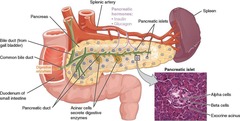
Pancreas
Located behind the stomach; secretes digestive enzymes into the small intestine and hormones for glucose regulation.
Islets of Langerhans
Specialized clusters of cells in the pancreas that secrete hormones responsible for glucose regulation.
Beta Cells
Cells in the pancreas that secrete insulin.
Alpha Cells
Cells in the pancreas that secrete glucagon.
Water Soluble Hormones
Hormones such as proteins, peptides, and amino acid derivatives that cannot cross the lipid membrane and interact with cells by binding to external receptor sites.
Fat Soluble Hormones
Hormones such as steroids that can diffuse across the lipid membrane and bind to receptor sites within the cytoplasm.
Human Growth Hormone (hGH)
Secreted by the anterior pituitary; stimulates production of growth factors from the liver and increases protein synthesis, cell division, and growth.
Thyroxine
Secreted by the thyroid gland; increases the rate at which the body metabolizes fats, proteins, and carbohydrates.

Hypothyroidism
Condition resulting from low thyroxine production.
Hyperthyroidism
Condition resulting from high thyroxine production.
Pituitary Dwarfism
Condition caused by insufficient human growth hormone (hGH) during childhood, affecting growth and development.
Gigantism
Condition resulting from excessive human growth hormone (hGH) production, leading to abnormal growth.
Negative Feedback
Regulatory mechanism in which thyroxine production is controlled by the hormone TSH.
Epinephrine
Hormone produced by the adrenal medulla involved in the short-term stress response.
Norepinephrine
Hormone produced by the adrenal medulla involved in the short-term stress response.
Cortisol
A glucocorticoid produced by the adrenal cortex, involved in the long-term stress response.
Aldosterone
A mineralocorticoid produced by the adrenal cortex, involved in the long-term stress response.
Antagonistic Hormones
Hormones that have opposing effects on the same physiological function.

Thyroxine
A hormone produced by the thyroid that requires iodine for its production.
Iodine
An essential element required by the thyroid to produce hormones such as thyroxine.
Goitre
A condition resulting from constant stimulation of the thyroid gland by TSH due to insufficient iodine, leading to thyroid enlargement.
Calcitonin
A hormone secreted by the thyroid that regulates blood calcium levels by stimulating calcium uptake into bones.
Parathyroid Hormone (PTH)
A hormone secreted by the parathyroid that regulates blood calcium levels by stimulating bone cells to release calcium into the blood.
Negative feedback loop
A regulatory mechanism involving calcitonin and PTH that maintains blood calcium levels.
Epinephrine
A hormone produced by the adrenal medulla that regulates the body's short-term response to stress, known as the 'fight or flight' response.
Norepinephrine
A hormone produced by the adrenal medulla that works alongside epinephrine to manage the body's short-term stress response.
Glucocorticoids
Hormones produced by the adrenal cortex that increase blood sugar and act as anti-inflammatory agents.
Cortisol
A type of glucocorticoid that is involved in the long-term response to stress and increases energy availability by raising blood sugar.
ACTH
Adrenocorticotropic hormone that stimulates the adrenal cortex to release cortisol.
Blood glucose regulation by cortisol
A process where cortisol promotes the breakdown of muscle protein and fat cells to increase glucose levels in the bloodstream.
Mineralocorticoids
Hormones produced by the adrenal cortex that increase blood pressure by enhancing sodium absorption in the kidneys.
Aldosterone
A type of mineralocorticoid that helps regulate blood pressure and fluid balance.
Addison's disease
An autoimmune disease that damages the adrenal cortex, leading to inadequate production of mineralocorticoids and glucocorticoids.
Symptoms of Addison's disease
Include low blood sugar, ion imbalances, low blood pressure, rapid weight loss, and general weakness.
Addison's disease
A condition where the body does not produce enough hormones, particularly affecting blood sugar levels.
Insulin
A hormone secreted by beta cells of the islets of Langerhans that makes cells more permeable to glucose after a meal, thereby decreasing blood glucose.
Glucagon
A hormone secreted by alpha cells of the islets of Langerhans that promotes the breakdown of glycogen in the liver to glucose, increasing blood glucose.
Diabetes mellitus
The inability to produce enough insulin or respond appropriately to insulin, causing blood glucose levels to rise sharply after meals.
Hyperglycemia
A condition characterized by high blood glucose levels, often resulting from insufficient insulin production or response.
Type 1 Diabetes
A form of diabetes diagnosed in childhood where the immune system attacks and destroys the beta cells of the pancreas, leading to decreased insulin production.
Type 2 Diabetes
A form of diabetes that develops over time, often associated with poor diet and lack of exercise, where cell receptors stop responding to insulin.
Antidiuretic hormone (ADH)
A hormone secreted by the posterior pituitary that regulates water reabsorption by kidneys, making nephrons more permeable to water.

Diabetes Insipidus
The inability to produce, store, or properly respond to ADH, resulting in large volumes of urine and risk of dehydration.
Negative feedback mechanisms
Processes that regulate insulin and glucagon to maintain normal blood glucose levels by working antagonistically.
Glycogen
A stored form of glucose in the liver that can be broken down into glucose when needed.
Ketones
Toxic by-products released when the body metabolizes fats and proteins instead of glucose.
Osmotic gradient
The difference in concentration of solutes across a membrane that can lead to changes in urine production.

Caffeine
A diuretic that increases the production of dilute urine by making kidneys less permeable to water.

Nephrons
Functional units of the kidneys that are responsible for filtering blood and producing urine.
Insulin injections
A treatment for diabetes, particularly Type 1, where insulin is administered before meals to manage blood glucose levels.
Sulfonamides
Medications used in the treatment of Type 2 diabetes when cells do not respond appropriately to insulin.
Fatigue
A common symptom in diabetes when cells cannot properly obtain glucose for metabolism.
Dehydration
A condition that can result from diabetes insipidus due to excessive urine production and loss of ions.
Posterior pituitary
The gland that secretes antidiuretic hormone (ADH) to regulate water balance in the body.
Immune system
The body's defense system that can mistakenly attack and destroy insulin-producing beta cells in Type 1 diabetes.
Diet and exercise
Lifestyle factors that can influence the management and treatment of Type 2 diabetes.