D. Polysaccharides
 Call Kai
 Learn
Learn Practice Test
 Spaced Repetition
 Match
Match Flashcards
 Knowt Play
1/105

Earn XP
Description and Tags
Proverbs 16:3
Name | Mastery | Learn | Test | Matching | Spaced | Call with Kai | Chat |
|---|
No analytics yet
Send a link to your students to track their progress
106 Terms
c. Starch
Plant storage polysaccharide.
a. Glycogen
b. Cellulose
c. Starch
d. Dextran
c. Starch
Homopolysaccharide composed entirely of glucose.
a. Inulin
b. Chitin
c. Starch
d. Cellulose
c. Amylose
Linear component of starch.
a. Amylopectin
b. Glycogen
c. Amylose
d. Dextran
d. Amylopectin
Branched component of starch.
a. Cellulose
b. Inulin
c. Amylose
d. Amylopectin
c. α(1→4)
Glucose linkage in amylose.
a. β(1→4)
b. α(1→6)
c. α(1→4)
d. β(1→6)
a. α(1→4) and α(1→6)
Glucose linkages in amylopectin.
a. α(1→4) and α(1→6)
b. β(1→4)
c. β(1→4) and β(1→6)
d. α(1→3) and α(1→6)
c. Amylose
Starch component that gives a dark blue color with iodine.
a. Amylopectin
b. Glycogen
c. Amylose
d. Cellulose
b. Amylopectin
Starch component that gives a violet-brown color with iodine.
a. Glycogen
b. Amylopectin
c. Cellulose
d. Inulin
b. 25%
Approximate percentage of amylose in starch.
a. 10%
b. 25%
c. 50%
d. 75%
d. 75%
Approximate percentage of amylopectin in starch.
a. 25%
b. 40%
c. 60%
d. 75%
Potato (Solanum tuberosum)
Wheat (Triticum aestivum)
Corn (Zea mays)
Rice (Oryza sativa)
Source of starch include _____ [4]
a. Potato (Solanum tuberosum)
Source of starch.
a. Potato
b. Cotton
c. Chicory
d. Mountain ash
a. Wheat (Triticum aestivum)
Source of starch.
a. Wheat
b. Chicory
c. Cotton
d. Manna
d. Corn (Zea mays)
Source of starch.
a. Mountain ash
b. Chicory
c. Cotton
d. Corn
c. Rice (Oryza sativa)
Source of starch.
a. Cotton
b. Barley
c. Rice
d. Chicory
a. Pregelatinized starch
Processed starch in which all parts of the granules are ruptured.
a. Pregelatinized starch
b. Sodium starch glycolate
c. Hydroxyethyl starch
d. Cellulose acetate phthalate
a. Binder
Pharmaceutical use of pregelatinized starch.
a. Binder
b. Lubricant
c. Glidant
d. Preservative
b. Sodium starch glycolate
Pharmaceutical preparation used as a superdisintegrant.
a. Pregelatinized starch
b. Sodium starch glycolate
c. Hydroxyethyl starch
d. Dextran
b. Hydroxyethyl starch (Hetastarch)
Plasma expander available as a 6% solution.
a. Dextran
b. Hydroxyethyl starch (Hetastarch)
c. Inulin
d. Cellulose
b. Cellulose
Major component of the plant cell wall.
a. Glycogen
b. Cellulose
c. Dextran
d. Starch
c. β(1→4)
Glucose linkage in cellulose.
a. α(1→4)
b. α(1→6)
c. β(1→4)
d. α(1→3)
c. Cotton (Gossypium hirsutum)
Source of cellulose.
a. Mountain ash
b. Chicory
c. Cotton
d. Corn
c. Alpha cellulose content
The quality indicator of powdered cellulose where a higher content of insoluble alpha cellulose in NaOH indicates higher quality
a. Beta cellulose content
b. Gamma cellulose content
c. Alpha cellulose content
d. Delta cellulose content
b. Purified absorbent cotton
Preparation obtained by removing wax and seeds from cotton using delinting.
a. Rayon (Viscose)
b. Purified absorbent cotton
c. Pyroxylin (Nitrocellulose)
d. Methylcellulose
b. Protecting wounds and applying solutions
Use of purified absorbent cotton.
a. Tablet coating
b. Protecting wounds and applying solutions
c. Plasma expander
d. Artificial tears
c. 90%
Approximate cotton content of purified absorbent cotton.
a. 50%
b. 70%
c. 90%
d. 100%
c. Pyroxylin
Nitrocellulose.
a. Cellulose acetate phthalate
b. Rayon
c. Pyroxylin
d. Hypromellose
c. Pyroxylin
Formed from the action of nitric acid and sulfuric acid on cotton.
a. Rayon
b. Methylcellulose
c. Pyroxylin
d. Cellulose acetate phthalate
b. Pyroxylin
Soluble gun cotton.
a. Purified absorbent cotton
b. Pyroxylin
c. Rayon
d. Hypromellose
b. Plain collodion
Pyroxylin dissolved in a 3:1 mixture of ether and ethanol.
a. Flexible collodion
b. Plain collodion
c. Rayon
d. Methylcellulose
a. Flexible collodion
“3% castor oil = 3 syllables”
“2% camphor= 2 syllables”
Pyroxylin containing 3% castor oil and 2% camphor.
a. Flexible collodion
b. Plain collodion
c. Cellulose acetate phthalate
d. Rayon
d. Cellulose acetate phthalate (CAP)
Preparation used for film coating tablets.
a. Methylcellulose
b. Purified absorbent cotton
c. Rayon
d. Cellulose acetate phthalate (CAP)
b. Hydroxypropyl methylcellulose
Preparation also known as hypromellose.
a. Methylcellulose
b. Hydroxypropyl methylcellulose
c. Cellulose acetate phthalate
d. Pyroxylin
a. Hydroxypropyl methylcellulose (Hypromellose)
Preparation used as artificial tears.
a. Hydroxypropyl methylcellulose/Hypromellose
b. Rayon
c. Soluble gun cotton/ Pyroxylin
d. Cellulose acetate phthalate
c. Methylcellulose
Preparation used as a laxative.
a. Hydroxypropyl methylcellulose
b. Cellulose acetate phthalate
c. Methylcellulose
d. Pyroxylin
b. Rayon (Viscose)
Regenerated cellulose fibers.
a. Purified absorbent cotton
b. Rayon (Viscose)
c. Cellulose acetate phthalate
d. Pyroxylin
c. Fabric and gauze
Use of rayon (viscose).
a. Artificial tears
b. Tablet coating
c. Fabric and gauze
d. Plasma expansion
b. Rayon
Also known as “Viscose”
a. Purified absorbent cotton
b. Rayon
c. Cellulose acetate phthalate
d. Pyroxylin
a. Higher insoluble alpha cellulose in NaOH
Higher quality powdered cellulose.
a. Higher insoluble alpha cellulose in NaOH
b. Higher soluble beta cellulose in NaOH
c. Higher lignin content
d. Higher hemicellulose content
b. Glycogen
Animal storage polysaccharide.
a. Starch
b. Glycogen
c. Cellulose
d. Dextran
c. Glycogen
Glucan that is more highly branched than starch.
a. Amylose
b. Cellulose
c. Glycogen
d. Inulin
c. Red-violet (wine red)
hindi nag rreact sa I2 kasi highly branched, kayasame lang sa color before treatment
Color produced by glycogen with iodine.
a. Dark blue
b. Violet-brown
c. Red-violet (wine red)
d. Black
b. It is highly branched.
Reason glycogen gives a red-violet (wine red) color with iodine.
a. It contains fructose.
b. It is highly branched.
c. It is composed of β(1→4) linkages.
d. It is insoluble in water.
b. Dextran
Glucan composed of α(1→3) and α(1→6) glucose linkages.
a. Glycogen
b. Dextran
c. Cellulose
d. Amylose
b. Leuconostoc mesenteroides
Microorganism source of dextran.
a. Streptomyces spp.
b. Leuconostoc mesenteroides
c. Lactobacillus acidophilus
d. Escherichia coli
d. Plasma expander
Therapeutic use of dextran.
a. Osmotic diuretic
b. Evaluation of renal function by GFR computation
c. Artificial tears
d. Plasma expander
c. 10%
6% sa other literature
Common concentration of dextran used as a plasma expander.
a. 2%
b. 5%
c. 10%
d. 20%
c. Inulin
Fructan composed entirely of fructose.
a. Dextran
b. Glycogen
c. Inulin
d. Chitin
d. Chicory root (Cichorium intybus)
Source of inulin.
a. Barley
b. Cotton
c. Potato
d. Chicory root
b. Evaluation of renal function by GFR computation
Use of inulin.
a. Plasma expansion
b. Evaluation of renal function by GFR computation
c. Sweetening agent
d. Artificial tears
d. Chitin
Polymer of N-acetylglucosamine (NAG).
a. Cellulose
b. Glycogen
c. Dextran
d. Chitin
c. Chitin
Found in the exoskeleton of animals, insects, mollusks, and arthropods.
a. Inulin
b. Cellulose
c. Chitin
d. Glycogen
c. N-acetylglucosamine (NAG)
Monomer of chitin.
a. Glucose
b. Fructose
c. N-acetylglucosamine (NAG)
d. Galactose
b. Pectin
Composed of various pentoses with galacturonic acid.
a. Cellulose
b. Pectin
c. Inulin
d. Starch
b. Protopectin
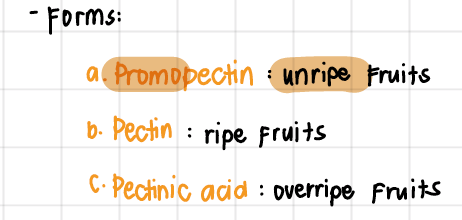
Unripe fruits.
a. Pectinic acid
b. Protopectin
c. Pectin
d. Cellulose
c. Pectin
Ripe fruits.
a. Pectinic acid
b. Protopectin
c. Pectin
d. Cellulose
a. Pectinic acid
overripe fruits.
a. Pectinic acid
b. Protopectin
c. Pectin
d. Cellulose
b. Pectin
Component of anti-diarrheal drug.
a. Acacia
b. Pectin
c. Xanthan
d. Karaya
d. Kaolin + Pectin
Kaopectate.
a. Kaolin + Acacia
b. Kaolin + Tragacanth
c. Kaolin + Xanthan
d.Kaolin + Pectin
a. Bismuth subsalicylate
Kaopectate is replaced by
a. Bismuth subsalicylate
b. Kaolin
c. Pectin
d. Kaolin + Pectin
b. Acacia/Gum arabic (Acacia senegal)
Most resistant to alcohol.
a. Tragacanth
b. Acacia/Gum arabic
c. Karaya
d. Xanthan
b. Acacia (Acacia senegal)
Gum arabic is also known as ______
a. Tragacanth
b. Acacia
c. Karaya
d. Xanthan
b. Acacia/Gum arabic (Acacia senegal)
Suspending agent.
a. Karaya
b. Acacia/Gum arabic
c. Agar
d. Psyllium
a. Acacia senegal
Acacia/Gum arabic SN
a. Acacia senegal
b. Sterculia urens
c. Astragalus gummifer
d. Plantago ovata
b. Tragacanth
Most resistant to hydrolysis.
a. Karaya
b. Tragacanth
c. Acacia
d. Guar
b. Bassorin

Tragacanth constituent responsible for swelling and gelling
a. Tragacanthin
b. Bassorin
c. Algin
d. Agar
a. Tragacanthin
Tragacanth constituent that is non-gelling
a. Tragacanthin
b. Bassorin
c. Algin
d. Agar
b. Vermiform
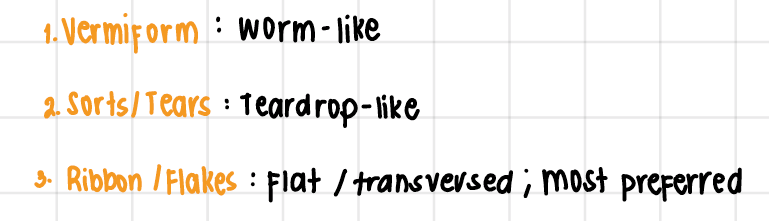
Tragacanth form:
Worm-like
a. Ribbon
b. Vermiform
c. Sorts
d. Flakes
c. Sorts / Tears
Tragacanth form:
Teardrop-like.
a. Ribbon
b. Vermiform
c. Sorts / Tears
d. Flakes
a. Ribbon / Flakes
Tragacanth form:
Flat/transversed
a. Ribbon / Flakes
b. Vermiform
c. Sorts
d. Jorts
a. Ribbon / Flakes
Most preferred Tragacanth form
a. Ribbon / Flakes
b. Vermiform
c. Sorts
d. Jorts
c. Astragalus gummifer
Tragacanth SN
a. Sterculia urens
b. Acacia senegal
c. Astragalus gummifer
d. Plantago ovata
a. Karaya
Least soluble gum.
a. Karaya
b. Acacia
c. Tragacanth
d. Guar
c. Karaya
Fetid gum (unpleasant odor gum).
a. Acacia
b. Xanthan
c. Karaya
d. Agar
a. Karaya + Tragacanth
Part of the laxative Movicol.
a. Karaya + Tragacanth
b. Karaya + Acacia
c. Guar + Acacia
d. Xanthan + Karaya
b. Sterculia urens
Karaya SN
a. Astragalus gummifer
b. Sterculia urens
c. Acacia senegal
d. Plantago ovata
b. Indian/Ghatti gum
Alternative to Acacia.
a. Karaya
b. Indian/Ghatti gum
c. Guar
d. Agar
d. Indian gum
Ghatti gum is also known as _____
a. Karaya gum
b. Agar gum
c. Guar gum
d. Indian gum
b. Anogeissus latifolia
Indian/Ghatti gum SN
a. Sterculia urens
b. Anogeissus latifolia
c. Acacia senegal
d. Ceratonia siliqua
a. Psyllium
Bulk laxative.
a. Psyllium
b. Guar
c. Quince
d. Agar
a. Plantago ovata
Psyllium.
a. Plantago ovata
b. Plantago major
c. Plantago asiatica
d. Plantago lanceolata
b. Quince
Cydonia vulgaris.
a. Guar
b. Quince
c. Psyllium
d. Locust bean
a. Guar
Cyamopsis tetragonolobus.
a. Guar
b. Psyllium
c. Quince
d. Karaya
d. Locust bean
Chocolate substitute.
a. Psyllium
b. Quince
c. Guar
d. Locust bean
d. Locust bean
Also known as “Carob pulp”
a. Psyllium
b. Quince
c. Guar
d. Locust bean
d. Locust bean
Also known as “St. John's Bread”
a. Psyllium
b. Quince
c. Guar
d. Locust bean
c. St. John's Bread/Carob pulp/Locust bean
Also known as “Ceratonia siliqua”
a. Quince
b. Guar
c. St. John's Bread/Carob pulp/Locust bean
d. Psyllium
a. Agar
From red algae.
a. Agar
b. Algin
c. Xanthan
d. Karaya
a. Agar
Also known as “Japanese Isinglass”
a. Agar
b. Algin
c. Xanthan
d. Karaya
d. Agar
Gelidium cartilagineum
a. Algin
b. Xanthan
c. Carrageenan
d. Agar
d. Agar
Gracilaria confervoides
a. Algin
b. Xanthan
c. Carrageenan
d. Agar
b. Agar
Culture media components.
a. Algin
b. Agar
c. Carrageenan
d. Acacia
c. Algin
From brown algae.
a. Agar
b. Carrageenan
c. Algin
d. Xanthan
b. Algin
Macrocystis pyrifera.
a. Agar
b. Algin
c. Karaya
d. Guar
c. Alginate
Raft-forming antacid.
a. Carrageenan
b. Agar
c. Alginate
d. Xanthan
c. Algin
Cast for measurement of dentures.
a. Xanthan
b. Carrageenan
c. Algin
d. Guar
b. Carrageenan
Irish Moss is also known as _____
a. Agar
b. Carrageenan
c. Algin
d. Xanthan
a. Carrageenan
Also known as “Chondrus crispus”
a. Carrageenan
b. Agar
c. Algin
d. Guar
b. Carrageenan
Also known as “Gigartina mamillosa”
a. Agar
b. Carrageenan
c. Xanthan
d. Karaya
e. Two of the above
Kappa
Lota
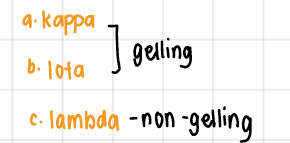
Gelling carrageenan form
a. Lambda
b. Kappa
c. Lota
d. None of the forms
e. Two of the above