Biomed II Lab Quiz #5
 Call Kai
 Learn
 Practice Test
 Spaced Repetition
 Match
 Flashcards
 Knowt Play
1/28

There's no tags or description
Looks like no tags are added yet.
29 Terms

SHEEP EYE - B
Cornea

SHEEP EYE - C
Sclera

EYE MODEL - D
Iris

EYE MODEL - D
Choroid coat
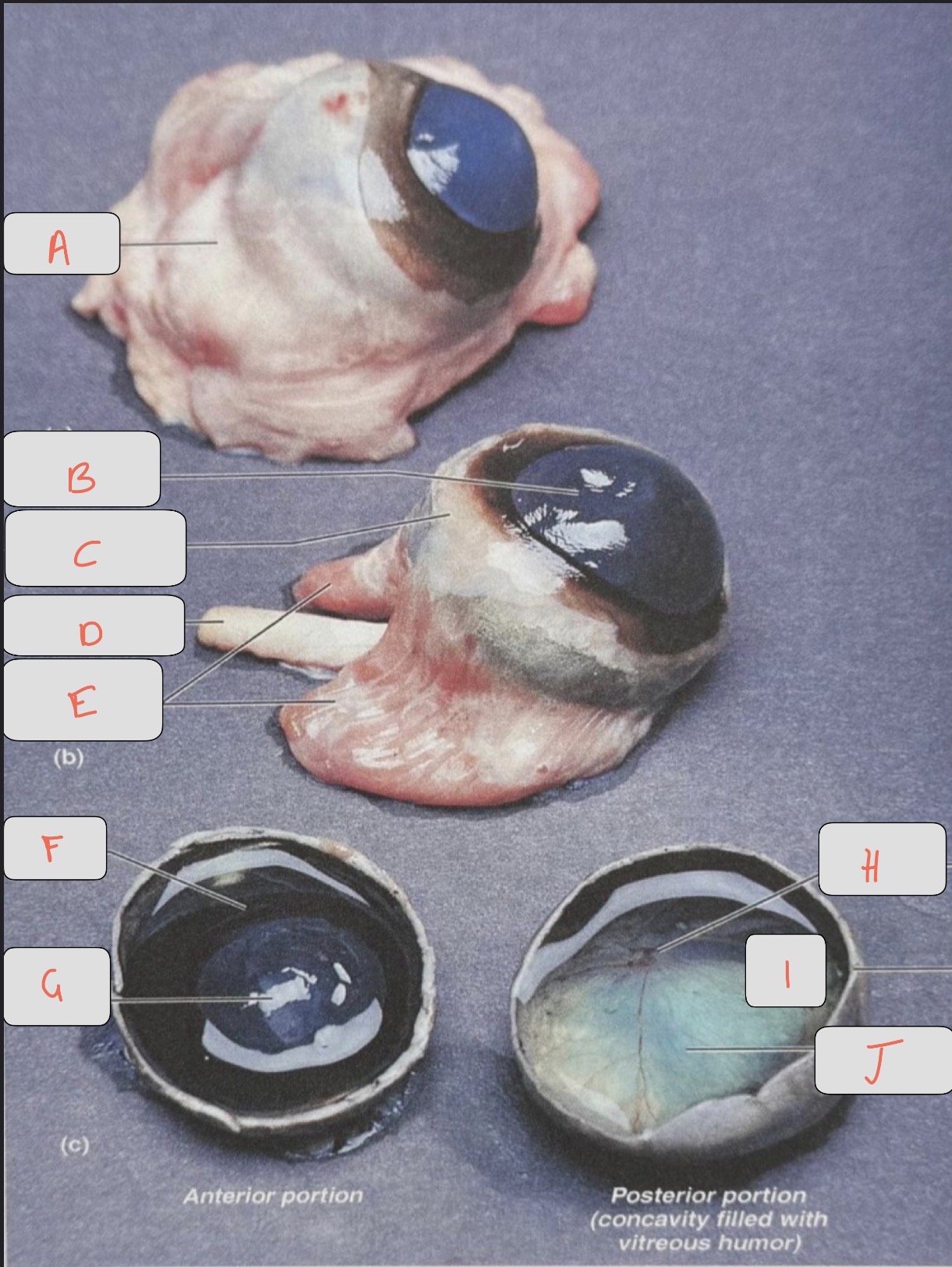
SHEEP EYE - J
Retina

SHEEP EYE - G
Lens

Macula lutea

EAR MODEL- E
External acoustic meatus

EAR MODEL - F
Tympanic membrane
What does the tympanic cavity contain?
The auditory ossicles (Hammer, anvil, stirrup)

Ear model - J
Pharyngotympanic tube

EAR MODEL - BLUE
semicircular canals

EAR MODEL- STAR
Cochlea

LYMPHATIC SYSTEM - A
Thymus

LYMPHATIC SYSTEM - C
Spleen

Pituitary gland

Thyroid gland

A
Pancreas

A
Adrenal gland

Testis
What is the blind spot?
A small area on the retina of the eye where the optic nerve connects and exits. This area lacks light-sensitive rods and cones, meaning it cannot detect light.
What is astigmatism?
a very common eye condition that causes blurry or distorted vision because the front surface of the eye or the lens inside is shaped more like a football than a round basketball
What does the cillary body help with?
Contraction
What is the Snellen chart?
Displays letters of progressively smaller size to measure test subjects sight/normal persons sight
Normal Vision
20/20 vision. This means that the test subject sees the same line of letters at 20 feet that a normal person sees at 20 feet.
Nearsighted/myopa
20/40 vision. The test subject sees at 20 feet what a normal person sees at 40 feet. (wide)
Farsighted/hyperopia
20/15 vision - a person can see objects at 20 feet that a person with 20/20 vision can only see at 15 feet. (Longer)
What does the corrective lens for myopic eye do?
Concave lens moves focal point further back
Hyperopic correctic lens
Convex lens moves focal point forward