cognitive neuroscience methods
 Call Kai
 Learn
 Practice Test
 Spaced Repetition
 Match
 Flashcards
 Knowt Play
1/28

There's no tags or description
Looks like no tags are added yet.
29 Terms
neurotransmitters
messages are passed via neurotransmitters
excitatory - cause the neuron to fire
action potential
what is cognitive neuroscience
the study of how brain structured and processes mediate cognitive behaviour
objectives of cognitive neuroscience
understanding - how the mind is created by the brain, links between cognition and neuroscience
build - models of how the brain works
establish - which brain regions and brain circuits are involved in different tasks, what changes in the brain as a consequence of learning
investigate - brain imaging, activity produced during cognition
challenges for cognitive neuroscience
complex systems - around 1 mil neurons in 1 cubic mm of brain
signal to noise ratio - needle in a haystack
between individual differences - experience, individual variability
within-individual differences - strategy, mood, task difficulty
techniques
brain structure
anatomical dissection
structural magnetic resonance imaging
brain function
single electrode stimulation
scalp-located electrodes - EEG, ERP
functional MRI (fMRI)
magneto-encephalography (MEG)
positron emission tomography (PET)
transcranial magnetic stimulation (TMS)
neuropsychology
data from individuals with brain damage
MRI
hydrogen atoms like constantly spinning magnets
align when in a scanner’s magnetic field
then radio waves sent in to make them face in a new direction
when they relax and return to their previous alignment, they emit energy (i.e. ‘resonance’)
this energy is what the scanner uses to create an image
MRI scans
static structure of the brain
hydrogen atoms in different tissues have different relaxation times and can be identified separately
the lower the water content of an area, the fewer hydrogen atoms there will be emitting signals
the weaker the signal, the darker the area appears on the scan
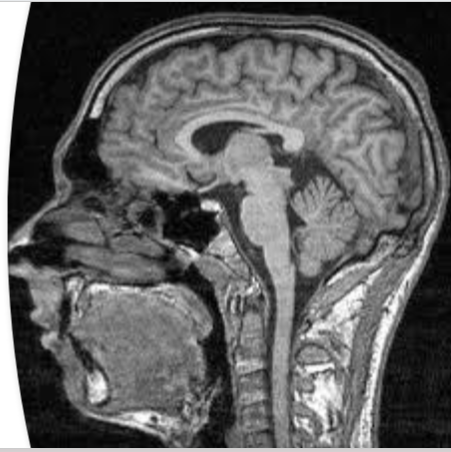
advantages of MRI
excellent spatial resolution
allows you to view the brain from multiple angles
non-invasive
excellent for looking at soft tissue
disadvantages of MRI
no temporal information
negative experience - noisy, have to stay very still, claustrophobic
expensive
older metal implants are not compatible
FMRI
not just structure but function
based on the same technique as MRI (magnets and radio waves)
but interested in blood flow in the brain
blood contains haemoglobin which contains iron which is magnetic
deoxygenated blood is affected by a magnetic field differently than oxygenated blood
when neurons are active, they burn energy - this is automatically replenished via oxygen carried by haemoglobin in the blood stream
active parts of the brain contain more oxygen-rich blood
by measuring the BOLD (blood oxygen level dependent) response in the MRI scanner, we can work out which parts of the brain were active recently
diamagnetic vs paramagnetic
haemoglobin is diamagnetic when oxygenated but paramagnetic when deoxygenated
diamagnetic = has a weak magnetic field
paramagnetic = has a strong magnetic field
this is called the BOLD response - Blood Oxygen Level Dependent
Piaget’s conservation of numbers task
2.5% of the 5-6 year olds could conserve numbers
99.7 of the 9-10 year olds could conserve numbers
but
our brains process a vast amount of information and perform multiple tasks at the same time so how can we tell if the brain activity is purely related to conservation?

conservation task - control experiment
closely matches main experiment
allows us to pinpoint what brain activity is related to extraneous processes e.g. visual information and environmental noises not related to the concept we’re interested in
both groups were accurate on the colour task

advantages of fMRI
excellent spatial resolution
reasonable temporal resolution
non-invasive
tells us which parts of the brain are used in tasks
disadvantages of fMRI
BOLD isn’t a direct measure of activity and care should be taken interpreting it
experience - noisy, have to stay very still, claustrophobic
expensive
can’t have any metal-based equipment for stimulus presentation
positron emission tomography (PET)
measures blood flow in the brain - more blood flow in active areas
inject, inhale or swallow a mildly radioactive drug (tracer) which is absorbed into the blood stream
measure how much of the tracer goes where in brain
higher levels of activity show up as bright spots
can also be used to evaluate certain brain disorders, such as tumours, Alzheimer’s disease and seizures
advantages of PET
reasonable structural resolution
direct reflection of activity
no motion artifacts
more comfortable experience than MRI/fMRI
disadvantages of PET
no temporal resolution
expensive
injection of radioactive substance so ethical issues
may need to do MR or CT as well
electroencephalography (EEG)
measures electrical signals generated by the brain through electrodes placed at the scalp
EEG signals are produced by partial synchronisation of cortical field activity and are measured as changes in voltage recorded at the scalp over time
how are EEG signals detected
electrodes are placed on the scalp, connected with gel or conductive solution
EEG signals are transported to an amplifier
the amplifier measures the difference in voltage between the active electrode and a reference electrode
advantages of EEG
very good temporal resolution
direct reflection of activity
not claustrophobic - can even be used by infants
disadvantages of EEG
poor spatial resolution
motion artifacts
inverse problem - how can we be sure which brain regions generated the electrical activity?
magnetoencephalogram (MEG)
the pryamidal cells of the cortex, when active, generate a significant magnetic field
for both EEG and MEG, the synchronous firing of 10,000 neurons is required to produce a field which is large enough to measure
magnetic fields are less distorted by the scalp than electrical fields
advantages of MEG
excellent temporal resolution
direct reflection of activity
good spatial resolution especially if combined with MRI
disadvantages of MEG
expensive
inverse problem - how can we be sure which brain regions generated the electrical activity
brain legions - neuropsychology
lesion patients
e.g. Phineas Gage
injured 1840s
no impairment of language, intelligence, movement or memory
irresponsible, disregard for social conventions
transcranial magnetic stimulation (TMS)
uses a changing magnetic field to induce weak electric currents in the cortex
noni- - invasive method causing depolarisation or hyperpolarisation
advantages of TMS
near portable
can stimulate or lesion
disadvantages of TMS
difficut to specify precise regions
ony durfave reaion