Denial is a river in egypt (copy)
 Call Kai
 Learn
 Practice Test
 Spaced Repetition
 Match
 Flashcards
 Knowt Play
1/41

There's no tags or description
Looks like no tags are added yet.
42 Terms
Which of the following should be withheld for 48 hours before bronchial challenge testing?
A. Theophylline
B. B-Adrenergic agents
C. Anticholinergic preparations
D. Beverages containing caffeine
A. Theophylline
A subject performing a methacholine challenge test has the following reproducible results:
FEV1 (baseline) 3.3 L
FEV1 (control) 3.2 L
FEV1 (0.0625 mg/ml) 3.2 L
FEV1 (0.25 mg/ml) 2.2 L
The technologist should do which of the following?
A. Repeat methacholine 0.25 mg/ml dose.
B. Administer methacholine 1.0 mg/ml.
C. Give 10 breaths of the next dose.
D. Stop—the test is positive.
D. Stop - the test is positive.
A patient has a eucapnic voluntary hyperventilation (EVH) test to evaluate bronchial hyperreactivity. If the subject’s FEV1 is 3.3 L and her FVC is 4.0 L, which of the following
is the appropriate target ventilation for the test?
A. 50 times the FEV1 for 1 minute
B. 30 times the FEV1 for 6 minutes
C. 2 times the FVC for 6 minutes
D. Cannot be determined without the MVV
B. 30 times the FEV1 for 6 minutes.
Which of the following changes in sGaw is consistent with increased airway reactivity?
A. Increase of 20% after inhalation of histamine
B. Decrease of 15% after inhalation of methacholine
C. Decrease of 35% after inhalation of histamine
D. Increase of 15% after cold air inhalation challenge
C. Decrease of 35% after inhalation of histamine.
Which of the following are true concerning withholding bronchodilators before bronchial challenge testing?
1. Cromolyn sodium should be withheld for 8 hours.
2. Long-acting inhaled -agonists should be withheld for 24 hours.
3. Sustained action theophylline should be withheld for 48 hours.
4. Anticholinergic agents should be withheld for 24 hours.
A. 1 and 2
B. 3 and 4
C. 1 and 3
D. 2 and 4
D. 2 and 4
A subject performing a methacholine challenge test has the following reproducible results:
FEV1 (baseline) 3.3 L
FEV1 (diluent) 2.8 L
The technologist should do which of the following?
A. Administer the first dose of methacholine.
B. Administer 2.50 mg/ml dose of methacholine.
C. Stop—the test is positive.
D. Administer an inhaled bronchodilator.
A. Administer the first dose of methacholine.
After 5 minutes of hyperventilation breathing cold air, a subject’s FEV1 falls 16% from the
pre-test value. The pulmonary function technologist should conclude that:
A. The subject has hyperreactive airways.
B. The air was not cold enough to provoke a response.
C. An additional 5 minutes of hyperventilation is required.
D. Inadequate CO2 was added to the inspired gas.
A. The subject has hyperreactive airways.
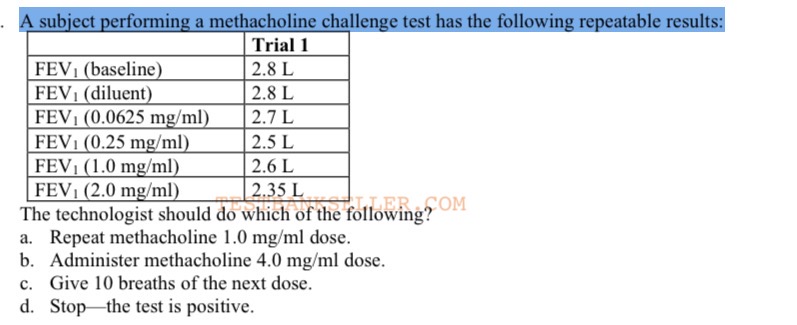
B. Repeat methacholine 1.0 mg/ml dose.
A 15-year-old subject performs an exercise challenge test on a treadmill to a heart rate of 180 beats per minute for 5 minutes and has the following reproducible results:
FEV1 (baseline) 3.5 L
FEV1 (after exercise) 3.0 L
The technologist should do which of the following?
A. The workload was not significant enough to elicit a response.
B. The duration was not significant enough to elicit a response.
C. The results were negative for exercise-induced bronchospasm.
D. The results were positive for exercise-induced bronchospasm.
D. The results were positive for exercise-induced bronchospasm.
What is the typical inspiratory gas mixture when performing a eucapnic voluntary hyperventilation study?
A. 5% CO2, 21% O2, balance N2
B. 10% CO2, balance O2
C. 5% CO2, balance O2
D. 10% CO2, 21% O2, balance N2
A. 5% CO2, 21% O2, balance N2
Which of the following is a direct bronchoprovocation test?
A. Methacholine
B. Mannitol
C. Adenosine
D. Exercise
A. Methacholine
When multiple methods of bronchoprovocation are ordered on the same day, how many hours after an exercise test should elapse before another test is performed?
A. 1
B. 2
C. 3
D. 4
D. 4
Which of the following patients would be at greatest risk for postoperative complications after a lung resection?
A. A patient with FEV1 of 1.65 L
B. A patient with MVV of 74% of predicted
C. A patient with PaCO2 of 35 mm Hg
D. A patient with VO2max of 9 ml/min/kg
D. A patient with VO2max of 9 ml/min/kg
A patient referred for exercise testing for disability determination should have which of the following?
A. Six-minute walk with pulse oximetry to document hypoxemia
B. Five minutes of treadmill exercise at 1.7 mph, 10% grade
C. Four to 6 minutes of treadmill exercise at 5 METs with blood gases
D. Cycle ergometer exercise at 85% predicted maximum HR with pulse oximetry
C. Four to 6 minutes of treadmill exercise at 5 METs with blood gases
An indirect calorimetry system uses a dilution technique that mixes a constant flow of entrained air with expired gas. This technique allows determination of which of the
following?
A. Exhaled ventilation
B. End-tidal CO2
C. VD/VT
D. FEO2
A. Exhaled ventilation
Which of the following findings indicate that indirect calorimetry data may be
unacceptable?
1. Data were collected for 5 minutes.
RQ 0.61
3. VCO2 varies by 10%.
4. VO2 varies by 6%.
A. 1 and 3
B. 2 and 4
C. 1, 2, and 3
D. 2, 3, and 4
C. 1, 2, and 3
The VC may decrease as much as _____ after thoracic or upper abdominal surgery.
A. 10%
B. 20%
C. 50%
D. 90%
C. 50%
Which of the following blood gas values suggests an increased incidence of postoperative
complications?
A. pH of 7.46
B. PaO2 of 69 mm Hg
C. PaCO2 of 59 mm Hg
D. COHb of 4.5%
C. PaCO2 of 59 mm Hg
A patient has his or her resting energy expenditure (REE) measured while breathing from a spirometer that has been filled with O2. This technique is described as:
A. Open-circuit calorimetry
B. Closed-circuit calorimetry
C. Bias-flow calorimetry
D. The Consolazio method
B. Closed-circuit calorimetry
A patient has a metabolic study performed with the following results:
VO2 300 ml/min
VCO2 270 ml/min
If the patient’s 24-hour urinary nitrogen (UN) is 22 g/24 hours, what is the approximate REE?
A. 1480 kcal/24 hours
B. 2084 kcal/24 hours
C. 2132 kcal/24 hours
D. 2666 kcal/24 hours
A. 1480 kcal/24 hours
A patient with COPD has been difficult to wean from mechanical ventilation. To minimize CO2 production, the caloric intake of the patient should consist mainly of:
A. Protein
B. Carbohydrate
C. Fat
D. Glucose
C. Fat
What type of analyzer is used in a nitric oxide measuring device?
A. Thermoconductivity
B. Polarographic
C. Infrared
D. Chemoluminescent
D. Chemoluminescent
In which of the following would you suspect an elevated FENO?
1. Asthma
2. Bronchitis
3. Smokers
4. Sarcoidosis
A. 1 only
B. 1 and 2
C. 1, 2, and 3
D. 1, 2, and 4
D. 1, 2, and 4

A. Report the mean of the two trials.
What does an elevated exhaled nitric oxide represent?
A. Increased airway muscle tone
B. Airway inflammation
C. Pulmonary vascular hypertension
D. Pulmonary edema
B. Airway inflammation
A 3-L syringe is used to calibrate a flow-sensing spirometer; the spirometer reads a volume of 3.04 L. The software correction factor for this system would be which of the following?
A. 0.95
B. 0.99
C. 1.01
D. 1.04
B. 0.99
According to ATS recommendations, the range and accuracy for a diagnostic spirometer should be which of the following?
A. 0 to 14 L with less than 1.5 cm H2O/L/sec resistance
B. 0.5 to 8 L ± 3% of reading or ± 0.05 L, whichever is greater
C. 0.5 to 6 L ± 5% of reading or ± 0.1 L, whichever is greater
D. 0.1 to 5 L ± 3% of reading or ± 0.05 L, whichever is greater
B. 0.5 to 8 L ± 3% of reading or ± 0.05 L, whichever is greater
An automated blood gas analyzer displays acceptable calibrations with no electrode drift noted. Multiple-level QC shows values for PCO2 and PO2 that are within 2 SD of the mean, but all pH values are more than 3 SD above the mean. Which of the following is most likely the cause?
A. Buffers are contaminated.
B. Calibration gas is contaminated.
C. Analyzer temperature is not 37° C.
D. Gas-liquid correction factor is set too low.
A. Buffers are contaminated.
Tonometry of whole blood may be used to provide QC for which of the following?
A. PO2 and PCO2 electrodes
B. PCO2 and pH electrodes
C. PO2 electrode only
D. pH electrode only
A. PO2 and PCO2 electrodes

Quality control run on a PO2 electrode shows the following results when plotted on a QC chart:
D. Random Error
Which of the following are true regarding infection control of pulmonary function equipment?
1. Disposable mouthpieces and noseclips should be used.
Tubing or valves through which the patient rebreathes should be changed weekly.
Volume-displacement spirometers should be flushed five times between patients.
Spirometers should be calibrated with bacteria filters in place.
A. 1 and 2
B. 3 and 4
C. 1, 2, and 3
D. 1, 3, and 4
D. 1, 3, and 4
Multiple injections from a 3-L syringe into a flow-based spirometer produce an average reading of 2.92 L. This value indicates:
A. The spirometer has a leak.
B. The spirometer meets ATS accuracy requirements.
C. Excessive flows were used for calibration.
D. The spirometer should not be used for pediatric patients.
B. The spirometer meets ATS accuracy requirements.
According to ATS recommendations, the acceptable “back pressure” (flow resistance) from a spirometer is less than _____ cm H2O at _____ L/sec.
A. 3.0; 7
B. 3.0; 14
C. 1.5; 7
D. 1.5; 14
D. 1.5; 14
An automated blood gas analyzer performs two-point calibrations that match expected values. Subsequent quality control runs show unacceptable values for PO2 and PCO2, but pH is acceptable. Which of the following is the most likely problem?
A. Contaminated buffers
B. Contaminated calibration gas
C. Analyzer temperature not at 37° C
D. Computer error
B. Contaminated calibration gas
Which of the following control materials would be best suited for quality control of a PO2 electrode used to measure O2 tensions less than 50 mm Hg?
A. Fluorocarbon-based control
B. Aqueous-based control
C. Tonometered buffer
D. Tonometered whole blood
D. Tonometered whole blood
Quality control runs on a PCO2 electrode have produced a mean of 40 mm Hg ± 2 mm Hg (1 SD). What are the chances of obtaining a value of 45 mm Hg on a control run if the electrode is functioning properly?
A. 95%
B. 50%
C. 5%
D. Less than 1%
C. 5%
Which of the following pieces of pulmonary function equipment must be disinfected
between patient uses?
1. Water seal spirometers
2. Dry rolling-seal spirometers
3. Spirometry tubing
4. Small-volume nebulizers for bronchodilator studies
a. 1 and 3
b. 2 and 4
c. 1 and 2
d. 3 and 4
D. 3 and 4
Standard precautions recommend that:
1. Gloves should be worn only for HIV- or hepatitis B–infected blood.
2. Used needles should not be resheathed.
3. Lab coats or gowns should be worn for handling blood.
4. Hands should be washed after removing gloves.
a. 1 and 2
b. 3 and 4
c. 1, 2, and 3
d. 2, 3, and 4
D. 2, 3, and 4
A control is:
A. A device for adjusting the output of a transducer
B. Any test signal used to measure accuracy or precision
C. A set of rules that determine what procedures to follow
D. A random sample from the population that is routinely tested
B. Any test signal used to measure accuracy or precision
According to 2005 ATS-ERS recommendations, calibration syringes should be accurate to within (±):
a. 3.5%
b. 0.5%
c. 20 ml
d. 30 ml
B. 0.5%
While performing a calibration check of a spirometer using a 3.00-L syringe, 2.84 L is measured. What should you do next?
a. Proceed with testing subjects.
b. Add 0.16 L to all subject measurements.
c. Check for leaks and recheck calibration.
d. Turn on the BTPS correction and recheck calibration.
c. Check for leaks and recheck calibration.
According to ATS-ERS recommendations, what three flow rates are required to calibrate a flow sensor?
A. 0.5 L/sec, 4.0 L/sec, 6.0 L/sec
B. 1.5 L/sec, 3.0 L/sec, 6.0 L/sec
C. 0.5 L/sec, 3.0 L/sec, 12.0 L/sec
D. 1.0 L/sec, 4.0 L/sec, 12.0 L/sec
C. 0.5 L/sec, 3.0 L/sec, 12.0 L/sec