07physical activity dimensions and assessments
 Call Kai
 Learn
 Practice Test
 Spaced Repetition
 Match
 Flashcards
 Knowt Play
1/22

There's no tags or description
Looks like no tags are added yet.
23 Terms
How are physical activity, exercise and physical fitness defined, and how do they differ?
Physical activity (WHO 2020): any bodily movement produced by skeletal muscles that requires energy expenditure. Slide keywords: every unplanned movement, no special goal.
Exercise (Caspersen 1985): a specific type of physical activity that is planned, structured and repeatedly done to improve or maintain physical fitness. Slide keywords: planning, focus on the goal.
Physical fitness (Caspersen 1985): the ability to carry out daily tasks with vigor and alertness, without undue fatigue and with ample energy for unforeseen emergencies. Slide keywords: execution, little strain visible
[Merksatz (meine Erklärung): Aktivität = alles, was Energie kostet. Exercise = geplante Aktivität mit Ziel. Fitness = Leistungsfähigkeit, also ein Zustand, keine Tätigkeit.]
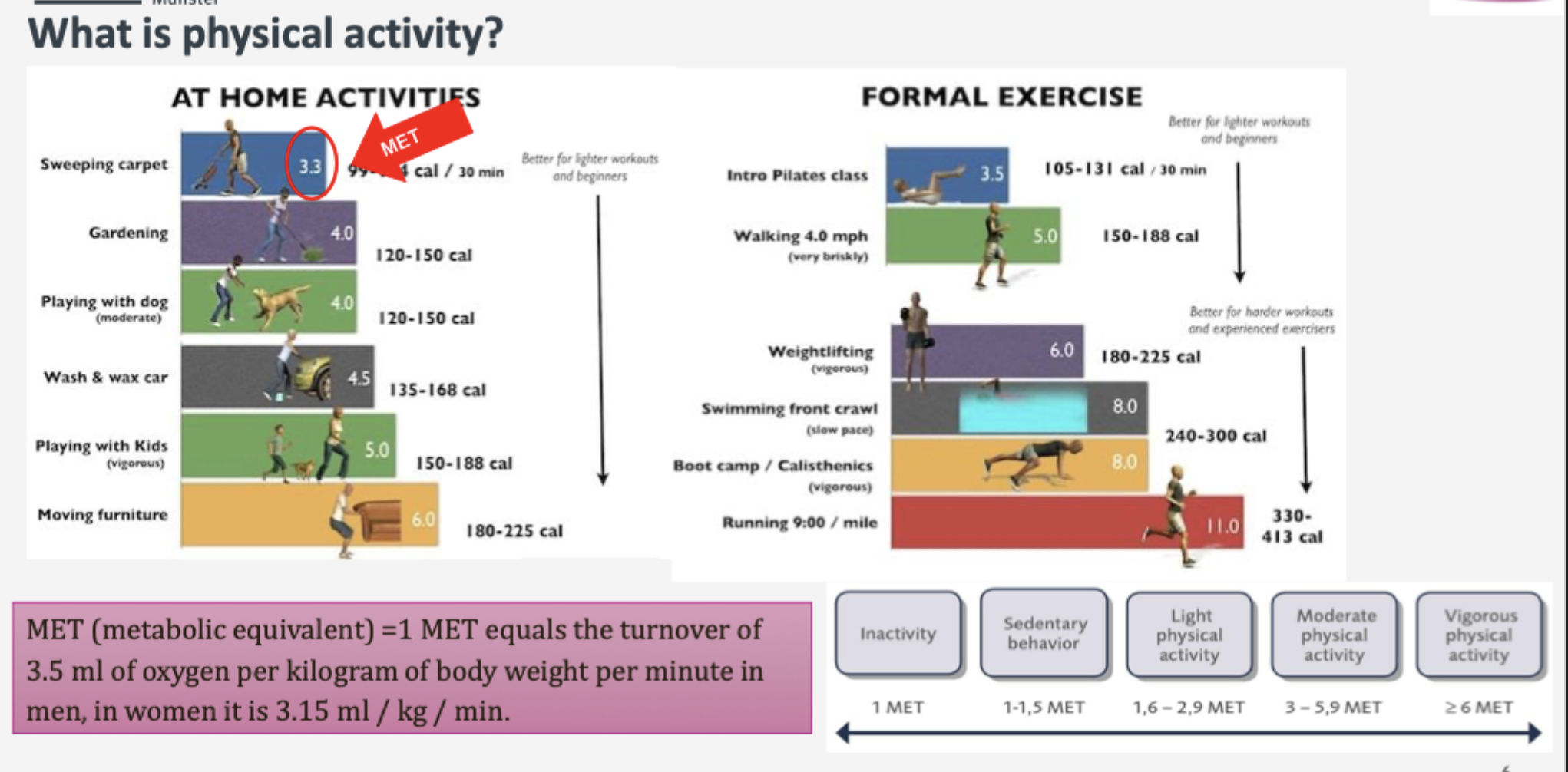
What is a MET, and how are intensity categories defined?
1 MET = turnover of 3.5 ml O₂ per kg body weight per minute in men, 3.15 ml/kg/min in women (slide). Categories:
Inactivity: 1 MET
Sedentary behavior: 1–1.5 MET
Light PA: 1.6–2.9 MET
Moderate PA: 3–5.9 MET
Vigorous PA: ≥ 6 MET
What are strengths and limitations of heart rate monitoring (telemetry)?
Heart rate is a good proxy for intensity if context and calibration are controlled.
Strengths: objective and continuous (frequency, intensity, duration), quick to apply in the field, shows the individual load of the body.
Limitations: confounded by non-physical factors (stress, caffeine, heat raise HR without activity), needs calibration (individual resting and maximal HR), costly for large samples and weak for anaerobic activities
What is an accelerometer, and what are its strengths and limitations?
An electronic device that assesses the acceleration of the body in certain directions and provides frequency, duration and intensity, minute by minute, over days (e.g. time in moderate/vigorous PA).
Strengths: detailed and objective, non-invasive and simple, long measurement periods.
Limitations: cost and limited use in large numbers, inaccurate for some activities (incline walking, weight training), measures movement, not physiology (no direct information on body load)
What is a pedometer, and what are its strengths and limitations?
The original motion sensor. It counts steps (slide: using a metronome that detects vertical movement) and measures distance if the stride length is known. 10,000 steps is considered equivalent to meeting the national PA guidance.
Strengths: inexpensive, non-invasive, easy for large groups, measures a common activity, can promote behavioural change.
Limitations: restricted to walking, less accurate when running or jogging, can be tampered, potentially reactive(wearing it may change the behaviour itself).
What are recall surveys (IPAQ, GPAQ), and what are their strengths and limitations?
They are less likely to influence behaviour and need less effort than diaries/logs, take 5–15 minutes, and give basic data on PA patterns in large populations.
Strengths: inexpensive and easy, large sample sizes, range of data (qualitative and quantitative).
Limitations: misinterpretation (questions understood differently), subjectivity or bias (answers reflect perceptions, not measurement), socially desirable answers
What are subjectieve measures?
They depend on our perceptions (what we think, feel, value) and are predominantly used for populations. They generally come as a diary or log that records the individual activities a person performs in a day, and they provide context, behaviour patterns, intensity and duration.
What is direct observation, and what are its strengths and limitations?
It measures PA type, time and place (context). It is the most accurate of all objective measures, but the least practical. Tools: BEACHES, SOFIT, SOPLAY (for children and youth, fitness lessons, play and leisure).
Strengths: detailed qualitative and quantitative data, targets specific behaviours, software-supported.
Limitations: labour-intensive (training needed, few participants), potentially reactive (being observed may change behaviour), confined settings (e.g. a playground)
B- BEACHES
Behaviors of Eating and Activity for Children’s Health-Evaluation System
B - SOFIT
System for Observing Fitness Instruction Time
B - SOPLAY
System for Observing Play and Leisure Activity in Youth
What is total energy expenditure (Ausgaben) (TEE) made of?
TEE = BMEE + PAEE + TEF
BMEE (basal metabolic energy expenditure = resting energy expenditure): about 65 %
PAEE (physical activity energy expenditure): about 25 %
TEF (thermic effect of food): about 10 %

B - What is the doubly labeled water method?
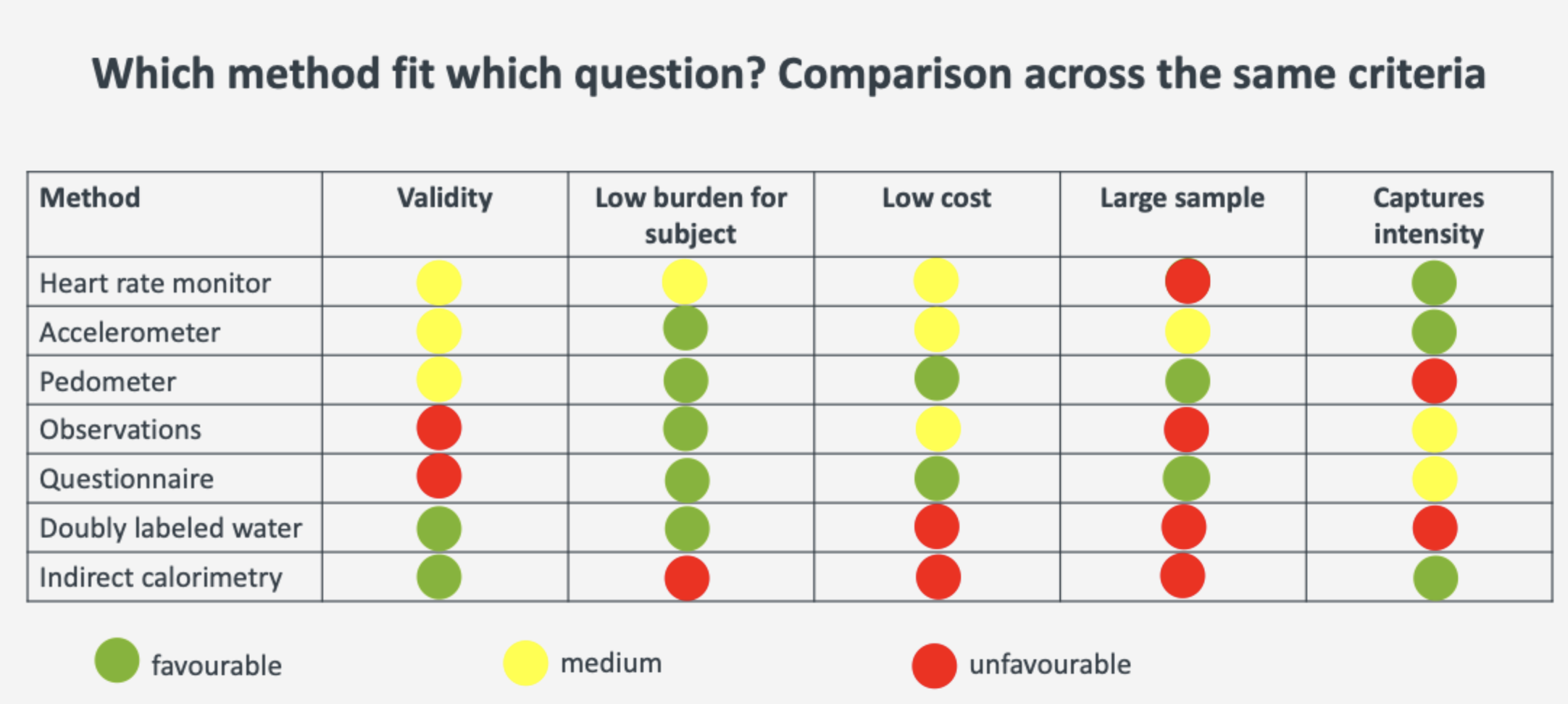
A technique that uses water labelled with ²H₂¹⁸O and measures the difference between the oxygen that stays in the body as H₂O and the oxygen that leaves as CO₂ (slide). In the comparison table: valid and low burden, but costly, not for large samples, does not capture intensity.
[Im Kern wird gemessen, wie schnell das markierte Wasserstoff- und Sauerstoff-Isotop den Körper verlassen. Die Differenz entspricht der CO₂-Produktion]

B - How does indirect calorimetry rate in the comparsion?
Valid and captures intensity, but high burden for the subject, costly, not suited for large samples

Which methods are objective vs. subjective, and how do cost and sample size relate?
Purposes: individual/clinical, intervention program, descriptive/needs assessment or cohort study, population monitoring.
Objective: heart rate, observation, accelerometer, pedometer
Subjective: diary/log, questionnaires/survey (global, usual, recall)
Trade-off: few participants ↔ high cost, many participants ↔ low cost

What are the three categories of PA assessment methods according to Müller et al.?
Category I: doubly labeled water, indirect calorimetry (IC), direct observation
Category II: heart-rate monitor, ADL-monitor, accelerometer, pedometer
Category III: questionnaire, interview, diary (subjective)
From I to III, costs/effort fall and the number of participants rises.

What is the relationship between validity and feasibility?
A trade-off: the more valid a method, the less feasible it is. Questionnaires/diaries are very feasible but less valid, and doubly labeled water and indirect calorimetry are highly valid but hardly feasible. Pedometer, heart rate monitor and accelerometer lie in between.
(ADL-Monitors)

How do the methods compare across the criteria?
Lernhilfe (meine Zusammenfassung): Valide, aber teuer und nicht für große Gruppen: doubly labeled water und indirect calorimetry. Billig und für große Gruppen: pedometer und questionnaire (dafür nicht valide bzw. keine Intensität). Intensität erfassen heart rate und accelerometer.
[Achtung bei Single Choice: Die Tabelle bewertet die Validität von Observations mit rot, Seite 22 nennt sie aber "the most accurate of all objective measures". Bei Tabellenfragen gilt die Tabelle, bei der Frage nach der genauesten objektiven Methode S. 22]
What is the physical activity paradox?
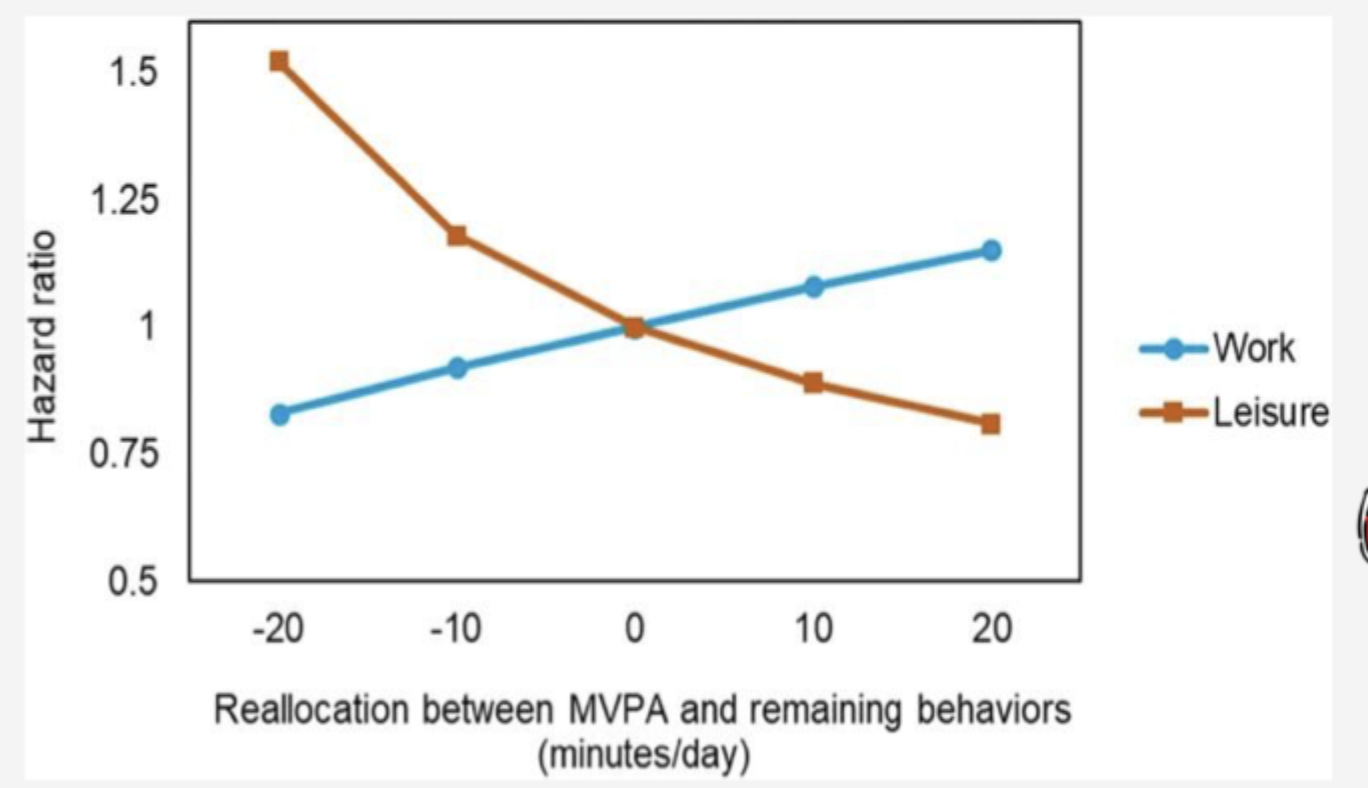
Leisure-time and occupational PA relate differently to health. Reallocating minutes to MVPA (moderate-to-vigorous PA) in leisure goes with a lower hazard ratio (about 1.5 → 0.8 from −20 to +20 min/day). At work it goes with a higher hazard ratio (about 0.8 → 1.15).
How do leisure and work physical activity differ in characteristics, physiological response and cardiovascular effect?
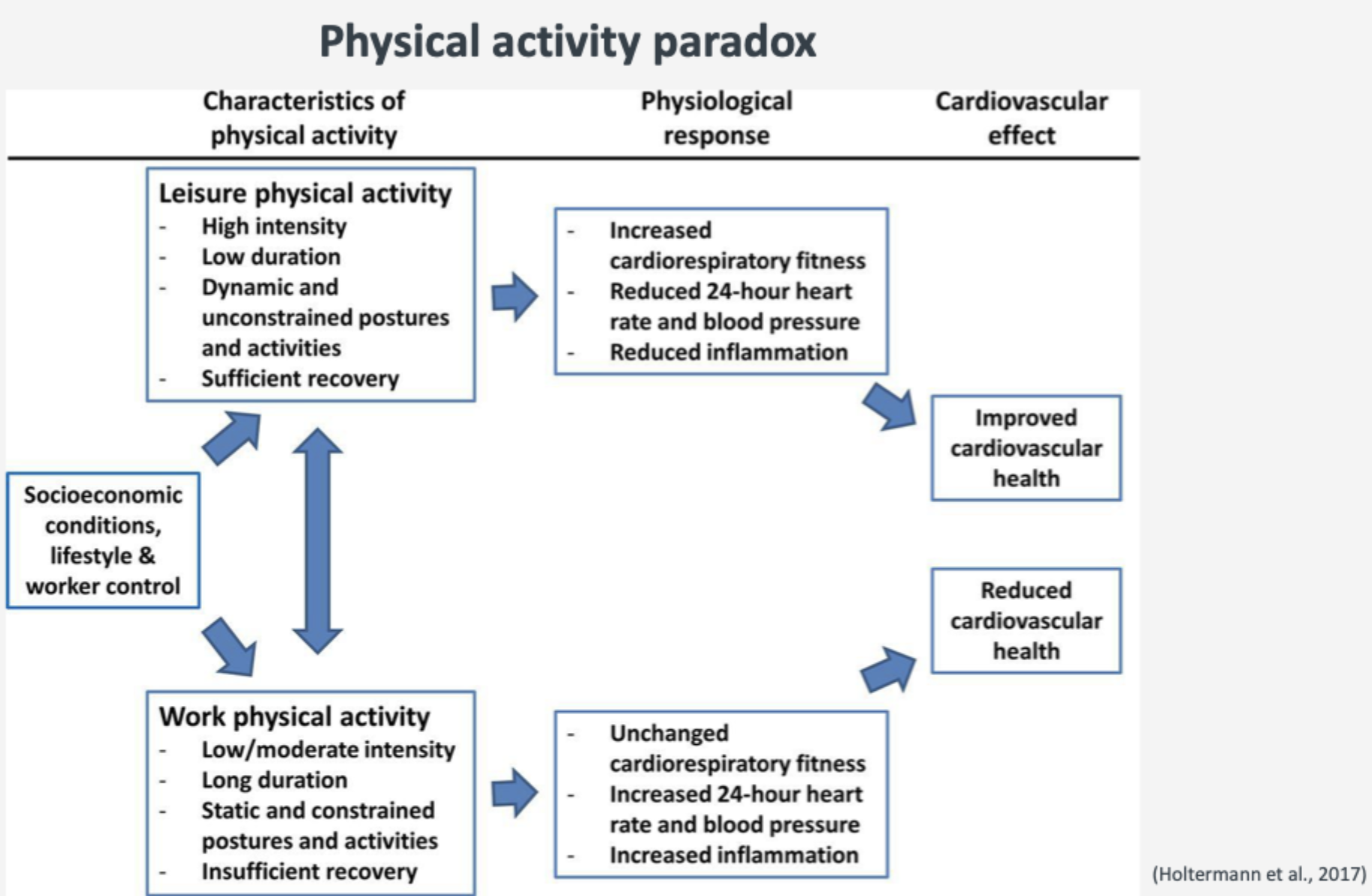
Leisure PA: high intensity, low duration, dynamic and unconstrained postures, sufficient recovery → increased cardiorespiratory fitness, reduced 24-hour heart rate and blood pressure, reduced inflammation → improvedcardiovascular health.
Work PA: low/moderate intensity, long duration, static and constrained postures, insufficient recovery → unchanged fitness, increased 24-hour heart rate and blood pressure, increased inflammation → reducedcardiovascular health.
Socioeconomic conditions, lifestyle and worker control influence both.
What are the six reasons for adverse effects of occupational physical activity (OPA)?
Low intensity or long duration
Increased heart rate over one day (24 h)
Heavy lifting or static postures, which increase blood pressure over one day (24 h)
Without sufficient recovery time or rest in between
Poor sense of control during the process of the worker's [work]
Inflammation level in different areas
B - What do the two studies show about the effects of the paradox?
The slides present them as effects of the physical activity paradox (Johansson et al., 2025):
Pain: pain risk rises with lower leisure-time PA, and it is already elevated in moderate–high OPA at moderate–high leisure-time PA.
Work ability (WA) and health-related productivity loss (HRPL): in people aged ≥ 60 with high OPA, more leisure-time PA goes with slightly lower work ability and higher productivity loss, unlike in low OPA.

Which interventions are named for active occupations?
"Classic" interventions: reduce pain, increase strength, improve working capacity, increase cardiovascular fitness (a little bit).
"More than" interventions: occupational load management, structured exercise, implementation of tools, micro-break structure.
[Kernaussage (meine Deutung): Neben klassischem Training soll man die Arbeitsbelastung selbst gestalten, zum Beispiel durch Pausen und Hilfsmittel]