Week 7 — Neural Correlates + Memory Part 1
 Call Kai
 Learn
 Practice Test
 Spaced Repetition
 Match
 Flashcards
 Knowt Play
1/55

There's no tags or description
Looks like no tags are added yet.
56 Terms
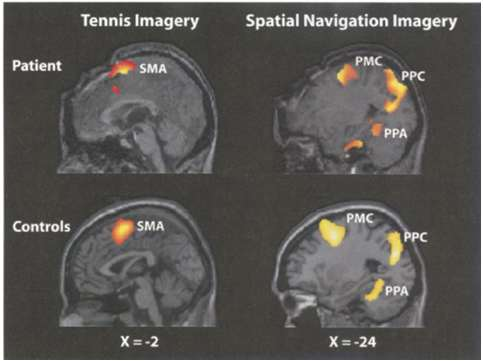
In Owen et al. (2006), an unresponsive patient was asked to imagine playing tennis and to imagine moving through their home. What brain activity was found, and what did it show? [Figure: owen-2006-tennis-spatial-navigation.png]
Tennis imagery activated the supplementary motor area (SMA); spatial-navigation imagery activated the parahippocampal place area (PPA) plus PMC/PPC - matching healthy controls. Despite unresponsive wakefulness, the patient understood spoken commands and responded through appropriate brain activity: covert command-following.

Name the DMN regions labelled in the lecture brain diagram. [Figure: dmn-brain-regions.png]
Posterior inferior parietal region, precuneus, posterior cingulate cortex, medial prefrontal cortex, and lateral temporal cortex.

What does functional connectivity mean, and what did Giacino et al. (2014) find for DMN connectivity across levels of consciousness? [Figure: dmn-connectivity-giacino-2014.png]
Functional connectivity is a statistical relationship: how strongly activity in different regions varies together, not proof of a direct connection. DMN connectivity was highest in healthy controls and declined with decreasing level of consciousness across minimally conscious, vegetative (unresponsive wakefulness), and coma groups, in PCC/precuneus, medial prefrontal cortex, temporoparietal junction, and parahippocampal gyrus.

In Cohen and Squire (1980), mirror reading was learned across three sessions, while participants did NOT learn a new reading rule each session. What does the graph show? [Figure: mirror-reading-cohen-squire-1980.png]
Mirror-reading time decreased steadily across sessions (learning retained across sessions). The new reversed passage read each session was consistently slower, showing that the improvement was not a general reading-rule gain but specific procedural learning of the repeated task.

Why does the Cohen and Squire mirror-reading study matter for memory theory? [Figure: mirror-reading-cohen-squire-1980.png]
It shows a dissociation: performance improves across sessions (implicit/procedural learning) even though the general reading rule is not learned afresh each session - evidence that implicit and explicit systems can operate independently.

What is the priming effect in word completion, and what does it show about implicit memory? [Figure: priming-word-completion.png]
People complete word stems (for example, _ _ _) with previously seen words more often than chance, even when they do not consciously recall the study list. This shows that prior exposure influences later performance without explicit recollection - a form of implicit memory.