URR Portal Venous System
 Call Kai
 Learn
 Practice Test
 Spaced Repetition
 Match
 Flashcards
 Knowt Play
1/34

There's no tags or description
Looks like no tags are added yet.
35 Terms
SMV and SV
MPV is formed by the confluence of the
decrease
portal veins increase or decrease in size as they near the diaphragm
MPV
____ carries 70-80% of blood into liver
hepatic artery (HA)
____ carries 20-30% of blood to liver
supine, quiet
portal vein should be assessed with patient position ____ and ___ respiration
13
normal MPV diameter is <___mm
hepatopetal
normal flow of MPV
peak velocity
if measuring the ____ of flow, angle correction must be used when evaluating MPV
inner to inner
MPV should be measured ___ to ___ at a point where PV crosses anterior to IVC
MPV
what is this dopplering?
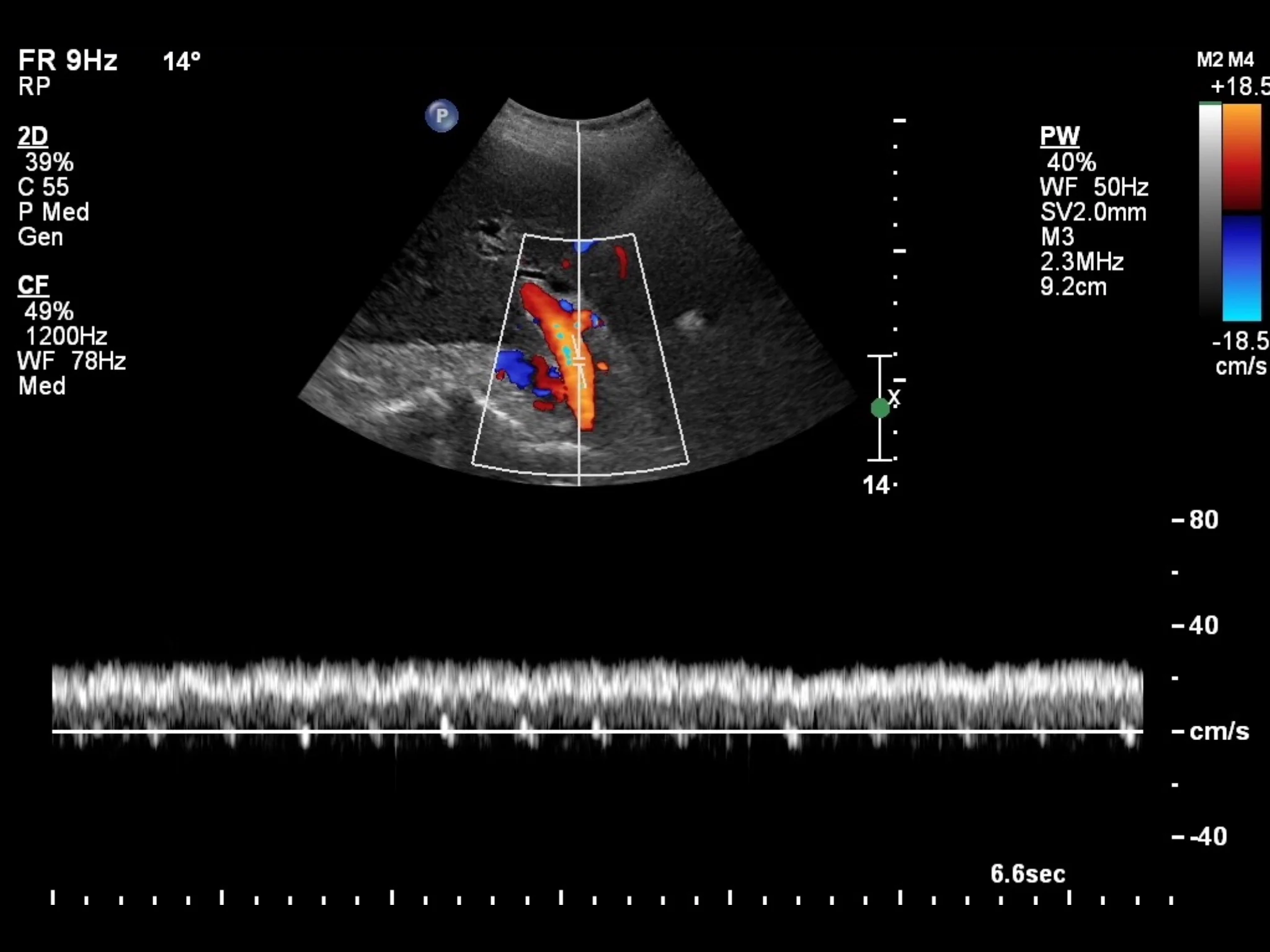
splenic vein (SV)
courses posterior to pancreas, joins SMV to form MPV
splenic vein (SV)
drains blood from stomach, spleen, pancreas
superior mesenteric vein (SMV)
joins SV posterior to neck of pancreas to form MPV
superior mesenteric vein (SMV)
drains blood from small intestine and proximal colon
inferior mesenteric vein (IMV)
ascends to left of IMA
joins SV posterior to body of the pancreas
drains blood from distal colon
cirrhosis
portal hypertension is most commonly caused by
hepatopetal, hepatofugal
in a TIPS shunt, flow should be ____ in prx shunt and ___ in dst shunt
thrombosis
most common cause of acute shunt stenosis.occlusion
hepatic vein anastomosis
most common site of TIPSS stenosis
neointimal hyperplasia
most common cause of chronic graft stenosis/occlusion
hepatofugal
in TIPSS, RT and LT portal veins wil demonstrate __ flow
monophasic
in TIPSS, shunt flow is __ phasic and mildly pulsatile with moderate spectral broadening
abnormal
TIPSS: hepatopetal flow in portal veins: norm or abnormal
normal
TIPSS: hepatofugal flow in portal veins: norm or abnormal
abnormal
TIPSS: hepatopetal flow in the associated hepatic vein is normal or abnormal
hereditary hemorrhagic telangiectasia
characterized by multiple arteriovenous malformations (AVMs)
recurrent episodes of bleeding
aka osler weber rendu disease
hereditary hemorrhagic telangiectasia
sono appearance:
dilated HA up to 10mm
multiple dilated tubular structures with color flow
dilated HV
hepatic artery thrombosis
most common and most severe complication of liver transplant
TIPSS
most common portocaval shunt
hepatic vein anastomosis
most common site ot TIPSS stenosis (chronic occlusion) is at the
native hepatic artery anastomosis
most common site for hepatic artery stenosis in a transplant is at the __ just ouside the hilum of the liver
portal vein connected to a hepatic vein
what vessels does a transjugular intrahepatic portosystemic shunt (TIPSS) connect
piggyback or interposition
the two types of liver transplant surgeries are
hepatic artery, portal vein
__ and _ are connected to the native vessels just proxial to the liver hilum in a liver transplant
200
in a liver transplant, the HA PSV should be <__cm/s