TTE 4274 Quiz questions
 Call Kai
 Learn
Learn Practice Test
 Spaced Repetition
 Match
Match Flashcards
 Knowt Play
1/35

There's no tags or description
Looks like no tags are added yet.
Name | Mastery | Learn | Test | Matching | Spaced | Call with Kai | Chat |
|---|
No analytics yet
Send a link to your students to track their progress
36 Terms
Which is not a component of a transportation system?
Users, Modes, Infrastructures & Services, Land Use, Connections
Land use
Transportation accounts for about __% of the total energy consumption
20, 25, 29, 32
29
What are the 3 important factors affecting travel demand?
Land Use, Weather, Socio-economic Characteristics of Population, Cost of Transportation Service
Land Use, Socio-economic Characteristics of Population, and Cost of Transportation Service
What are the 2 approaches to model travel demand?
Trip based approach, Socio-economic based approach, Activity based approach, Cost based approach
Trip based approach and Activity based approach
TAZ stands for?
Trip Analysis Zone, Traffic Analysis Zone, Traffic Assessment Zone, Trip Assessment Zone
Traffic Analysis Zone
Which one below is not a step in the 4 steps of the travel demand modeling process?
Land Use Planning, Trip Generation, Trip Distribution, Mode Choice, Trip Assignment
Land Use Planning

Trip Generation, Trip Distribution, Mode Choice, Trip Assignment
Trip Distribution

What is the category of the following trips?
Home-based trip, Non home-based trip
Home-based trip

What is production zone of trip number 3?
101

Which zone has produced zero trips?
105

Which zone has attracted zero trips?
101

How many trips will be generated by households with medium income and 1 car? Total no. households = 60
111

Determine the number of social trips per household (Y2) in this problem
0.576

How many trips in total will be generated at peak hour?
1466
What is the main problem of linear regression model of trip generation?
Produces fractions of trips, Produces too few trips, Produces too many trips, Needs a lot of data
Produces fractions of trips
Which two factors affect trip distribution?
Population of the zones, Weather, Trip cost, Individual income
Population of the zones and Trip cost
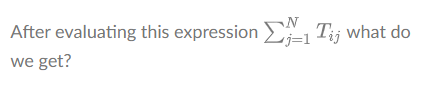
Total number of trips with origin at zone i
Total number of trips with origin at zone j
Total number of trips with destination at zone i
Total number of trips with destination at zone j
Total number of trips with origin at zone i

Total number of trips with origin at zone i
Total number of trips with origin at zone j
Total number of trips with destination at zone i
Total number of trips with destination at zone j
Total number of trips with destination at zone j

0.27
Which factor is less likely to influence someone’s mode choice?
Trip purpose, Trip maker’s gender, The safety of the chosen mode, The population of the area where the trip is being made
The population of the area where the trip is being made

Fill in the box with the ? mark
Automobile, Transit, Non-motorized
Transit

What mode will a traveler with an income of $10K choose?
Drive alone, Car pool, and Transit
Transit

-7.29, 5.79, -5.79, 7.29
-7.29

What is the probability that a traveler will choose the transit mode?
0.08, 0.17, 0.27, 0.37
0.08
What two factors will affect more a driver’s route choice behavior?
Congestion, Driver’s age, Toll, Trip purpose
Congestion and Toll

Linear, Non-linear
Non-linear
What are the two assumptions of All or Nothing Assignment?
For a given OD pair, everyone chooses the shortest path
For a given OD pair, users will experience equal travel time on all chosen paths
Each link will have constant travel time for the time period of analysis
For a given OD pair, everyone chooses the shortest path
Each link will have constant travel time for the time period of analysis
![<p>[2,1], [0,-], [4,1]</p>](https://assets.knowt.com/user-attachments/2896c788-ab19-40a0-ba20-9a27a85b59b9.png)
[2,1], [0,-], [4,1]
[2,1]
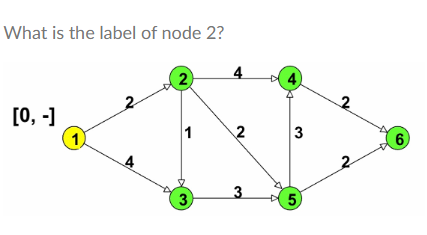
What is the shortest distance from node 1 to node 4?
4, 5, 6
6
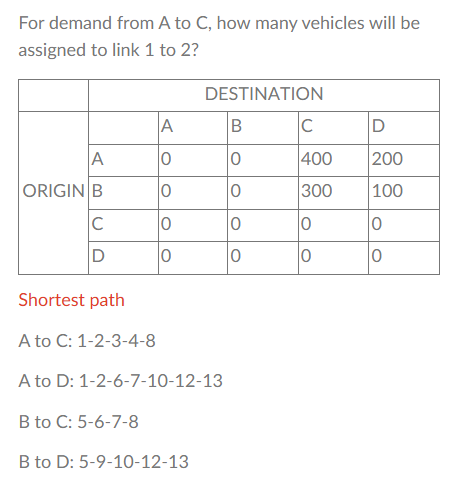
200, 400, 600
400

For demand from A to D, how many vehicles will be assigned to link 1 to 2?
200, 400, 600

Determine the flows in link 12 to 13
100, 200, 300
Which of the following statements is/are false at User Equilibrium?
Travelers can improve their travel times by changing routes
Travelers cannot improve their travel times by changing routes
For a given O-D, all used routes have equal travel times
All routes have non-zero flows
Travelers can improve their travel times by changing routes and All routes have non-zero flows

6 veh-min, 92 veh-min, 552 veh-min
552 veh-min

70 veh-min, 498 veh-min, 552 veh-min
498 veh-min
3 approaches for traffic assignment
All or Nothing assignment
User equilibrium
System optimal