MTH 209 Exam 2 Formulas
 Call Kai
 Learn
 Practice Test
 Spaced Repetition
 Match
 Flashcards
 Knowt Play
1/21

There's no tags or description
Looks like no tags are added yet.
22 Terms
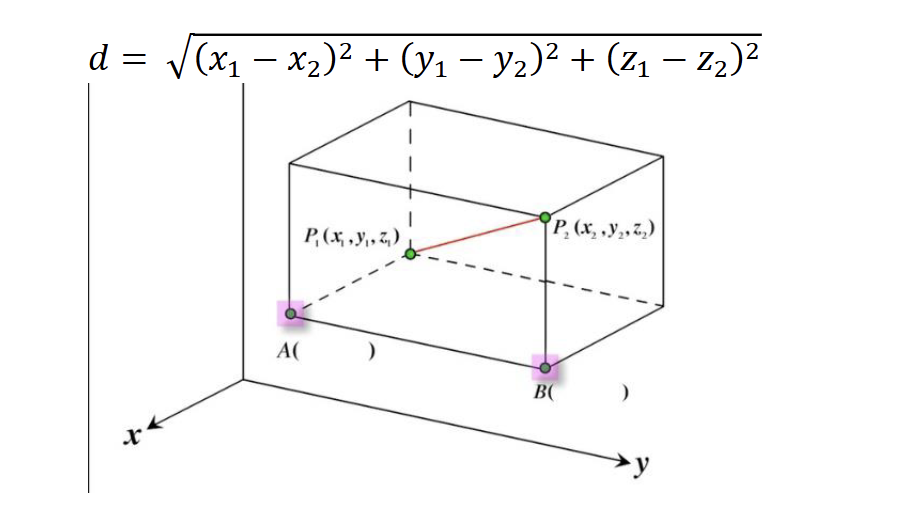
Distance Between 2 points in 3D space
point 1 = (x1,y1,z1)
point 2 = (x2,y2,z2)
Midpoint of the line segment joining two points in 3D space
point 1 = (x1,y1,z1)
point 2 = (x2,y2,z2)

Equation of a sphere
center at (h,l,k)
radius = r

Norm/Length/Magnitude of a Vector
vector v = <v1,v2,v3>

Addition of Vectors
vector u = <u1,u2,u3>
vector v = <v1,v2,v3>

Multiplication by scalar
vector v = <v1,v2,v3>
c = scalar

Unit vector in direction of vector v
same as multiply by scalar where scalar is the reciprocal of the magnitude of vector v

Dot/Scalar/Inner Product
vector u = <u1,u2,u3>
vector v = <v1,v2,v3>
vectors are perpendicular if this is zero

Angle between two vectors
arccosine of the dot product of vector u and vector v divided by the product of their magnitudes

projection of vector u onto vector v
the ratio of the dot product of vector u and vector v to the length of vector v squared then multiply by vector v

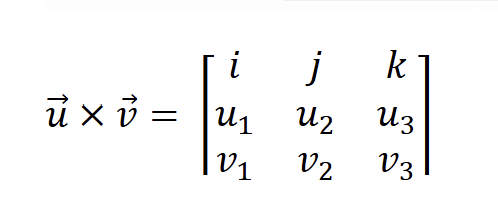
Cross product
vector u = u1i + u2j + u3k
vector v = v1i+v2j+v3k
vectors are parallel if this is zero
produces a vector perpendicular to the two vectors
Area of a Parallelogram
magnitude of the cross product of vector u and vector v which is the same as the magnitude of each vector multiplied by the sin of the angle between the two vectors

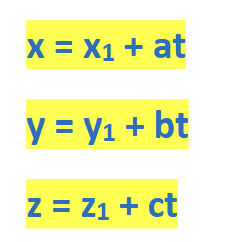
Parametric equations of a line in space
point on the line = (x1,y1,z1)
any point on the line (x,y,z)
parallel vector v (to the line) = <a,b,c>
t = parameter
symmetric equations of a line in space
point on the line = (x1,y1,z1)
any point on the line (x,y,z)
parallel vector v (to the line) = <a,b,c>
a,b,c cannot be zero

Standard form of a equation of a plane in space
point on a plane in space = (x1,y1,z1)
normal vector n = <a,b,c>
any point on a plane in space (x,y,z)

General form of a equation of a plane in space
point on a plane in space = (x1,y1,z1)
normal vector n = <a,b,c>
any point on a plane in space (x,y,z)
d = constant

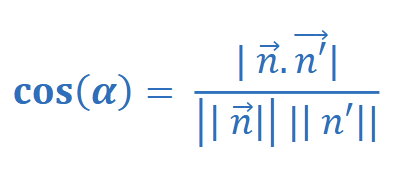
Angle between two planes
vector n = normal vector of plane 1
vector n’ = normal vector of plane 2
take smaller angle
Vector-valued Function
f(t),g(t), and h(t) are components of the function

Limit of a Vector-Valued Function
Defined component-wise

Derivative of Vector-Valued Function
computed component-wise

Unit Tangent Vector
derivative of vector valued function divided by its magnitude

Unit normal vector
derivative of unit tangent vector divided by its magnitude
