ochem II ch 25
 Call Kai
 Learn
 Practice Test
 Spaced Repetition
 Match
 Flashcards
 Knowt Play
1/25

Earn XP
Description and Tags
WHERE new groups attach to benzene, HOW FAST the reaction occurs
26 Terms
ortho, meta, para positions
ortho/para directors
OH, NHCOCH3, CH3, F, Cl, Br
*attached through an atom with a lone pair OR through an alkyl carbon
meta directors
NO2, N+(CH3)3, COOH, CN, COOEt, COCH3
*attached through an atom with no lone pairs that is electronegative or bonded to highly electronegative carbons
Activating Groups vs Deactivating Groups
Activating —> a substituent that increases the reaction rate relative to benzene (electron donating, stabilize arenium ion and lower activation energy)
Deactivating —> a substituent that decreases the reaction rate relative to benzene (electron withdrawing, destabilize arenium ion and increase activation energy)
Activating Group vs Deactivating Group Directors
Activating: Ortho/Para
Deactivating: Meta, except halogens
Why does nitration of nitrobenzene require H₂SO₄?
NO₂ strongly deactivates the ring; H₂SO₄ increases the NO₂⁺ concentration.
Can Friedel–Crafts reactions occur on strongly deactivated benzene rings?
Generally no. Moderately or strongly deactivated rings do not react readily.
Why is polyalkylation common in Friedel–Crafts alkylation?
The first alkyl group activates the ring, making subsequent alkylations faster.
What happens when phenol reacts with Br2 in water vs in acetic acid?
In water, multiple brominations occur (ortho/para placement).
When acetic acid is added, the lower pH suppresses high activating phenoxide, slowing the reaction (one ortho placement).

How does strong acid affect an aromatic amine's directing ability?
Protonation changes the group from activating ortho/para to deactivating meta.
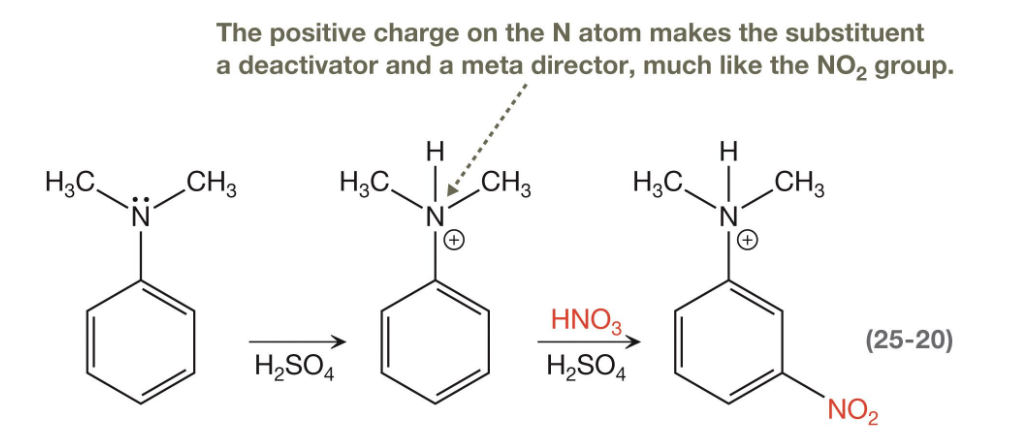
Why can't aromatic amines generally undergo Friedel–Crafts reactions?
The nitrogen coordinates to AlCl₃, strongly deactivating the aromatic ring.

What happens when two substituents agree on EAS directing positions?
The electrophile preferentially attaches at positions favored by both groups.

Which substituent dominates when two directing groups disagree?
Usually the more strongly activating group.
What positions are disfavored by steric hindrance during EAS?
Positions ortho to two different substituents.
*It provides greater stabilization of the arenium ion intermediate.
What if two substituents have similar activating strengths?
A mixture of regioisomers may form.
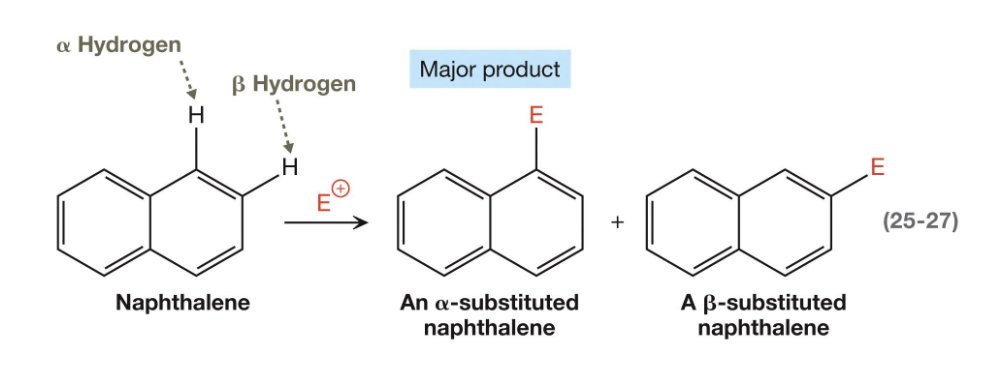
Where does EAS generally occur on naphthalene?
At the α-position (C-1).
*Napthalene is activated, undergoes faster EAS
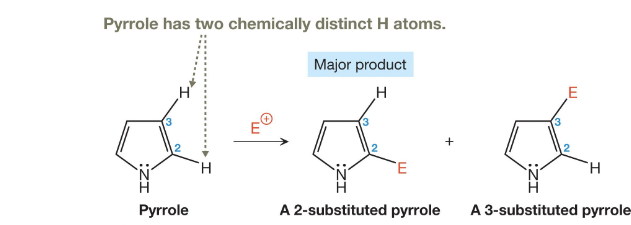
Where does EAS primarily occur on pyrrole?
At C-2, adjacent to nitrogen.
*Its C-2 arenium ion has three resonance structures versus two at C-3.
*activated
Where does EAS primarily occur on pyridine?
At C-3.
*It avoids a highly unstable resonance structure with positive charge on nitrogen.
*deactivated

Azo Coupling
Diazonium ion + aromatic ring —> Azo compound
Nucleophilic Aromatic Substitution via a Meisenheimer Complex
Nucleophile attacks an aromatic ring and replaces a leaving group
*Ortho or para to the leaving group promotes this
Nucleophilic Aromatic Substitution via the Benzyne Intermediate
base removes H, LG leaves, new group attaches
When synthesizing an ortho- or para-disubstituted benzene, which group should generally be installed first?
When synthesizing a meta-disubstituted benzene, which group should generally be installed first?
An ortho/para director.
A meta director.
Why must Friedel–Crafts acylation occur before nitration when synthesizing m-nitroacetophenone?
NO₂ strongly deactivates benzene and prevents Friedel–Crafts acylation.


Amine Protection


Sulfonyl as a Blocking Group


NH2 as a Blocking Group
