MATA31 Analysis - things to remember
 Call Kai
 Learn
Learn Practice Test
 Spaced Repetition
 Match
Match Flashcards
 Knowt Play
1/80

There's no tags or description
Looks like no tags are added yet.
Name | Mastery | Learn | Test | Matching | Spaced | Call with Kai | Chat |
|---|
No analytics yet
Send a link to your students to track their progress
81 Terms
Limits: do logarithms grow faster or slower than polynomials?
Slower
Limits: do logarithms grow faster or slower than exponentials?
slower
Limits: do logarithms grow faster or slower than factorials?
slower
Limits: do logarithms grow faster or slower than hyper exponentials(n^n)?
slower
Limits: do polynomials grow faster or slower than logarithms?
faster
Limits: do polynomials grow faster or slower than exponentials?
slower
Limits: do polynomials grow faster or slower than factorials?
slower
Limits: do polynomials grow faster or slower than hyper exponentials?
slower
Limits: do exponentials grow faster or slower than logarithms?
faster
Limits: do exponentials grow faster or slower than polynomials?
faster
Limits: do exponentials grow faster or slower than factorials?
slower
Limits: do exponentials grow faster or slower than hyper exponentials?
slower
Limits: do factorials grow faster or slower than logarithms?
faster
Limits: do factorials grow faster or slower than polynomials?
faster
Limits: do factorials grow faster or slower than exponentials?
faster
Limits: do factorials grow faster or slower than hyper exponentials?
slower
Limits: do hyper exponentials grow faster or slower than logarithms?
faster
Limits: do hyper exponentials grow faster or slower than polynomials?
faster
Limits: do hyper exponentials grow faster or slower than exponentials?
faster
Limits: do hyper exponentials grow faster or slower than factorials?
faster
Write the formula for the ratio/quotient test.
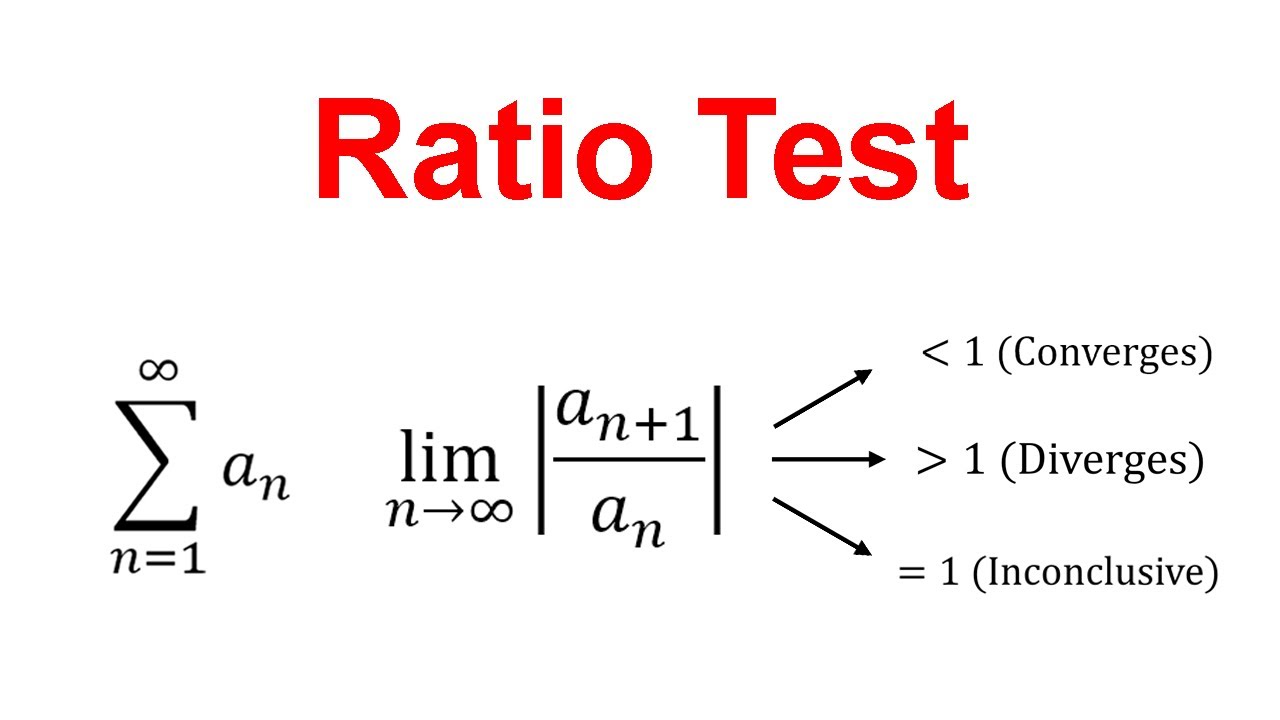
When does the ratio/quotient test show convergence? divergence?
Q<1 - converges; Q=1 - inconclusive; Q>1 - diverges
what does Q=0 mean for the ratio/quotient test?
absolute convergence
what does Q=∞ mean for the ratio/quotient test?
divergence
sin(2x)=?
2 sinx cosx
cos(2x) = ? (3 options)
cos²x-sin²x
1-sin²x
2cos²x-1
tan(2x) = ?
(2tanx)/(1-tan²x)
sinx, tanx inequality
0 < sinx < x < tanx
lnx inequality for x>-1
x/(x+1) ≤ ln(1+x) ≤ x-1
sum of geometric series when x∈(-1, 1)

when does a infinite geometric series converge? diverge?
convergence if the absolute value of the common ratio r<1
divergence if r≥1
when does a finite geometric series converge? diverge?
will always converge to a specific real sum
if a and b are positive numbers the arithmetic mean is ___?
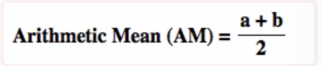
if a and b are positive numbers the geometric mean is ___?

if a and b are positive numbers the harmonic mean is ___?

sum of a geometric series when x∉(-1,1)

when the effective base is x>1 does that signify convergence or divergence? (ex: (9/2)ⁿ)
divergence to infinity
when the effective base is x<1 does that signify convergence or divergence? (ex: (2/7)ⁿ)
converges to 0
Does the series ∑ 1/2ⁿ converge or diverge? to what value?
converges to 2
Does the series ∑ xⁿ = 1/(1-x) converge or diverge when |x|<1?
converges
write the harmonic series.
∑1/k
does the harmonic series converge or diverge?
diverges to infinity
write the basel series.
∑1/k²
does the Basel series converge or diverge?
converges to some finite number.
write Grandi’s series.
∑(-1)ⁿ
does Grandi’s series converge or diverge?
diverges but not to infinity
write Mengoli’s formula.
∑ 1/k(k+1)
Does the Mengolis series converge or diverge? to what value?
it is convergent and the partial sums approach the value 1
what is the limit of the harmonic sequence?
the sequence approachs 0
what is oresme’s trick? write out an example
for the harmonic series: group terms into groups of 1/2≥x; 1 + ½ + (1/3 + ¼) + (1/5 +1/6 + 1/7 + 1/8) + ….
what is the limit of the Basel sequence?
the limit of this series converges to π²/6
what is the limit of the mengoli’s sequence of partial sums?
the limit of this series is 1
describe sequences and series/their connection.
a series has a limit that the sequence of partial sums approaches.
what is the limit of the grandi’s sequence of partial sums?
the limit does not exist
write the formula for sums and their tails.
∑aₙ=Sₙ+Tₙ
what is the formula for the tail of a series?
Tₙ = Sₙ - L (where the series is equal to L)
how can Oresme’s trick with the tails be written to calculate the difference of partial sums?
|Sₙ-L|<ε (where x can be a real number; such as 1/10, 1/100, 1/1000)
write the definition of the limit of a sequence of partial sums.
∀ε>0, ∃N>0 st ∀n∈ natural numbers it holds that:
n>N → |aₙ-L|<ε
what is the limit of the sequence of partial sums of the series ∑1/2^k if it starts at k=0?
2
what is the limit of the sequence of partial sums of the series ∑1/2^k if it starts at k=1?
1
write the triangle inequality.
|a+b+c| ≤ |a| + |b| + |c|
what’s the limit as n approaches infinity of (1+1/n)ⁿ?
e
whats does tan^-1(x) converge to?
π/2
whats does sin^-1(x) converge to?
π/2
divergence test: what happens if aₙ doesn’t tend to zero?
diverges
divergence test: what happens if aₙ tends to zero?
convergence
if the partial sums of a positive series are bounded above does the series converge or diverge?
converge
if the partial sums of a positive series are not bounded above does the series converge or diverge?
diverge
true or false? if aₙ≤bₙ and bₙ converges → aₙ converges
True
true or false? if aₙ≤bₙ and bₙ diverges → aₙ diverges
false
true or false? if aₙ≤bₙ and aₙ converges → bₙ converges
false
true or false? if aₙ≤bₙ and aₙ diverges → bₙ diverges
true
for what values of p does the p-series test converge?
when p > 1
for what values of p does the p-series test diverge?
p ≤ 1
describe a convergence result for the limit comparison test.
divide the original series by a known series. if the result is a finite number then both series behave in the same way. aka if the comparison series diverges the original series will also diverge
formula for the root test
lim k→∞ (aₙ)^(1/n)=Q
for what values Q does the root test converge? diverge?
Q<1 → aₙ converges
Q>1 → aₙ diverges
Q = 1 → no information
whats the error estimate formula?
|Sₙ-L|≤a(n+1)
when is a infinite series absolutely convergent?
if the absolute value is convergent
What is the standard exponential limit definition (e^x)?
lim (1+x/n)^n
what is “lim (1+x/n)^n” the limit of?
e^x