IM3-adaptive immunity
 Call Kai
 Learn
 Practice Test
 Spaced Repetition
 Match
 Flashcards
 Knowt Play
1/13

There's no tags or description
Looks like no tags are added yet.
14 Terms
what are the limitations of the innate system

what is the adaptive immune system
its the individual response to specific antigen exposure its capable of change during response- adaptation
its characteristics/things we want from it:
antigen specificity
diversity
immunological memory
self/non-self recognition
what are the general function/roles of the B- lymphocytes
they recognise antigens using surfacereceptors which are antibodies themselves
once the b-cell has recognised it it undergoes endocytoses- it takes it inside of the b-cell and cuts it into fragments
these fragments then get presented back on the surface of the b-cell #this then activates the t-cells
so theres reciprocal activation between the b and the t-cells and the activation of the b-cells produce antiboides
where do b-lymphocytes derive from what do they have on their surface right after
they mature in the haemopoietic stem cells in the bone marrow and they express antibodies igM/igD on their surface
once mature in the bone marrow where do lymphocytes go to
they move out to the lymph nodes, this is where detection of antigens occur
this results in endocytosis and presentation of antigen fragments to t-cells which help the b-cells to produce antibodies
what are the two things needed for b-cell activation + how it can be enhanced
engagement of its surface antibodies and costimulatory signals/help form the t-cells
this signal can be further enhanced by complement coreceptors.
this may cause too much inflammation and response
explain the down regulation of b-cell activation
the engagement of the FC receptors which bind onto the FC regions of the antibody switch the b-cells off

what are the common feature/ role of antibodies
they have specific recognition to antigens
they can target circulating microbes and toxins for phagocytosis
what are the two different types of immunity produced by vaccination
active-inactivated pathogens are given to stimulate antibodies production
passive-antibodies are injected directly into the patient
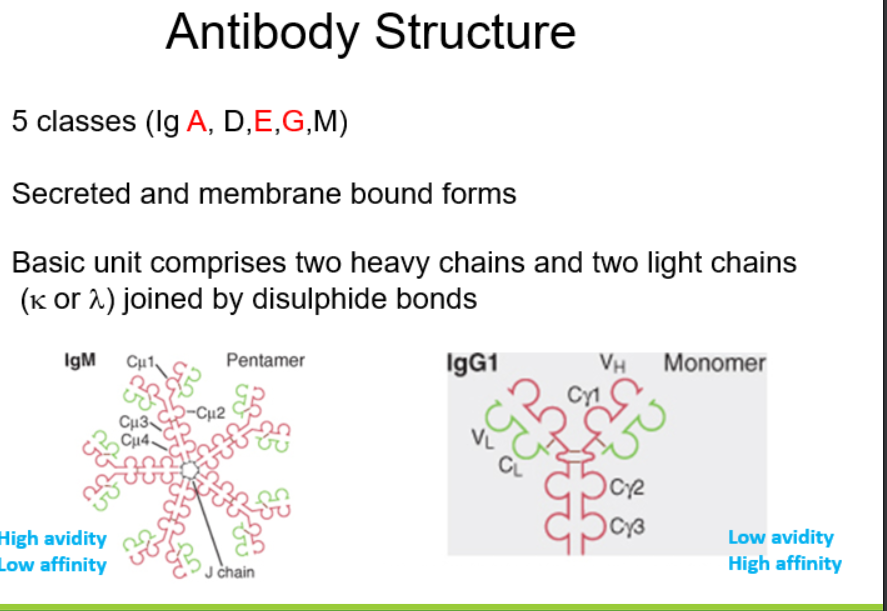
describe the structure of antibodies
IgM- They have high avidity, so they can bind a lot of antigens but the low affinity means they bind weakly
overtime class switching can happen and it can swich to a different class which has a low adidity but a high affinity
what are the different types/classes of antibodies and where are they found/what are they used for

what are the main FC mediated effector functions of IgG,IgM and IgE
the fc region of an antibody binds to FC receptors or complement proteins to trigger immune responses
IgG- binds fc recptors on neutrophils and marophages-> phagocytosis
IgE- activates mast cells and contibutes to eosinophil response -> degranulation and histamine release
IgM and IgG- can tigger complemnt activation
IgG= gobble microbes
IgE= allergy
IgM=complement
how can antibodies be used by us as tools

how are monoclonal antibodies made
take a different species e.g. a mouse and inject the antigen into them
the mouse then makes antibodies against it
we fuse these antiboides with tumor cells( long living ) to make hybriomas
these are then grwon up in culture and then they secrete out monoclonal antibodies .