Immunology - Unit 1: Innate Immunity
 Call Kai
 Learn
Learn Practice Test
 Spaced Repetition
 Match
Match Flashcards
 Knowt Play
1/141

There's no tags or description
Looks like no tags are added yet.
Name | Mastery | Learn | Test | Matching | Spaced | Call with Kai | Chat |
|---|
No analytics yet
Send a link to your students to track their progress
142 Terms
immunology
study of host’s rxn when foreign substance is introduced to the body
antigen
foreign substance
can be anything—> bacteria, dust, pollen
immunity
all physiologic mechanisms that enable host to recognize materials as foreign and to dispose of them with or without injury to its own tissues
where does immunology get involved?
protection from bacteria, viruses, fungi, and parasites
vaccine responses and immune memory
allergy, autoimmunity, and transplant rejection
tumor surveillance and immunotherapy
inflammatory contributions to chronic disease
immunochemistry and immunohematology
what are protective outcomes of immunity?
remove pathogens
neutralize toxins
clear damaged cells
build memory
what are pathologic outcomes of immunity?
allergy
autoimmunity
chronic inflammation
transplant rejection
is immunity always protective?
no, it can cause injury (pathologic outcomes)
what are the 2 main types of immunity?
innate and adaptive
what strategies does innate immunity use?
recognition: germline-encoded patterns
initial speed: minutes to hours
diversity: limited, but broad (doesn’t differentiate between different antigens/pathogens)
repeat exposure: typically no memory
major players: barriers, phagocytes, NK, complement
what strategies does adaptive immunity use?
recognition: somatically generated receptors
initial speed: days (takes time to adapt to produce things like specific antibodies)
diversity: extremely diverse
repeat exposure: faster, stronger memory
major players: B cells, T cells, antibodies
innate immunity feature of recognition
germline-encoded patterns
innate immunity feature of initial speed
minutes to hours
innate immunity feature of diversity
limited, but broad
innate immunity feature of repeat exposure
typically, no memory
innate immunity feature of major players
barriers, phagocytes, NK, complement
adaptive immunity feature of recognition
somatically generated receptors
adaptive immunity feature of initial speed
days
adaptive immunity feature of diversity
extremely diverse
adaptive immunity feature of repeat exposure
faster, stronger memory
adaptive immunity feature of major players
B cells, T cells, antibodies
What are two kinds of responses for adaptive immunity?
humoral and cell mediated
Main features of Humoral response/ Humoral Mediated Immunity (HMI)
B cells —> plasma cells (produce antibodies, typically tag antigens for disposal)
antibody-mediated
main defense against extracellular pathogens
Features of Cell Mediated Response/ Cell-Mediated Immunity (CMI)
T cells
Direct cell-to-cell contact (check if cell is part of the body) or production of cytokines (tells cells what to do)
Main defense against intracellular pathogens and cancerous cells
how does innate immunity shape the adaptive response (flow chart)?
Detect danger → release cytokines → activate antigen-presenting cells → direct T-cell responses to produce cytokines → activate B cells to produce Abs
what is the first line of defense for innate immunity?
anatomical
intact skin
mucosal surfaces
mechanical clearance
antimicrobial secretions
what are the anatomical defenses of innate immunity?
intact skin
mucosal surfaces
cilia clearance
mechanical clearance
mucous blanket expelled by coughing
urine flow
antimicrobial secretions
saliva and tears contain lysozyme
low pH of stomach and vagina
what physiological factors can affect immunity?
body temperature
microbes grow poorly at or above 37ºC
acute phase reactants
proteins normally found at low levels, but rapidly increase during infection, trauma, or injury
produced by hepatocytes (w/i 12-24 hrs)
What are major acute phase reactants (proteins that increase during infection, trauma, injury)
C-reactive proteins (CRP)
Serum amyloid A (SAA)
Fibrinogen
Hepcidin
Ferritin
Complement proteins
Haptoglobin
Albumin/ transferrin
Major acute phase reactant: C-reactive protein (CRP)
opsonization and complement activation; common clinical inflammation marker
-large increase during acute phase
Major acute phase reactant: Serum amyloid A (SAA)
Immune-cell recruitment and lipid transport; rises markedly w/ inflammation
-large increase during acute phase
Major acute phase reactant: Fibrinogen
coagulation and repair; contributes to an increase ESR
-moderate increase during acute phase
Major acute phase reactant: hepcidin
restricts iron availability by decreasing absorption and macrophage iron release
-small increase during acute phase
Major acute phase reactant: Ferritin
stores and sequesters iron; may rise substantially during inflammation
-small increase during acute phase
Major acute phase reactant: complement proteins
amplify opsonization, inflammation, and pathogen elimination
-small increase during acute phase
Major acute phase reactant: haptoglobin
binds free hemoglobin; limits oxidative damage and iron availability
-small increase during acute phase
Major acute phase reactant: albumin/transferrin
negative acute-phase reactants; concentrations decrease during inflammation
-small decrease during acute phase
in what ways do the microbiota reinforce barrier defense?
through direct and immune effects
how do the microbiota directly reinforce barrier defense?
compete for nutrients
occupy space, making it difficult for pathogens to colonize
produce bacteriocins to inhibit growth from competing microbes
how do the immune effects of microbiota reinforce barrier defense?
support epithelial barrier integrity
provide low level signals to maintain low innate immune activity
helps shape the development of immune responses
what is the “Hygiene Hypothesis”?
theory that reduced exposure to microorganisms early in childhood may lead to increased risk: allergies, other immune-mediated disease
microbial diversity matters
antibiotics, diet, environment, and genetics interact
what is the repeatable logic of the innate response?
Barrier breach → pattern detection (PAMPs and DAMPs) → local alarm (potential cytokine release) → effector response → resolution
what are pattern recognition receptors (PRRs) and what do they detect?
detect context—> recognize specific molecular patterns
Pathogen-associated molecular patterns (PAMPs)
Damage-associated molecular patterns (DAMPs)
what are the major PRR families?
Toll-like Receptors (TLR)
C-type lectin receptors (CLRs)
Nucleotide-binding oligomerization domain receptor (NODs)
Scavenger Receptors (SR)
Where are Toll-like Receptors (TLR) located and what are some examples of what they detect?
cell surface or endosome (inside the cell)
detect LPS, lipoproteins, nucleic acids
Where are C-type lectin receptors (CLRs) located and what are some examples of what they detect?
cell surface
detect microbial carbohydrates
Where are Nucleotide-binding oligomerization domain receptors (NODs) located and what are some examples of what they detect?
cytosol
detect stress, bacterial products
Where are Scavenger Receptors (SR) located and what are some examples of what they detect?
Cell surface
detect modified lipoproteins, components of damaged cells
PAMPs: what receptor detects LPS (lipopolysaccharide) and what is the interpretation?
TLR4
gram-negative bacterial product
PAMPs: what receptor detects flagellin and what is the interpretation?
TLR5
motile bacterial structure
PAMPs: what receptor detects mannose (sugar not used in human cells) and what is the interpretation?
CLRs
Repeat patterns on the surface of microbes
PAMPs: what receptor detects zymosan (product of yeast) and what is the interpretation?
TLR2
yeast present
PAMPs: what receptor detects Viral RNAs and what is the interpretation?
TLRs 3, 7, 8
Viruses present
How does PRR signaling produce distinct outputs (flowchart)?
Cell recruitment → transcription factor activation (activator protein-1/ AP-1, nuclear factor kb/ NF-kb, interferon regulatory factors/ IRFs) → cytokine or interferon release (enhance inflammation) → local and systemic effects
what are the immune cells of innate immunity?
Neutrophils
Eosinophils
Basophils and Mast cells
Monocytes/ Macrophages
Natural Killer (NK) cells
Neutrophils
rapid, expendable responders
predominate granulocyte—> 40-75% of WBCs in peripheral blood
Half life= 8-20 hours → 1-2 days of survival in tissues
protect against microbes via phagocytosis
Receptors:
Fc portion of IgG
Complement receptor
what receptors do neutrophils contain?
Fc portion of IgG
Complement receptor
What are the two functional pools that neutrophils occupy?
circulating pool and marginated pool
Neutrophils - circulating pool
Moves freely in the blood
measured directly in routine counts
available for recruitment
Neutrophils - marginated pool
found in spleen, liver, and bone marrow (lymphoid organs)
can rapidly enter circulation
influenced by stress hormones and inflammation
Eosinophils
Granulocyte → granules released when activated causing an effect on the body
1-3% of cirulating nucleated cells
easy to identify (red stain)
protects against parasitic infections
dampens allergic response
weak phagocytosis
what cell pool do basophils come from?
blood
what cell pool do mast cell come from?
tissue
Basophils and Mast cells
granulocyte
<1% of circulating cells
Not from the same precursors
Mast cells found in thymus, spleen, lung, GI tract, bone marrow
Easy to identify (blue/purple)
Involved in allergies→ granules contain histamine
Receptors:
Fc receptor for IgE heavy chain
what receptor do basophils and mast cells have?
Fc receptor for IgE heavy chain
what’s the difference between monocytes and macrophages?
monocytes are found in blood; macrophages are either tissue resident or migrated to tissue
Monocytes/Macrophages
3-10% of WBCs in peripheral blood
Multipotent→ give rise to many different types of macrophages
macrophages found in tissue (tissue resident or migrated)
Functions: phagocytosis, antigen presentation (important for adaptive immune system)
Markers:
Fc receptor for IgG
Receptors for CRP and complement
MHCII
What markers/receptors are found in monocytes/macrophages
Fc receptor for IgG
Receptors for CRP and complement
MHCII
how do macrophages balance defense and repair?
they have roles in protecting the body as well as maintaining homeostasis
how do macrophages defend the body?
recognize PAMPs and DAMPs
phagocytose microbes
release inflammatory mediators
how do macrophages maintain homeostasis?
clear apoptotic cells thru efferocytosis (a type of phagocytosis that allows the recycling of what’s eaten)
recycle cellular material and release anti-inflammatory cytokines
coordinates repairs
natural killer (NK) cells
3% of peripheral lymphocytes
large granular lymphs
NOT T or B cell
Mediate rapid lysis of virally-infected, tumor, or foreign graft cells
Prior immunization isn’t needed→ doesn’t need an antibody marker to kill cell (if cell doesn’t identify itself w/ MHCI signal, it’s killed)
Markers
CD16: Fc receptor for IgG
Antibody-dependent cell mediated cytolysis (ADCC)
what are markers/receptors of natural killer cells?
CD16: Fc receptor for IgG
Antibody-dependent cell mediated cytolysis (ADCC)
how do NK cells make a balance-of-signals decision?
Scan target → assess inhibitory MHC I signal (infected cells are unable to produce signals to let NK cells they’re infected) → integrate activating ligands → release perforin and granzymes

what does immune recruitment convert a blood cell to?
a tissue responder —> migration from blood to tissue→ chemotaxis (signals attract cell towards particles that need to be phagocytosed

What are the steps to cellular migration in innate immunity?
Recruitment converts blood cell to tissue responder
migration from blood to tissue, helped thru chemotaxis that attract cells to particles that need to be phagocytosed
inflamed endothelium becomes a gateway
microbial mediators, cytokines, and chemokines in tissue inflame the endothelium
adhesion molecules expressed on endothelium
selectins on endothelium bind to cellular receptors
weak rolling attachment
Cell will bind to integrins, which will capture it on the blood vessel wall → firm attachment
Diapedesis/ extravasion
the leukocyte can squeeze thru the endothelium (diapedesis)
cells leaves blood vessel for tissue (extravasation)
Migration
cell can migrate fully into tissue to phagocytose invading pathogen
what happens during the migration step during cellular migration in innate immunity?
cell can migrate fully into tissue to phagocytose invading pathogen

what happens during the diapedesis/extravasion step during cellular migration in innate immunity?
the leukocyte can squeeze thru the endothelium
cells leaves blood vessel for tissue

what happens during the capture step when the inflamed endothelium becomes a gateway during cellular migration in innate immunity?
Cell will bind to integrins, which will capture it on the blood vessel wall → firm attachment

what happens during the rolling adhesion step when the inflamed endothelium becomes a gateway during cellular migration in innate immunity?
microbial mediators, cytokines, and chemokines in tissue inflame the endothelium
adhesion molecules expressed on endothelium
selectins on endothelium bind to cellular receptors
weak rolling attachment (rolling adhesion)

What are the steps to phagocytosis?
Neutrophils engulf the microbes
Physical contact between WBC and foreign antigen
Opsonins (C3b, IgG, CRP) increase rate and amount of uptake
Opsonization coats the pathogen and allows the phagocyte to bind and ingest it
Formation of Phagosome
Particle is ingested
binding occurs thru opsonins or pattern recognition patterns (like foreign lipid not on human cells)
once inside cell, it forms the phagosome
Fusion of lysosome and phagosome
lysosome contains hydrolytic enzymes that break down antigens
forms phagolysosome
Digestion
lysosome granules kill using superoxide ions, hypochlorite, and hydrogen peroxide
myeloperoxidase (MPO) and H2O2 needed for killing
Reactive oxygen particles (toxic) give respiratory burst to kill pathogen
Release of debris
During phagocytosis, what happens during digestion?
lysosome granules kill using superoxide ions, hypochlorite, and hydrogen peroxide
myeloperoxidase (MPO) and H2O2 needed for killing
Reactive oxygen particles (toxic) give respiratory burst to kill pathogen
Release of debris
During phagocytosis, how does the phagolysosome form?
fusion of phagosome w/ lysosome

During phagocytosis, what happens during the formation of the phagosome?
Particle is ingested
binding occurs thru opsonins or pattern recognition patterns (like foreign lipid not on human cells)
once inside cell, it forms the phagosome

During phagocytosis, what happens when neutrophils engulf microbes?
Physical contact between WBC and foreign antigen
Opsonins (C3b, IgG, CRP) increase rate and amount of uptake
Opsonization coats the pathogen and allows the phagocyte to bind and ingest it
How do opsonins like C3b, IgG, and CRP increase the rate and amount of uptake of microbes/antigens during phagocytosis?
they are antibodies that can be bound to bacteria → make targets easier to recognize
direct interaction btwn antibody and receptor on neutrophil allow engulfing
what happens during Chronic Granulomatous Disease (CGD)?
Absence of NADPH oxidase enzyme leads to decreased H2O2 → unable to generate respiratory burst and kill pathogen
Granulomas form where phagocytes can’t kill pathogen
Recurrent pus-producing infection
previously fatal in childhood, but can now be treated w/ granulocyte transfusion or BMT as treatment

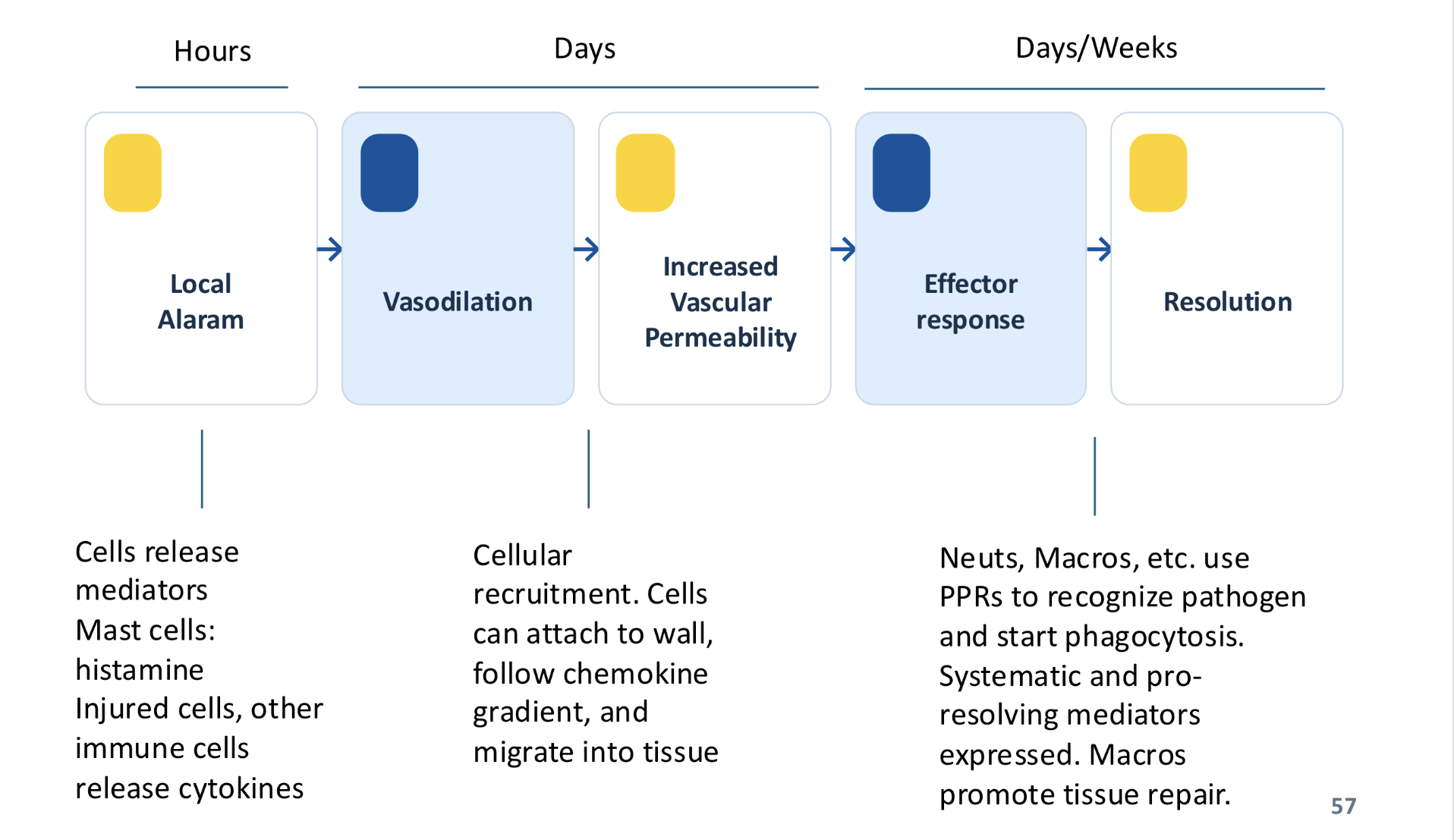
what is the process of inflammation creating a controlled access zone (flowchart)?
Local alarm (w/i hrs) - cells release mediators; Mast cells release histamine; Injured cells, other immune cells release cytokines
Vasodilation (days)
—Cellular recruitment. Cells attach to wall, follow chemokine gradient, and migrate into tissue
Increased Vascular permeability (days)
Effector response (days/weeks)
—neuts, macros, etc. use PPRs to recognize pathogen and start phagocytosis. Systematic and pro-resolving mediators expressed. Macros promote tissue repair.
Resolution (days weeks)
What are the inflammatory mediators that are small soluble proteins?
cytokines, specificially: IL-1, IL-6, TNF-a
what are cytokines?
small soluble proteins that regulate the immune system; inflammatory mediators
Proinflammatory: IL-1, IL-6, TNF-a
function:
-increase adhesion and diapedesis (travel through tissue)
-chemoattractants
-cell activation and differentiation
-physical symptoms
what are the functions of cytokines as pro-inflammatory mediators
-increase adhesion and diapedesis (travel through tissue)
-chemoattractants
-cell activation and differentiation and differentiation
-physical symptoms
Cytokines: IL-1
Induced expression by microbes (LPS)
Produced by monos/macros (can also be produced by other immune cells to a lesser extent)
Cellular effects: Induces IL-6, IL-2 secretion in T helper cells
Systematic effects: fever, acute phase reactants (like CRP), and activation of immune cells

what is the cytokine IL-1 produced by?
monos/macros
(can also be produced by other immune cells to a lesser extent)
what are the cellular effects of IL-1?
induces IL-6
IL-2 secretion in T helper cells
what are the systematic effects of IL-1?
fever
acute phase reactants (like CRP)
activation of immune cells
what is the pro-inflammatory cytokine IL-6 produced by and what are its functions?
produced by innate and lymphoid cells
Function: acute phase reactants; stimulates B cells to proliferate and differentiate into plasma cells (which can then produce antibodies)
what is the pro-inflammatory cytokine TNF-a triggered by and produced by? What are its functions?
Expression triggered by LPS
Secreted by monos/macros
Function: enhances antigen presentation, causes apoptosis of tumor cells
what are inflammatory mediators other than cytokines?
Vasoactive amines (ex. Histamine)→ causes rapid permeability changes
Lipid mediators (ex. prostaglandins, leukotrines) → Hormone-like, trigger vasodilation, swelling, pain
Plasma cascades (Ex. complement, bradykinin)→ causes opsonization and lysis; amplification and vessel permeability
What is an example of a vasoactive amine and what does it do?
Histamine
Inflammatory mediator → causes rapid permeability changes
What are examples of lipid mediators and what do they do?
prostaglandins, leukotrines
Inflammatory mediator → Hormone-like, trigger vasodilation, swelling, pain
What are examples of plasma cascades and what do they do?
complement, bradykinin
Inflammatory mediator→ causes opsonization and lysis; amplification and vessel permeability