Earth science final
 Call Kai
 Learn
 Practice Test
 Spaced Repetition
 Match
 Flashcards
 Knowt Play
1/136

There's no tags or description
Looks like no tags are added yet.
137 Terms
Science
Science is simply a logical way of thinking about the world
What do Scientists use about the world around them to make inferences
Scientists use observations about the world around them to make inferences
The Scientific method
Is the way to describe the way scientists gather and use information
Whats an good example of how the scientific method could be used in daily life
You could possibly use it to see which body spray smells better
Whats a hypothesis
A hypothesis is a testable explanation for a question or problem
We often use logical reasoning to form a hypothesis, there are 2 main types of reasoning. What are they?
Inductive reasoning and deductive reasoning
Whats inductive reasoning?
Inductive reasoning is when you look for patterns or rules in the natural world.
whats deductive reasoning?
Deductive reasoning compares new things to rules of the natural world.
Whats a good inductive statement?
Everyday Mrs. Wright collects phones.
Whats a good Deductive statement?
This old camera does not work as well as a new one.
Whats a controlled experiment?
A controlled experiment is one that only changes one variable.
What are the parts of a controlled experiment?
Controls = what are you keeping the same? Ex: Bread pantry
Independent variable = What are you changing? Ex: Bread on counter
Dependent variable = What are you measuring as a result? Ex; Which one takes longer to mold.
What can data be organized into? What do they help see?
Data can be organized into charts, graphs, or tables. These help see results in an easy format.
Data is divided into 2 categories, what are they?
Qualitative data and Quantitative data
Whats Qualitative data?
Descriptions, words
Whats Quantitative data?
Numbers, measurements

Look at graph
The graph setup is called a descriptive title.
What does a conclusion do?
A conclusion either supports or rejects the hypothesis.
What is science not used for?
Science is not used to prove that something is true.
How do we become more confident in our results?
By repeating the experiment, we can be more confident in our results.
what does sharing data with others do?
Sharing data with others helps the whole scientific community to further our knowledge.
What to scientist often do when an experiment is complete?
When an experiment is complete, the scientist often submits the results for peer review.
Peers = ?
Peers = individuals at the same level of education or specialization.
What do the scientific peers do?
These scientific person review the experiment to determine if there are flaws.
What happens when the experiment has flaws?
The experimental results will not be published in a scientific journal.
What happens when there are no flaws in the experiment?
The experimental results may be published in a scientific journal.
what is one of the most important ways the scientific community guards against faulty science?
Peer review is one of the most important ways the scientific community guards against faulty science?
What does a scientific theory explain and what is it supported by?
A scientific theory explains a phenomenon and is supported my many different fields of evidence.
What are scientific theories?
Scientific theories are broad explanations that apply to many situations.
Ethics = ?
Ethics = The branch of knowledge that deals with moral principles.
How do ethics come into play particularly in environmental science?
To see if it will harm the environment or not.
What are the three ethical world-views prevail in environmental science?
Anthropocentrism = values the human population and human welfare.
Biocentrism = values every organism even humans.
Ecocentrism = values ecosystems and communities, not individuals.
What is the earth made of?
The earth is made of 4 interacting spheres.
What Are all the interacting spheres?
Lithosphere/geosphere: Stone/ground
Hydrosphere/cryosphere: water, crysosphere is the frozen part of the hydrosphere
Atmosphere: air
Biosphere: life
Geoshpere includes?
The geoshere is made of rocks, minerals, soil, and layers of the earth’s interior.
Hydrosphere includes?
The hydrosphere is made of all the water that is on Earth’s surface, underground, and in the air. The cryosphere is the portion of the hydrosphere that is frozen. It includes glaciers and sea ice. Both of these are monitored to collect data about climate change.
Atmosphere includes?
The atmosphere is made of gases that surround earth, it is mainly made up if two gases - Nitrogen and oxygen
Biosphere includes?
The biosphere is the portion of the earth where life is found. It extends high into the air and below the surface into the oceans.
What are earth’s spheres constantly doing?
Earth’s spheres are constantly Interacting as conditions change.
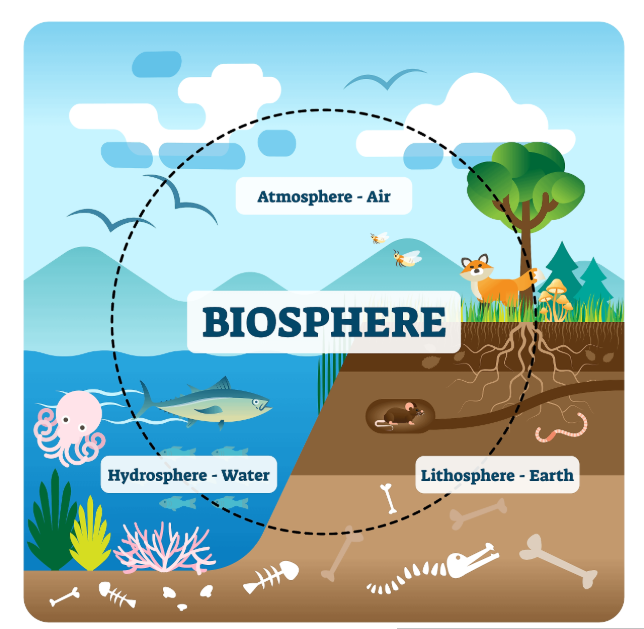
Location of spheres
What is Ecology?
Ecology is the scientific study of interactions between organisms and their environments.
What do Ecologist collect?
Ecologist collect Qualitative data (observations of organisms) and Quantitative data (measurements)
What are Biotic factors?
Biotic factors refer to living organisms that inhabit an environment.
What are Abiotic factors?
Abiotic factors refer to nonliving organisms that inhabit an environment.
What is the order of the Ecological systems from smallest to largest?
Organism: one individual living thing
Population: group of organisms of one species in one place at one time
Community: interacting populations (Many species all together)
Ecosystem: All Biotic and Abiotic factors in a certain area
Biome: all the ecosystems in a portion of the world with specific climate
Biosphere: The portion of the earth where life is found
What is a niche?
A niche is the unique role a species plays in an environment.
What is a habitat?
A habitat is where an organism lives. it can be shared among many species. A habitat includes food, shelter, and resources.
What is a fundamental niche?
A fundamental niche is a role an organism can occupy without competition.
What is a realized niche?
A realized niche is a smaller niche an organism occupies because of competition
What is tolerance?
Tolerance is the ability of an organism to survive in changing conditions, such as temperature.
What are specialist?
Specialist are organisms that have limited tolerance and can only withstand small changes in their environments.
What are generalist?
Generalist are organisms that adapt easily to changes in their niche due to large ranges of tolerance.
What are Autotrophs?
Producers
How do autotrophs/producers obtain energy?
Autotrophs/Producers obtain energy from the sun or chemical compounds.
What are Heterotrophs?
Consumers
How do heterotrophs/consumers obtain energy?
Heterotrophs/Consumers depend on autotrophs/producers for energy. (They eat them)
What do herbivores eat?
Herbivores eat plants.
What do carnivores eat?
Carnivores eat meat.
What do omnivores eat?
Omnivores eat plants and meat.
What do scavengers do?
Scavengers eat animals that have already died. They keep organisms from covering the ground while decomposing.
What do decomposers do?
Decomposers break down dead and decaying matter into simpler molecules that can be absorbed.

What do food chains show?
Food chains show the feeding relationships of organisms. The arrows show how much energy is being transferred. The energy transfer is 10% each time.

What do food webs show?
Food webs show many overlapping food chains and what eats what.
What are organisms sorted into?
Organisms are sorted into trophic levels in an energy pyramid.
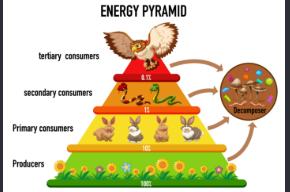
Why do the tropic levels have a pyramid shape?
Greater number of organisms are found at a lower level. 10% or energy is transferred.
What is the first law of Thermodynamics?
Energy cannot be created or destroyed.
How can energy be transferred?
Energy can be transferred from one organism to another in predatory relationships.
What happens to energy that is not transferred?
Stays in undigested food or is given off as heat.
What are Symbiotic relationships?
Symbiotic relationships are two species living in close contact for some of all their lives.
What are the three types of relationships?
Mutualism - Is a relationship where both organisms benefit.
Commensalism - One organism benefits and one is unaffected.
Parasitism/Preditation - One organism gets harmed while the other benefits.
Whats a species?
A species is a population of organisms that can interbreed and reproduce under natural conditions. There are 5-30 million species on earth.
How is an endangered species different from a threatened species?
An endangered species is in immediate jeopardy of extinction, while a threatened species is lower but likely to be extinct in the future.
What are factors that cause extinction?
Habitat loss, introduction to non-native species, over exploration, pollution, and disease.
What type of protection is offered by the Endangered Species Act of 1973?
Trade restrictions on species that are threatened or endangered. Land necessary for survival of a species is designated as a critical habitat and can’t be destroyed.
What is a gene pool?
A gene pool is the combined genetic information for a particular population of organisms. Each species has a common gene pool.
Speciation
Speciation - If the gene pool of two populations are separated and cannot be shared through reproduction. The population may develop into a new species.
What causes the differences in these groups to heighten over time?
Environments, natural selection.
What types of isolation causes speciation?
Behavioral - The two are incapable of inter breeding due to differences in court ship.
Mechanical - Reproductive, so different they can no longer mate.
Temporal - Mate at different times.
Geographic - Separated, so that prevents reproduction.
What’s Interspecific competition?
Interspecific competition is the competition between species.
What is the principle of competitive exclusion and how does it impact species?
Two species competing for the same limited resource cannot both have thriving populations.
What does linear/arithmetic growth show?
Linear growth show a pattern increasing in a constant rate.
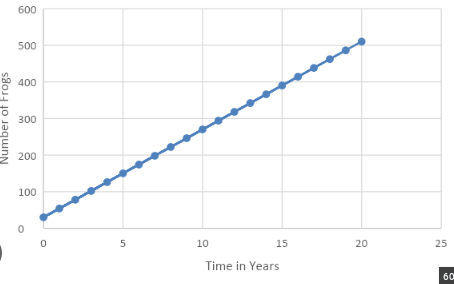
What kind of growth does Exponential/geometric growth show?
Exponential/geometric growth shows a pattern increasing at a constant rate.

How do populations increase and how can they be graphed?
Populations increase exponentially and can be graphed on a J curve.

What is Biotic potential, and what is it based on?
Biotic Potential is the rate at which a species increases, its based on its habitat requirements and reproductive rates.
What are Limiting factors?
Limiting factors are how the environment keeps populations from increasing forever, Limiting factors may cause organisms to die or move out of an area.
Eventually, the population will stabilize at the carrying capacity.
Carrying capacity - Is that maximum population size.
What are Density - Dependent factors
Factors that have an increasing effect as the population increases. Ex: Predators, Diseases, or competition.
What are Density - independent factors?
Factors the effect all populations regardless of how large. Ex: Temperature, Storms, Floods, droughts.
When Limiting factors limit the populations, the J curve will not continue to increase. It levels off at the carrying capacity. This is called an S curve.

What are populations made up of?
Populations are made up of individual organism, each with a particular life span.
When discussing an individuals life in terms of populations size, there are few terms ecologists use:
Natality - The addition of new individuals (birth)
Fecundity - Ability to reproduce
Fertility - # of offsprings produced
Mortality - Death rate
Life expectancy - Predicted length of survival
A survivorship curve shows the probability of survival for a given group or species. There are 3 survivorship curves based on the natality and mortality of individuals.
The 3 curves

What are characteristics of K strategists?
Stable environment
reproduce slower
strong, long life
large
high energy
High parental care
1 and 2 curve type
Ex: Lions, Humans, Bears
What are characteristics for R strategist?
Unstable environments
reproduce rapidly
weak
short life
small
type 3 curve
low energy
low parental care
Ex: Bunny, Bird, fish, Frog
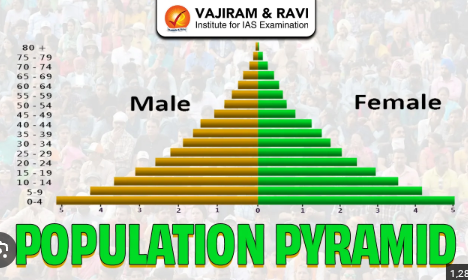
What does a population pyramid or age structure diagram show?
Shows a snapshot of the current population. This picture shows an expanding population.
What is a biome?
A biome is an area of the planet that can be classified according to the plants and animals that live in it.
What are the 4 characteristics that define a biome?
Temperature, soil, amount of lights, amount of water.
Tundra
Tundra - Cold, treeless, ground permanently frozen. 150-250mm rainfall
Taiga -
Taiga - Cold, animals hibernate, largest biome, coniferous tress. 400-1000mm
Grasslands -
Grasslands - Large rolling terrain, many grasses, few trees, fire. 250-750mm