#2 What are the actual and potential impacts of climate change in BC? part 1

0.0(0)
Studied by 0 people
call kaiCall Kai
learnLearn
examPractice Test
spaced repetitionSpaced Repetition
heart puzzleMatch
flashcardsFlashcards
GameKnowt Play
Card Sorting

1/14

encourage image

There's no tags or description

Looks like no tags are added yet.

15 Terms

1
New cards

Radiation

Electromagnetic waves: classified by

wavelength

• Longwave (LW): lower energy

• Shortwave (SW): higher energy

<p>Electromagnetic waves: classified by</p><p>wavelength</p><p>• Longwave (LW): lower energy</p><p>• Shortwave (SW): higher energy</p>
2
New cards

the Sun’s energy is emitted in the form of …

of electromagnetic radiation. mostly Shortwave (SW)

3
New cards

The earths energy (terrestrial)

also emitted in the form of electromagnetic wavelengths. Mostly Long wave

4
New cards

Stefan-Boltzmann Law of Radiation:

sun: ’m HOT, so I emit LARGE amounts of high intensity energy

Earth: “I’m COOL, so I emit LESSER amounts of energy. plus my ENERGY is at a lower intensity than Mr. Hotshot over there!”

The amount of energy emitted by an object is related to its temperature

5
New cards

Wein’s Law of Radiation:

Sun: “I’m HOT, so I emit my maximum amount of radiation at SHORTER wavelengths”

SW = visible & ultraviolet (UV)

Earth: I’m COOL, so I emit my maximum amount of radiation at LONGER wavelengths”

LW = infrared (IR) a form of invisible electromagnetic

6
New cards

Sunmary: Radiation Emissions Spectra for Sun and Earth

☀ The Sun's Radiation (Shortwave)

  • Peak Wavelength: Around 0.5 microns.

  • Spectrum Range: Mostly visible light (VIS), with some ultraviolet (UV) and near-infrared.

  • Characteristics: The Sun is extremely hotter. It emits short wavelengths, high frequencies, and higher energy radiation.

🌍 The Earth's Radiation (Longwave)

  • Peak Wavelength: Around 10 microns.

  • Spectrum Range: Entirely in the thermal infrared region.

  • Characteristics: The Earth is much cooler. It emits long wavelengths, low frequencies, and lower energy radiation.


<p><span data-name="sun" data-type="emoji">☀</span><strong> The Sun's Radiation (Shortwave)</strong></p><ul><li><p><span><strong>Peak Wavelength:</strong> Around <strong>0.5 microns</strong>.</span></p></li><li><p><span><strong>Spectrum Range:</strong> Mostly <strong>visible light (VIS)</strong>, with some ultraviolet (UV) and near-infrared.</span></p></li><li><p><span><strong>Characteristics:</strong> The Sun is extremely <strong>hotter</strong>. It emits <strong>short wavelengths</strong>, <strong>high frequencies</strong>, and <strong>higher energy</strong> radiation.</span></p></li></ul><p><span data-name="earth_africa" data-type="emoji">🌍</span><strong> The Earth's Radiation (Longwave)</strong></p><ul><li><p><span><strong>Peak Wavelength:</strong> Around <strong>10 microns</strong>.</span></p></li><li><p><span><strong>Spectrum Range:</strong> Entirely in the <strong>thermal infrared</strong> region.</span></p></li><li><p><span><strong>Characteristics:</strong> The Earth is much <strong>cooler</strong>. It emits <strong>long wavelengths</strong>, <strong>low frequencies</strong>, and <strong>lower energy</strong> radiation.</span></p></li></ul><p></p>
7
New cards

What is Earth’s Average Temperature?

•Earth’s average temperature as a whole is

about -18 degrees C.

•Earth’s average surface temperature is about

15 degrees C

8
New cards

Earth Greenhouse effect

☀ 1. Incoming Solar Radiation (Shortwave)

  • Total Incoming: The Sun delivers 343 w/m2 of solar energy to the top of the atmosphere.

  • Reflection: About 103 w/m2 is immediately reflected back into space by clouds, the atmosphere, and bright surfaces on Earth (like ice).

  • Atmospheric Passage: The remaining 240 w/m2 passes down through the atmosphere.

  • Surface Absorption: About half of the original energy, 168 w/m2 , is directly absorbed by the Earth's surface, heating up the land and oceans.

🌍 2. Outgoing Heat Radiation (Longwave)

  • Thermal Conversion: The absorbed solar energy warms the Earth's surface. The surface then converts this heat and radiates it back upward as longwave infrared radiation.

  • Greenhouse Gas Trap: Instead of escaping directly into space, greenhouse gases (like carbon dioxide, water vapor, and methane) absorb a large portion of this rising infrared radiation.

  • Re-emission: These gas molecules then re-emit the heat in all directions—including back down toward the Earth's surface, trapping extra warmth in the lower atmosphere.

⚖ 3. The Energy Balance

  • Final Escape: Eventually, 240 w/m2 of outgoing infrared radiation successfully passes through the atmosphere and escapes into space.

  • Equilibrium: Because the net incoming solar energy (\(343 - 103 = 240 w/m2 exactly equals the final outgoing infrared radiation (240 w/m2) the planet maintains a stable overall climate balance.
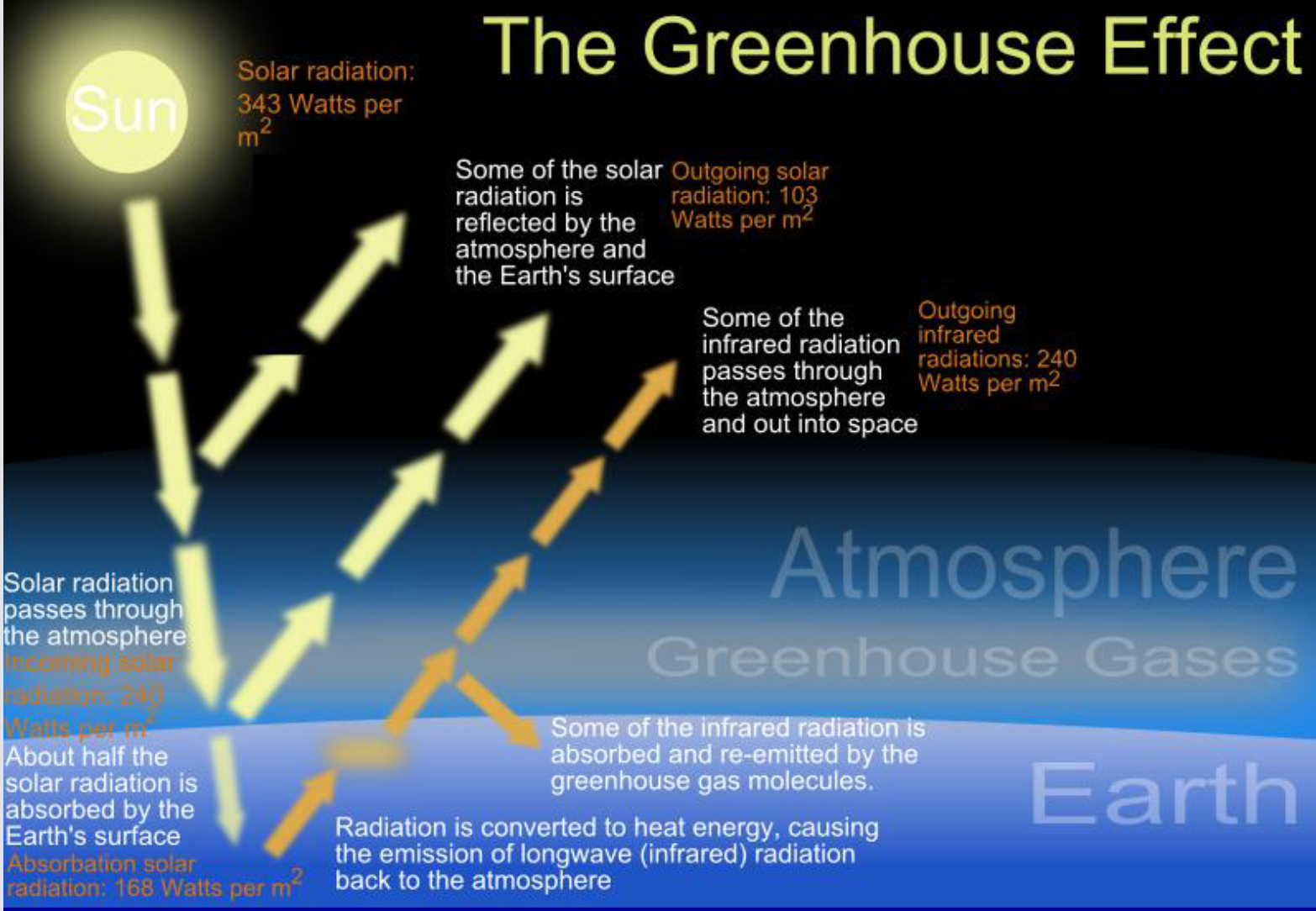

<p><span data-name="sun" data-type="emoji">☀</span><strong> 1. Incoming Solar Radiation (Shortwave)</strong></p><ul><li><p><span><strong>Total Incoming:</strong> The Sun delivers <strong>343 w/m2 </strong>of solar energy to the top of the atmosphere.</span></p></li><li><p><span><strong>Reflection:</strong> About <strong>103 </strong></span><strong>w/m2</strong><span> is immediately reflected back into space by clouds, the atmosphere, and bright surfaces on Earth (like ice).</span></p></li><li><p><span><strong>Atmospheric Passage:</strong> The remaining <strong>240 </strong></span><strong>w/m2 </strong><span>passes down through the atmosphere.</span></p></li><li><p><span><strong>Surface Absorption:</strong> About half of the original energy, <strong>168 </strong></span><strong>w/m2 </strong><span>, is directly absorbed by the Earth's surface, heating up the land and oceans.</span></p></li></ul><p><span data-name="earth_africa" data-type="emoji">🌍</span><strong> 2. Outgoing Heat Radiation (Longwave)</strong></p><ul><li><p><span><strong>Thermal Conversion:</strong> The absorbed solar energy warms the Earth's surface. The surface then converts this heat and radiates it back upward as <strong>longwave infrared radiation</strong>.</span></p></li><li><p><span><strong>Greenhouse Gas Trap:</strong> Instead of escaping directly into space, <strong>greenhouse gases</strong> (like carbon dioxide, water vapor, and methane) absorb a large portion of this rising infrared radiation.</span></p></li><li><p><span><strong>Re-emission:</strong> These gas molecules then re-emit the heat in all directions—including <strong>back down toward the Earth's surface</strong>, trapping extra warmth in the lower atmosphere.</span></p></li></ul><p><span data-name="scales" data-type="emoji">⚖</span><strong> 3. The Energy Balance</strong></p><ul><li><p><span><strong>Final Escape:</strong> Eventually, <strong>240 </strong></span><strong>w/m2 </strong><span>of outgoing infrared radiation successfully passes through the atmosphere and escapes into space.</span></p></li><li><p><span><strong>Equilibrium:</strong> Because the net incoming solar energy (\(343 - 103 = 240 </span><strong>w/m2 </strong><span> exactly equals the final outgoing infrared radiation (240 </span><strong>w/m2) </strong><span> the planet maintains a stable overall climate balance.</span></p></li></ul><p></p>
9
New cards

Why is the surface so much warmer than the Earth as a whole?

due to the greenhouse effect. The Trap and Loop: Look at the curved orange arrows at the bottom right. The text states: "Some of the infrared radiation is absorbed and re-emitted by the greenhouse gas molecules."

  • Double Heating: This means the Earth's surface is not just heated once by the Sun 168 w/m2. It is continuously warmed a second time by heat that was trying to escape but got redirected back down by the atmosphere.


10
New cards

Selective emission and absorption

Some substances emit and absorb radiation at certain wavelengths only. This is mainly true of gases

11
New cards

Example: Absorption by atmospheric gases

☀ Incoming Radiation (Left Side)

  • High Transparency: The atmosphere is highly transparent (near 0 absorption) in the visible light (VIS) spectrum (around 0.4 to 0.7 microns). This allows sunlight to reach and warm the Earth's surface.

  • UV Protection: Ozone (\(O_{3}\)) and Oxygen (\(O_{2}\)) show an absorption value of 1 in the ultraviolet (UV) range. This means they absorb and block harmful high-energy UV rays from reaching the surface.

🌍 Outgoing Radiation (Right Side)

  • Heat Trapping: The Earth emits longwave infrared (IR) radiation (from 3 to 30+ microns).

  • The Major Absorbers: Water Vapor (\(H_{2}O\)) and Carbon Dioxide (\(CO_{2}\)) have massive red blocks in the IR region, meaning they absorb almost all the outgoing heat at those specific wavelengths.

  • Other Greenhouse Gases: Methane (\(CH_{4}\)) and Nitrous Oxide (\(N_{2}O\)) also have narrow spikes in the IR zone, trapping heat at specific narrow wavelengths.


<p><span data-name="sun" data-type="emoji">☀</span><strong> Incoming Radiation (Left Side)</strong></p><ul><li><p><span><strong>High Transparency:</strong> The atmosphere is highly transparent (near 0 absorption) in the <strong>visible light (VIS)</strong> spectrum (around 0.4 to 0.7 microns). This allows sunlight to reach and warm the Earth's surface.</span></p></li><li><p><span><strong>UV Protection:</strong> <strong>Ozone (\(O_{3}\)) and Oxygen (\(O_{2}\))</strong> show an absorption value of 1 in the ultraviolet (UV) range. This means they absorb and block harmful high-energy UV rays from reaching the surface.</span></p></li></ul><p><span data-name="earth_africa" data-type="emoji">🌍</span><strong> Outgoing Radiation (Right Side)</strong></p><ul><li><p><span><strong>Heat Trapping:</strong> The Earth emits longwave <strong>infrared (IR)</strong> radiation (from 3 to 30+ microns).</span></p></li><li><p><span><strong>The Major Absorbers:</strong> <strong>Water Vapor (\(H_{2}O\))</strong> and <strong>Carbon Dioxide (\(CO_{2}\))</strong> have massive red blocks in the IR region, meaning they absorb almost all the outgoing heat at those specific wavelengths.</span></p></li><li><p><span><strong>Other Greenhouse Gases:</strong> <strong>Methane (\(CH_{4}\))</strong> and <strong>Nitrous Oxide (\(N_{2}O\))</strong> also have narrow spikes in the IR zone, trapping heat at specific narrow wavelengths.</span></p></li></ul><p></p>
12
New cards

Greenhouse effect: Warms Earth’s surface

  • 🚫 1. The Big Misconception: The Sun is Not Involved

    • The Rule: Look at the white text box on the left: "Notice that the greenhouse effect does NOT involve radiation coming in from the Sun."

    • The Reality: Solar radiation (shortwave) passes right through greenhouse gases without being trapped. The greenhouse effect only happens after the Earth absorbs that sunlight and converts it into upward-bound infrared heat (longwave).

    🔴 2. Simplified Directions (Up vs. Down)

    • The Mechanism: The red circle and red arrows highlight the Greenhouse Gases layer.

    • The Simplification: Instead of complex scattered paths, the diagram simplifies GHG behavior into two streams:

      • Up: Some trapped heat is passed along to escape out into space 239 Wm-2.

      • Down: A massive chunk is re-emitted back to the ground as Back Radiation 333 wm-2.

    📈 3. The Core Rule: More GHGs = Stronger Warming

    • The Takeaway: As human activities add "MORE GHGs," the red circled area gets thicker and more efficient at trapping heat.

    • The Result: The Back Radiation arrow (333) will increase, forcing the surface to absorb more heat, which drives up global temperatures and worsens the Net Imbalance 0.9 wm-2.


<ul><li><p><span data-name="no_entry_sign" data-type="emoji">🚫</span><strong> 1. The Big Misconception: The Sun is Not Involved</strong></p><ul><li><p><span><strong>The Rule:</strong> Look at the white text box on the left: <em>"Notice that the greenhouse effect does </em><strong><em>NOT</em></strong><em> involve radiation coming in from the Sun."</em></span></p></li><li><p><span><strong>The Reality:</strong> Solar radiation (shortwave) passes right through greenhouse gases without being trapped. The greenhouse effect <strong>only</strong> happens <em>after</em> the Earth absorbs that sunlight and converts it into upward-bound infrared heat (longwave).</span></p></li></ul><p><span data-name="red_circle" data-type="emoji">🔴</span><strong> 2. Simplified Directions (Up vs. Down)</strong></p><ul><li><p><span><strong>The Mechanism:</strong> The red circle and red arrows highlight the <strong>Greenhouse Gases</strong> layer.</span></p></li><li><p><span><strong>The Simplification:</strong> Instead of complex scattered paths, the diagram simplifies GHG behavior into two streams:</span></p><ul><li><p><span><strong>Up:</strong> Some trapped heat is passed along to escape out into space <strong>239 Wm-2</strong>.</span></p></li><li><p><span><strong>Down:</strong> A massive chunk is re-emitted back to the ground as <strong>Back Radiation</strong> <strong>333 wm-2</strong>.</span></p></li></ul></li></ul><p><span data-name="chart_increasing" data-type="emoji">📈</span><strong> 3. The Core Rule: More GHGs = Stronger Warming</strong></p><ul><li><p><span><strong>The Takeaway:</strong> As human activities add <strong>"MORE GHGs,"</strong> the red circled area gets thicker and more efficient at trapping heat.</span></p></li><li><p><span><strong>The Result:</strong> The <strong>Back Radiation</strong> arrow (333) will increase, forcing the surface to absorb more heat, which drives up global temperatures and worsens the <strong>Net Imbalance 0.9</strong></span><strong> wm-2</strong><span>.</span></p></li></ul></li></ul><p></p>
13
New cards

What do greenhouse gases do?

  • The Match: The Earth cools down by sending heat waves out into space. Greenhouse gases vibrate at the exact same frequency as these waves.

  • The Trap: When a heat wave hits a greenhouse gas molecule, the molecule absorbs the energy, vibrates, and shoots that heat back out in all directions—including right back down to Earth.

  • The Result: This process keeps the planet much warmer than it would be without an atmosphere.


14
New cards

We need the Greenhouse Effect!

It is what keeps Earth a comfortable temperature for life

• Without any greenhouse gases in the atmosphere, Earth’s average temperature would be -18 degrees C

15
New cards



