Lesson4- 3.5c(The nitrogen Cycle)

0.0(0)
Studied by 1 person
call kaiCall Kai
learnLearn
examPractice Test
spaced repetitionSpaced Repetition
heart puzzleMatch
flashcardsFlashcards
GameKnowt Play
Card Sorting

1/4

encourage image

There's no tags or description

Looks like no tags are added yet.

5 Terms

1
New cards
<p>1 What is the role of microorganisms?</p><ol start="2"><li><p>Name a nitrogen fixing bacteria?</p></li><li><p>What percentage of the atmosphere is nitrogen?</p></li></ol><p><strong>The role of microorganisms</strong></p><p>Microorganisms, such as fungi and bacteria, are an important part of food webs and ecosystems. →</p><p>Many are …4?</p><p>Saprobionts do two things. 5.Name them?</p><p>The two things in more detail:</p><ul><li><p>Feed on the remains of dead plants, animals and their waste products (faeces and urine), …6? them down. This makes saprobionts a type of dec…7? and it allows important chemical elements in the remains and waste to be re…8?.</p></li><li><p>They secrete enzymes and digest food …9?, then ab…10? the nutrients they need. This is known as …11? digestion. During this process, organic molecules are broken down into …12? ions.</p><p></p></li></ul><p>-Obtaining nutrients from dead organic matter and animal waste using extracellular digestion is known as …13?.</p><p></p>

1 What is the role of microorganisms?

  1. Name a nitrogen fixing bacteria?

  2. What percentage of the atmosphere is nitrogen?

The role of microorganisms

Microorganisms, such as fungi and bacteria, are an important part of food webs and ecosystems. →

Many are …4?

Saprobionts do two things. 5.Name them?

The two things in more detail:

  • Feed on the remains of dead plants, animals and their waste products (faeces and urine), …6? them down. This makes saprobionts a type of dec…7? and it allows important chemical elements in the remains and waste to be re…8?.

  • They secrete enzymes and digest food …9?, then ab…10? the nutrients they need. This is known as …11? digestion. During this process, organic molecules are broken down into …12? ions.


-Obtaining nutrients from dead organic matter and animal waste using extracellular digestion is known as …13?.


  1. Obtain nutrients from dead organic matter/ animal waste

  2. Rhizobium

  3. 78%

  4. Saprobionts

  5. Break down the remains of dead plants,animals+their waste products and secrete enzymes.

  6. Breaking

  7. Decomposer

  8. Recycled

  9. Externally

  10. Absorb

  11. Extracellular

  12. Inorganic

  13. Saprobiotic nutrition


2
New cards
<p><strong>Mycorrhizae</strong></p><p>Some fungi form …1? relationships with the …2? of plants. These relationships are known as …3?.</p><p>Note: Symbiotic- Two species live closely together and one or both depend on the other for survival.</p><p>Fungi are made of long thin stands called ..4?. These connect to the plant's …5?.</p><p>Hyphae increase the …6? of the roots helping the plant to absorb more …7? from the soil that are usually scarce. (phosphorus)→ They also increase the uptake of wa..8?</p><p>In turn, the fungi obtains …9? compounds, like glucose, from the plant</p><p></p><p><strong>The nitrogen cycle</strong></p><p>Plants and animals need nitrogen to make …10? and nucleic acids (DNA and RNA).</p><p>The atmosphere is made up of …11? nitrogen, but plants and animals cannot use it in that form - they need bacteria to convert it to nitrogen containing compounds.</p><p>The nitrogen cycle shows how:</p><ul><li><p>Nitrogen is converted to a useable form</p></li><li><p>Passed on between different living organisms and non-living environment</p><p>The nitrogen cycle includes food chains and 4 different processes that involve bacteria. 12.Name the 4 processes?</p></li></ul><p></p>

Mycorrhizae

Some fungi form …1? relationships with the …2? of plants. These relationships are known as …3?.

Note: Symbiotic- Two species live closely together and one or both depend on the other for survival.

Fungi are made of long thin stands called ..4?. These connect to the plant's …5?.

Hyphae increase the …6? of the roots helping the plant to absorb more …7? from the soil that are usually scarce. (phosphorus)→ They also increase the uptake of wa..8?

In turn, the fungi obtains …9? compounds, like glucose, from the plant


The nitrogen cycle

Plants and animals need nitrogen to make …10? and nucleic acids (DNA and RNA).

The atmosphere is made up of …11? nitrogen, but plants and animals cannot use it in that form - they need bacteria to convert it to nitrogen containing compounds.

The nitrogen cycle shows how:

  • Nitrogen is converted to a useable form

  • Passed on between different living organisms and non-living environment

    The nitrogen cycle includes food chains and 4 different processes that involve bacteria. 12.Name the 4 processes?


  1. Symbiotic

  2. Roots

  3. Mycorrhizae

  4. Hyphae

  5. Roots

  6. Surface area

  7. Ions

  8. Water

  9. Organic

  10. Protein

  11. 78%

  12. •Nitrogen fixation

    •Ammonification

    •Nitrification

•Denitrification


<ol><li><p>Symbiotic</p></li><li><p>Roots</p></li><li><p>Mycorrhizae</p></li><li><p>Hyphae</p></li><li><p>Roots</p></li><li><p>Surface area</p></li><li><p>Ions</p></li><li><p>Water</p></li><li><p>Organic</p></li><li><p>Protein</p></li><li><p>78%</p></li><li><p>•Nitrogen fixation</p><p>•Ammonification</p><p>•Nitrification</p></li></ol><p>•Denitrification</p><p></p>
3
New cards
<p><strong>The nitrogen cycle</strong></p><p><strong>Nitrogen Fixation</strong></p><p>summary→ Nitrogen gas in the …1? is converted to nitrogen containing compounds (…2?)</p><p>Bacteria such as …3? turns nitrogen into Ammonia which is then converted to …4? ions in …5? that are used by …6?.</p><p>Rhizobium forms …7?(both benefit) relationships with leguminous plants (beans) - providing the plant with nitrogen compounds and in return the bacteria are supplied …8?.</p><p></p><p><strong>Ammonification</strong></p><p>Nitrogen containing compounds(must say DNA,proteins in an exam questions) from dead organisms are turned into ammonia by …9?→</p><p>These go onto form …10?</p><p>Animal waste (urine and faeces) also contain ..11? compounds. These are also turned into ammonia by …12?.</p>

The nitrogen cycle

Nitrogen Fixation

summary→ Nitrogen gas in the …1? is converted to nitrogen containing compounds (…2?)

Bacteria such as …3? turns nitrogen into Ammonia which is then converted to …4? ions in …5? that are used by …6?.

Rhizobium forms …7?(both benefit) relationships with leguminous plants (beans) - providing the plant with nitrogen compounds and in return the bacteria are supplied …8?.


Ammonification

Nitrogen containing compounds(must say DNA,proteins in an exam questions) from dead organisms are turned into ammonia by …9?→

These go onto form …10?

Animal waste (urine and faeces) also contain ..11? compounds. These are also turned into ammonia by …12?.

  1. Atmosphere

  2. Ammonia

  3. Rhizobium

  4. Ammonium

  5. Solution

  6. Plants

  7. Mutualistic

  8. Carbohydrates

  9. Saprobionts

  10. Ammonium ions

  11. Nitrogen

  12. Saprobionts


<ol><li><p>Atmosphere</p></li><li><p>Ammonia</p></li><li><p>Rhizobium</p></li><li><p>Ammonium</p></li><li><p>Solution</p></li><li><p>Plants</p></li><li><p>Mutualistic</p></li><li><p>Carbohydrates</p></li><li><p>Saprobionts</p></li><li><p>Ammonium ions</p></li><li><p>Nitrogen</p></li><li><p>Saprobionts</p></li></ol><p></p>
4
New cards
<p><strong>Nitrification</strong></p><p>summary→ Ammonium ions in the …1? are changed into nitrogen compounds that can be used by plants (…2?).</p><p>•First, nitrifying bacteria called …3? change ammonium ions into …4?.</p><p>•Then, other nitrifying bacteria called …5? change nitrites into …6?</p><p></p><p><strong>Denitrification</strong></p><p><span>Summary→ Nitrates in the soil are converted into nitrogen gas by …7? bacteria</span></p><p><span>They use nitrates in the soil to carry out …8? and produce nitrogen gas. This happens under …9? conditions (water-logged soil)</span></p><p><span>Nitrogen gas also is produced by lig…10? and artificial …11?</span></p>

Nitrification

summary→ Ammonium ions in the …1? are changed into nitrogen compounds that can be used by plants (…2?).

•First, nitrifying bacteria called …3? change ammonium ions into …4?.

•Then, other nitrifying bacteria called …5? change nitrites into …6?


Denitrification

Summary→ Nitrates in the soil are converted into nitrogen gas by …7? bacteria

They use nitrates in the soil to carry out …8? and produce nitrogen gas. This happens under …9? conditions (water-logged soil)

Nitrogen gas also is produced by lig…10? and artificial …11?

  1. Soil

  2. Nitrates

  3. Nitrosomonas

  4. Nitrites

  1. Nitrobacter

  2. Nitrates

  3. Denitrifying

  4. Respiration

  5. Anaerobic

  6. Lighting

  7. Fertilizers


<ol><li><p>Soil</p></li><li><p>Nitrates</p></li><li><p class="has-focus">Nitrosomonas </p></li><li><p class="has-focus">Nitrites </p></li></ol><ol start="5"><li><p class="has-focus">Nitrobacter </p></li><li><p class="has-focus">Nitrates</p></li><li><p class="has-focus">Denitrifying </p></li><li><p class="has-focus">Respiration</p></li><li><p class="has-focus">Anaerobic </p></li><li><p class="has-focus">Lighting</p></li><li><p class="has-focus">Fertilizers </p></li></ol><p></p><p> </p><p></p>
5
New cards
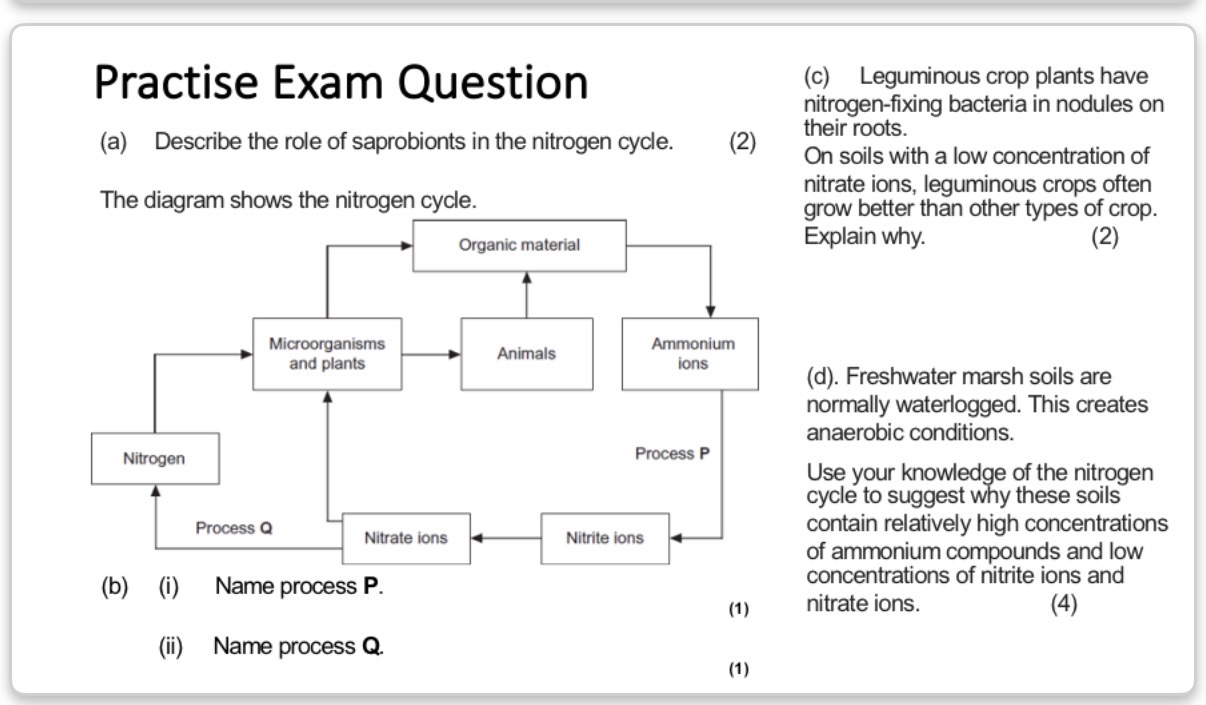
<p>Answer image questions</p>

Answer image questions

knowt flashcard image