PT 759 - Autonomic Nervous System
 Call Kai
 Learn
Learn Practice Test
 Spaced Repetition
 Match
Match Flashcards
 Knowt Play
1/62

There's no tags or description
Looks like no tags are added yet.
Name | Mastery | Learn | Test | Matching | Spaced | Call with Kai | Chat |
|---|
No analytics yet
Send a link to your students to track their progress
63 Terms
How many divisions are there in the autonomic nervous system?
3: sympathetic, parasympathetic, enteric

What is the primary function of the ANS?
Maintain homeostasis and optimal internal environment

Does the ANS need to be consciously controlled?
No operates via subconscious involuntary control

Visceral afferents enter the spinal cord and do what once there?
Synapse with visceral efferents and with neurons that go to the brainstem, hypothalamus and thalamus

Which cranial nerves convey autonomic afferent information?
Glossopharyngeal (CN IX)
Vagus (X)
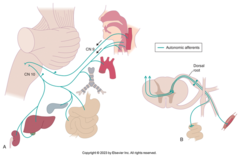
Sensory neurons of the ANS are embedded in the visceral organs and vasculature and use which types of receptors?
- Mechanoreceptors
- Chemoreceptors
- Nociceptors
- Thermoreceptors
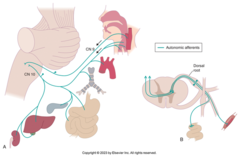
The medulla plays a role in regulating which bodily processes?
HR
Breathing
Vasoconstriction
Vasodilation

The pons plays a role in regulating which bodily processes?
Respiration

What is the role of the hypothalamus in the ANS? And through which bodily processes?
Maintains equilibrium in interior by influencing:
Eating
Drinking
Sleep
Body temp
Sexual function
Hormones

What is the role of the emotion/motivation system in autonomic regulation?
Emotions are translated in bodily responses (anxiety increases HR)
What are the two main divisions of the ANS? And what is the third?
Two main are sympathetic and parasympathetic
Third is enteric
How do the sympathetic and parasympathetic systems work together to maintain homeostasis?
They counterbalance each other
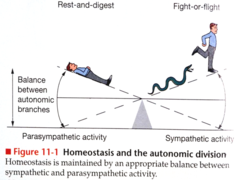
When would the sympathetic division of the ANS be stimulated?
When performing activities that require energy (ex. freeze, flight or fight)

What effects does sympathetic stimulation of the ANS produce?
Increases in HR, BP, blood flow to somatic muscle
Decrease in blood flow to gut

When would the parasympathetic division of the ANS be stimulated?
When trying to conserve energy and replenish bodily resources
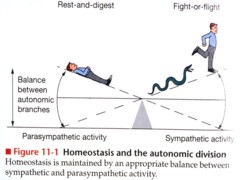
What effects does parasympathetic stimulation of the ANS produce?
Decreases in HR and BP
Increased gut motility

The sympathetic and parasympathetic nervous systems share similarities in that they both?
Activate visceral and arterial smooth muscle
Cause secretion by wide array of glands

Sympathetic and parasympathetic control of the viscera regulates which systems?
Regulates:
- cardiovascular system
- respiratory system
- digestive system
- urinary system
- glandular secretions
- sexual and reproductive systems
- osmosis and temp

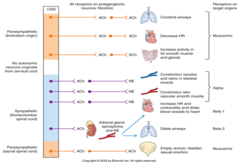
Be able to explain this picture and all the pathways.

Where do sympathetic nerves of the efferent pathways of the ANS originate and where do they synapse?
Originate at T1-L2 spinal cord segments
Synapse in paravertebral ganglia (located in sympathetic trunk) or in outlying ganglia

What are the outlying ganglia that sympathetic nerves of the efferent pathways of the ANS synapse with?
Cervical ganglia
Celiac ganglia
Mesenteric ganglia

Where do parasympathetic nerves of the efferent pathways of the ANS originate?
Originate from cranial nerve nuclei in brainstem and sacral spinal cord segments

The 2-neuron pathway present in the efferent pathways of the ANS includes neurons synapsing where? And what are the 2 neurons?
2 neurons synapsing in a peripheral region:
Pre-ganglionic neurons
Post-ganglionic

Where is the pre-ganglionic neuron in the efferent pathway of the ANS located? And where do its fibers extend to?
Located in brainstem or spinal cord
Fibers extend to autonomic ganglion

Post ganglionic neurons of the efferent pathway are also called what?
Where are they located?
And where do their fibers extend to?
Called lower motor neurons
Located in the autonomic ganglion
Fibers extend to effector organ or glands

Are the autonomic ganglia of the efferent pathways of the ANS located outside the spinal cord?
Yes, external to spinal cord

Identify the pre-ganglionic neuron that synapses in the sympathetic chain ganglion, the lower motor neuron, and post-ganglionic fibers in this photo.

The sympathetic chain is located where in relation to the spinal cord?
Lateral to and near the vertebral column

Postganglionic ganglia of the parasympathetic NS are located where?
At or within visceral effector organs

The sympathetic nervous system has cell bodies going from T1-L2 giving it the other name of?
Thoracolumbar outflow

The neurotransmitters used in the ANS are?
Acetylcholine
Norepinephrine
Epinephrine

Preganglionic neurons of both the sympathetic and parasympathetic systems secrete which NT onto lower motor neurons?
Acetylcholine (ACh)

The lower motor neurons (postganglionic neurons) for the sympathetic and parasympathetic systems use which NT?
ACh
NE
Epi

In the sympathetic NS preganglionic neurons secrete which NT? And postganglionic LMN secrete which NT?
Pre secretes ACh
Post secretes NE

In the parasympathetic NS both pre and postganglionic neurons secrete which NT?
ACh

What is the major function of sympathetic NS and what is it known as?
Major function: maintain optimal blood supply to organs
Known as "fight-or-flight"
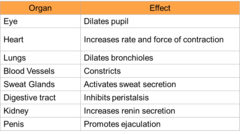
A person who has threatened/fearful response would cause sympathetic activation creating what changes?
HR increase
Breathing rapid and deep
Skin cold and sweaty
Pupils dilate
Gut motility reduced
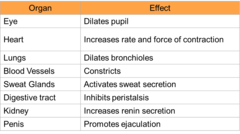
Major effects of the sympathetic NS are?
Optimized blood flow to organs
Regulation of body temp and metabolic rate
Regulation of activity of viscera

Spinal segments from the sympathetic nervous system innervates viscera in which areas of the trunk and thorax?
Upper thoracic
Various thoracic
Lower thoracic
Upper lumbar

The upper thoracic spinal segments of the sympathetic neurons innervate which regions?
Head
Neck
UE
Heart
Thoracic cavity

Various thoracic spinal segments of the sympathetic NS innervate which viscera?
Stomach
Intestines
Parts of colon
Adrenal medulla
Abdomen
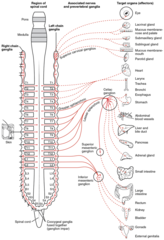
Lower thoracic and upper lumbar spinal segments of the sympathetic NS innervate which viscera?
Parts of colon
Rectum
Pelvis
Lower trunk
LE

In addition to innervating the viscera, the sympathetic NS also sends axons out (efferent) with each segment that do what?
Constrict blood vessels
Open sweat glands
Excite hair follicles

The sympathetic nervous system is composed of what?
Sympathetic chain
Superior cervical ganglion
Celiac ganglion
Superior mesenteric ganglion
Inferior mesenteric ganglion
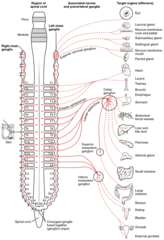
The adrenal medulla secretes which NT used in the sympathetic NS? And in response to what?
Secretes EPI and NE into the blood stream in response to stress

EPI and NE ramp up what response in the body?
Fight or flight

Pre ganglionic cells in the sympathetic NS secrete which NT? And LMN in the ganglia secrete which NT?
Pre secrete ACh
LMN secrete NE

How quickly do target organs respond to norepinephrine, and how long does the effect last?
Immediate and time limited

What is the principal function of the parasympathetic NS?
Energy conservation and storage

After someone finishes a meal, what PNS effects would you see in a person?
Low BP, HR, respiratory rate
GI tract activity high
Warm skin
Constricted pupils
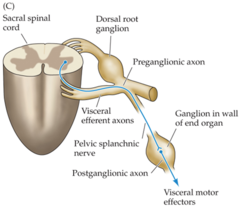
Is the PNS more or less restricted in its distribution (craniosacral outflow)?
More restricted

Cell bodies of preganglionic neurons are located where in the PNS?
Brainstem nuclei of cranial nerves:
CN III, VII, IX, X
Sacral segments S2-S4
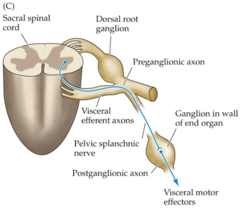
Cell bodies of postganglionic neurons are found where in the PNS?
At or within visceral effector organs
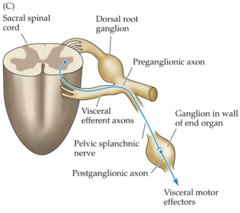
Effector organs of the PNS are?
Pupils
Salivary, nasal, and lacrimal glands
Heart and lungs
Most visceral organs

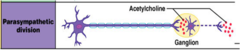
What NT does the PNS only use?
ACh

What are the various receptor types in the PNS? And what type of signal do they send?
Nicotinic always send excitatory
Muscarinic can send inhibitory or excitatory
What is the function of the enteric system?
Influence activity of the GI tract

The enteric system is composed of which two systems?
Intrinsic and extrinsic systems

The intrinsic system of the enteric system does what?
Modulate secretion and motility

The extrinsic system of the enteric system does what?
Override intrinsic system through sympathetic or parasympathetic systems to increase or decrease motility

Give an example of differential activation of the SNS or PNS creating a specific effect at a target organ.
Pupils dilate or constrict in response to light intensity
Initiation of gag reflex or swallowing in response to stimuli in the larynx and esophagus

Effects of the SNS and PNS are synergistic creating what effect at the target organ?
Opposing actions are balanced to create optimal organ function
Dysfunction of the ANS include what? (Might not be on quiz/midterm)
Horner's syndrome
Orthostatic hypertension
Postural orthostatic tachycardia syndrome (POTS)
Reflex syncope
