lecture 9 - functional organization of nervous tissue
 Call Kai
 Learn
 Practice Test
 Spaced Repetition
 Match
 Flashcards
 Knowt Play
1/132

There's no tags or description
Looks like no tags are added yet.
133 Terms
What is the main role of the nervous system?
To gather information, process it, and produce responses that help maintain controlled conditions and homeostasis.

What are the three general functions of the nervous system?
Sensory functions, integrative functions, and motor functions.

What is the sensory role of the nervous system?
Gathering information from the external and internal environment.

What are examples of external sensory information?
Touch, vision, hearing, pressure on the skin, and temperature changes.
What are examples of internal sensory information?
Blood oxygen and carbon dioxide levels, pH changes, and blood pressure changes.
What are sensory receptors?
Specialized receptors that detect changes in the internal or external environment.
Why does the nervous system gather internal information?
To determine whether adjustments are needed to maintain homeostasis.

What is the motor role of the nervous system?
Responding to sensory information by producing a response.
What tissues can the motor side of the nervous system affect?
Muscles and glands.

What is the integrative function of the nervous system?
Analyzing sensory information and deciding what information and responses should be used.

Why does the nervous system not consciously perceive all sensory information?
Ignoring some sensory information allows the brain to focus attention on more pressing information.

What are examples of higher-order processing or executive functions?
Mental activities, consciousness, thinking, memories, and emotions.

What does the integrative function include besides processing sensory information?
Storing aspects of sensory information and making decisions about appropriate motor responses.

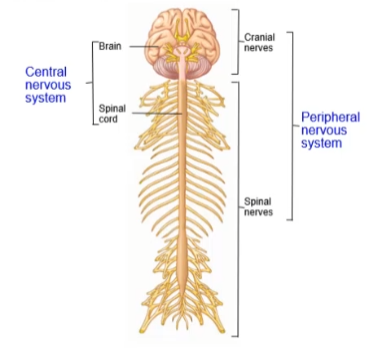
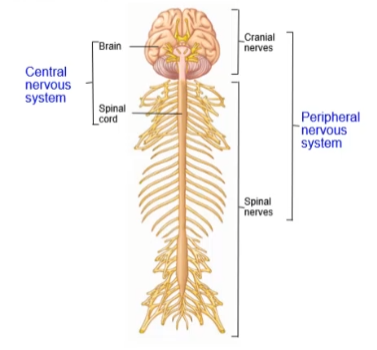
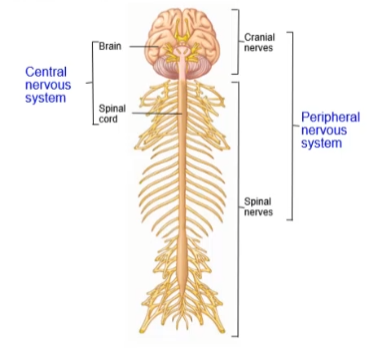
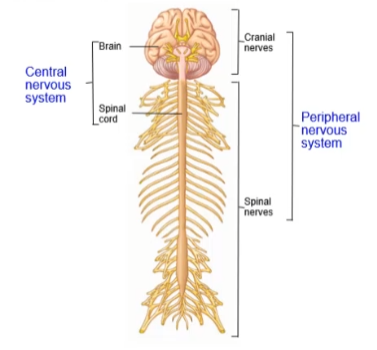
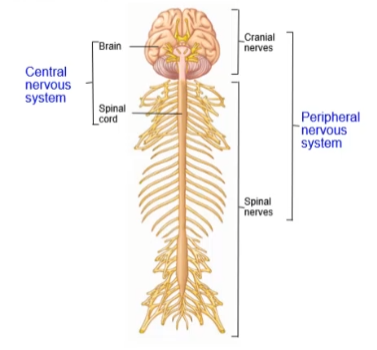
What are the major components of the nervous system?
Brain, spinal cord, nerves, and specialized sensory receptors.
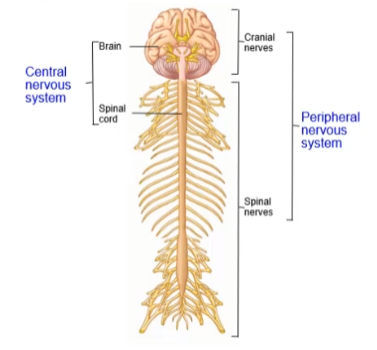
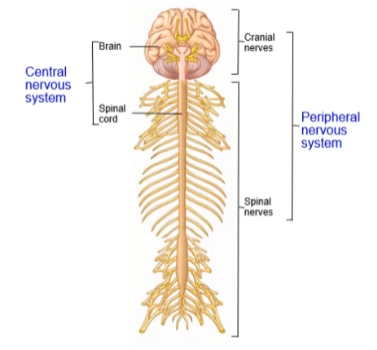
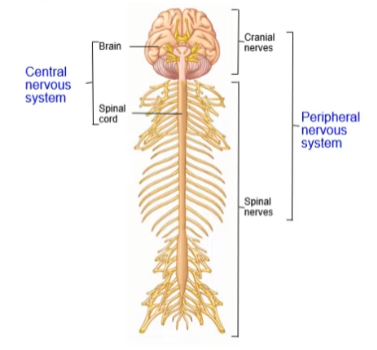
What are the two major divisions of the nervous system?
Central nervous system and peripheral nervous system.

What are the parts of the central nervous system?
Brain and spinal cord.

What is the peripheral nervous system?
Everything outside the brain and spinal cord, including nerves and sensory receptors.
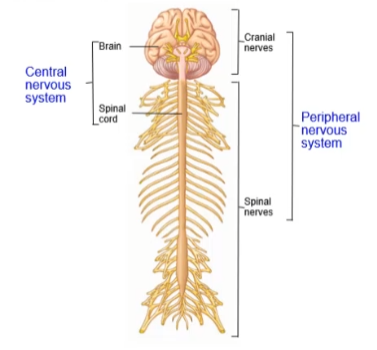
What does the peripheral nervous system contain?
Nerves that enter or exit the brain and spinal cord, plus sensory receptors.

What are the two types of nerves in the peripheral nervous system?
Cranial nerves and spinal nerves.

What are cranial nerves?
Nerves that originate or terminate in structures of the brain.

How many pairs of cranial nerves are there?
12 pairs.

What are spinal nerves?
Nerves that originate or terminate in the spinal cord.

How many pairs of spinal nerves are there?
31 pairs.

What determines whether a nerve is classified as a cranial or spinal nerve?
Where the nerve originates or terminates.

What is a neuron?
A specialized cell in nervous tissue that can conduct signals from one part of the body to another.
What is the cell body of a neuron?
The main part of the neuron from which extensions such as the axon and dendrites arise.

What is an axon?
A long extension from the cell body that carries information toward another location.

What is the function of an axon?
To carry signals from a neuron toward another cell or target tissue.

What are dendrites?
Cytoplasmic projections from the cell body that receive information from other neurons.

What is another function of specialized dendrites?
They can help gather sensory information from the internal and external environment.

What is a nerve?
A bundle of axons from many neurons along with their sheaths.

What does a nerve connect?
The central nervous system with sensory receptors, muscles, and glands.

In which directions can information travel through nerves?
Toward the central nervous system for sensory information or away from it for motor information.
What is a ganglion?
A collection of neuron cell bodies outside the central nervous system.
What is the plural of ganglion?
Ganglia.

Where are ganglia located?
Outside the central nervous system, as part of the peripheral nervous system.

What is one role of a ganglion?
It can contain neuron cell bodies and can be a connection point between two neurons.

Where are the cell bodies of spinal sensory neurons located?
In ganglia outside the central nervous system.

What is a plexus?
A network of nerves (sometimes with neuron cell bodies mixed in) located outside the CNS.

What is the plural of plexus?
Plexuses.
How does a plexus differ from a nerve?
A nerve is a bundle of axons, while a plexus is a network where nerves join, exchange information, and separate again.
What is one function of a plexus?
It allows neural information to be exchanged between different levels of the spinal cord.

What are the two main divisions of the peripheral nervous system?
Sensory division and motor division.

What is another name for the sensory division of the peripheral nervous system?
Afferent division.

What does the sensory or afferent division do?
Carries information from the internal and external environment toward the central nervous system.

What type of electrical signals carry nervous system information?
Action potentials.

What triggers an action potential in the sensory division?
A stimulus that activates a sensory receptor.

What happens after a sensory receptor detects a stimulus?
An action potential is generated and carried toward the central nervous system.
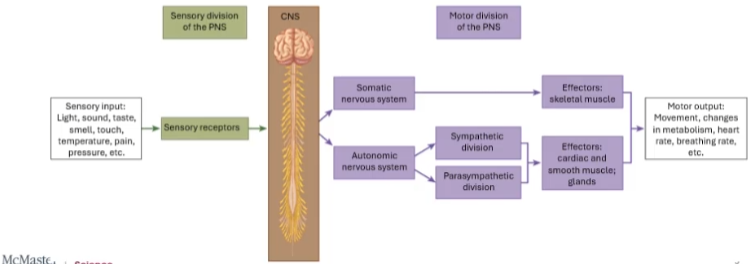
What types of information can be carried by the sensory division?
Light, sound, taste, smell, touch, temperature, pressure, and pain.
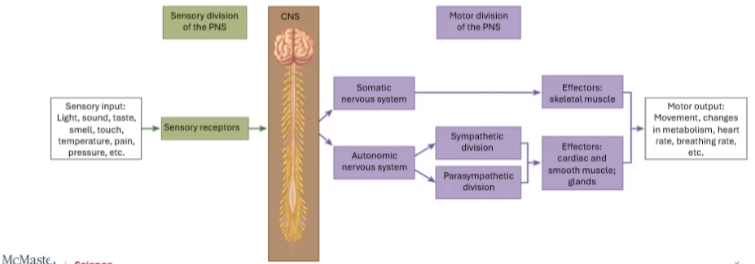
What is the motor division of the peripheral nervous system?
The division that carries signals from the central nervous system to effector tissues.

What is another name for the motor division?
Efferent division.

What are effector tissues?
Muscles or glands that are the target tissues of motor signals.

What are the 3 main divisions of the motor peripheral nervous system?
Somatic nervous system, autonomic nervous system and enteric nervous system.
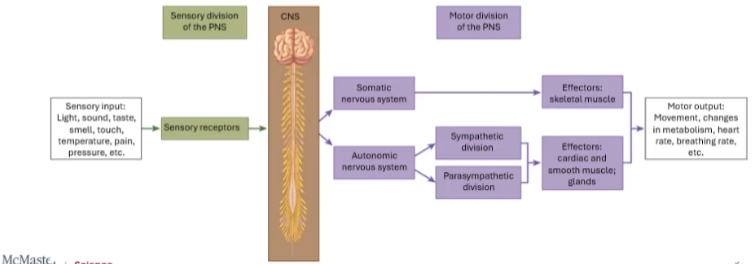
What are the target tissues of the somatic nervous system?
Skeletal muscles.
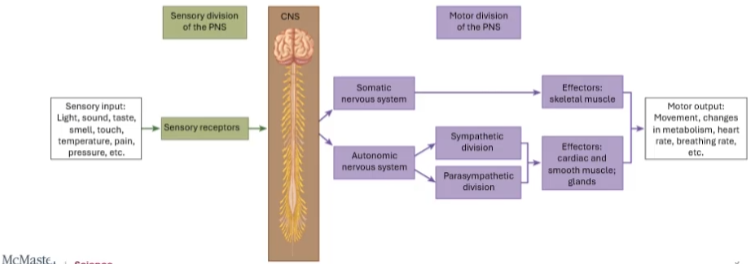
What are the target tissues of the autonomic nervous system?
Cardiac muscle, smooth muscle, and glands.

What are the three main muscle types mentioned in the lecture?
Skeletal muscle, cardiac muscle, and smooth muscle.

What is skeletal muscle?
Muscle that moves bones and creates movement in the body.

What is cardiac muscle?
Muscle that makes up the heart.

What is smooth muscle?
Muscle that generally cannot be consciously controlled.

Where are examples of smooth muscle found?
Around digestive organs and in structures such as the pupils of the eyes.

What are the two types of glands mentioned?
Exocrine glands and endocrine glands.

What does the somatic nervous system control?
Skeletal muscle.

What does the autonomic nervous system control?
Cardiac muscle, smooth muscle, and glands.

What are the two divisions of the autonomic nervous system?
Sympathetic nervous system and parasympathetic nervous system.

What are the three motor divisions discussed in the lecture?
Somatic nervous system, autonomic nervous system, and enteric nervous system.

What are examples of motor outputs controlled by the autonomic nervous system?
Changes in metabolism, heart rate, and breathing rate.

What is the general pathway of nervous system information?
Sensory receptors → sensory division → central nervous system → motor division → effector tissue.

What are the two ways sensory information is gathered?
General senses and special senses.

What are general senses?
Sensory receptors distributed throughout the body.

What are examples of general senses?
Temperature and pressure detected by receptors throughout tissues such as the skin.

What are special senses?
Senses involving very specialized receptors located in specific organs.

What is an example of a special sense?
Vision.
Where are the specialized receptors for vision located?
In the retina of the eye.

How do general and special senses differ?
General receptors are distributed throughout the body, while special receptors are highly specialized and located in specific organs.

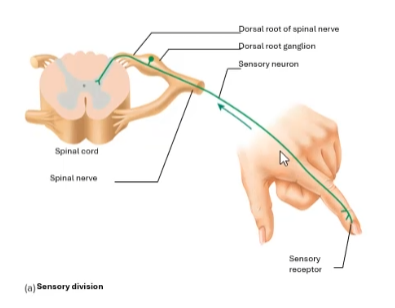
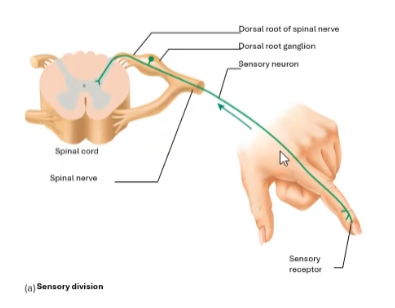
What happens when a stimulus activates a sensory receptor?
An action potential moves through the sensory neuron toward the spinal cord or central nervous system.

Where are the cell bodies of spinal sensory neurons located?
Outside the central nervous system in a ganglion.

What is the dorsal root ganglion?
A ganglion containing the cell bodies of sensory neurons associated with a spinal nerve.
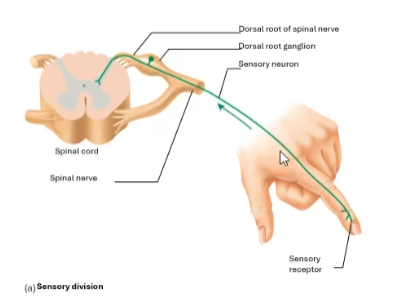
Why is it called the dorsal root ganglion?
The sensory information enters the spinal cord through the dorsal root.

What does the dorsal root carry?
Sensory information toward the spinal cord.

What does the ventral root carry?
Motor information away from the spinal cord.

Where does sensory information enter the spinal cord?
Through the dorsal root.
Where does motor information leave the spinal cord?
Through the ventral root.

What happens to the dorsal and ventral roots?
They come together to form the spinal nerve.

What types of information do spinal nerves carry?
Both sensory and motor information.

What is the somatic nervous system?
The motor division connecting the central nervous system to skeletal muscles.

Is the somatic nervous system voluntary or involuntary?
Skeletal muscles are under voluntary or conscious control.
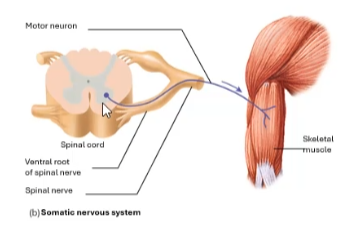
How many neurons are involved in the somatic motor system?
One neuron.

Where is the cell body of the somatic motor neuron located?
Inside the central nervous system, specifically the spinal cord in the example given.

Where does the axon of a somatic motor neuron travel?
From the spinal cord to the target skeletal muscle.

What is a single-neuron motor system?
A system where the neuron cell body is in the central nervous system and its axon travels directly to the target tissue.

What is a synapse?
A connection between one neuron and another neuron or between a neuron and a target tissue.

What happens at a synapse?
Information from an electrical signal is passed to another neuron or a target tissue.

Why are synapses important?
They are places where nervous system signals can be continued or blocked.

What is a neuromuscular junction?
The synapse between a neuron and a skeletal muscle cell.
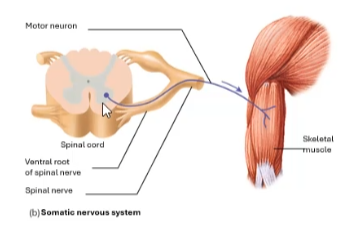
Where does somatic motor information leave the spinal cord?
Through the ventral root.

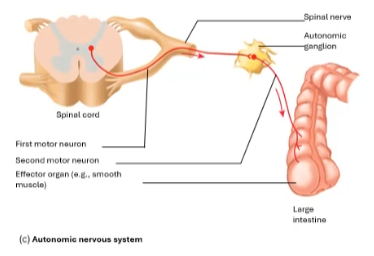
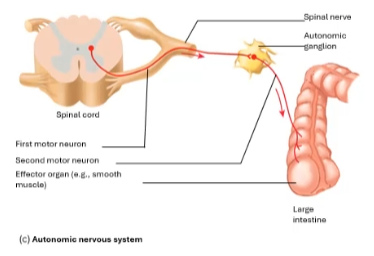
What is the autonomic nervous system?
A motor division connecting the central nervous system to smooth muscle, cardiac muscle, and certain glands.
Is the autonomic nervous system consciously controlled?
No; its target tissues are under involuntary control.
How many neurons are involved in the autonomic motor system?
Two neurons.

Where is the cell body of the first autonomic neuron?
In the central nervous system.

Where does the first autonomic neuron connect with the second neuron?
In an autonomic ganglion.