Soft Mast, Hard Mast, and Winter Woody Browse
 Call Kai
 Learn
 Practice Test
 Spaced Repetition
 Match
 Flashcards
 Knowt Play
1/39

Earn XP
Description and Tags
Comprehensive vocabulary flashcards covering fall and winter soft mast, winter twig and woody browse morphology, and hard mast identification in western North Carolina.
40 Terms

Flowering dogwood: twigs exhibit opposite branching and buds, very slender twigs that can be greenish or reddish/purple, and small buds.

Magnolia

Devil's walking stick
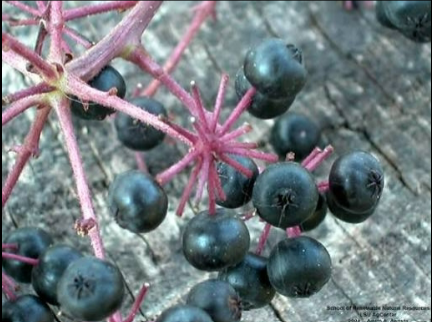
Devils Walking stick: red stems arranged in a 'wheel' shape.

Smooth sumac

Viburnum: A shrub producing loose clusters of elongated, shiny red drupes.

Chinese privet: A shrub characterized by evergreen leaves and loose branched clusters of hard, blue drupes.

Multiflora rose: A shrub producing branched clusters of small, oval rosehips.

Wild grape: A woody vine that bears branched clusters of dark blue berries.

Porcelain berry

Oriental bittersweet

Greenbrier: A climbing vine with tendrils, alternate branching and buds, and green, square (4-sided) stems that may follow a zig-zag pattern and bear short, scattered thorns. Produces small round clusters of blue berries arranged in a 'wheel' shape.

Pokeweed: An herbaceous plant that produces loose, unbranched clusters of purple berries borne on reddish stems.
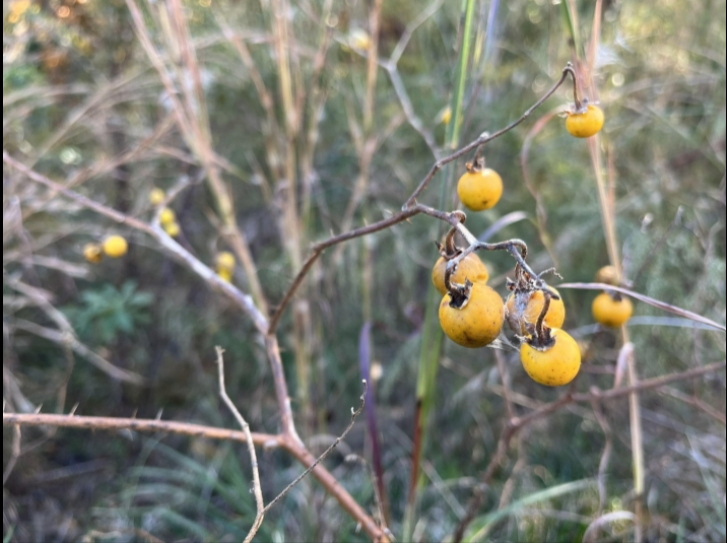
Horse nettle: An herbaceous plant with thorny stems growing low to the ground that produces large, non-edible yellow berries resembling cherry tomatoes.
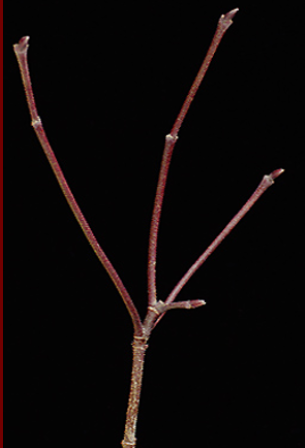
Flowering dogwood

White ash: A tree with opposite branching and buds, sturdy and stout twigs, and a chocolate brown terminal bud resembling a tiny Hershey's kiss.

Red maple: A tree featuring opposite branching and buds, slender twigs, and blunt terminal buds that can be red or greenish.

Sugar maple: A tree featuring opposite branching and buds, slender twigs, and sharp, brown terminal buds.

American beech: A tree with alternate branching and buds, very slender twigs, and very long, pointed buds resembling thorns. Produces hard mast of small triangular nuts enclosed in husks covered with soft spines.

Black cherry: A tree with alternate branching and buds, very slender twigs, small triangular buds, and scratched bark that emits an odor of bitter almonds.

Pignut hickory: alternate branching

Bitternut hickory: A tree with alternate branching and buds, slender and light tan twigs, and a distinct sulfur yellow terminal bud.

White Oak: alternate
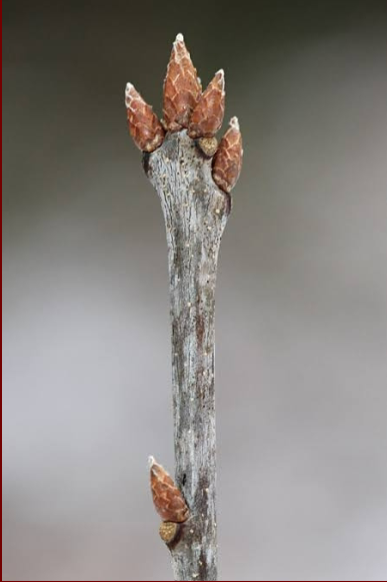
Northern Red Oak: Alternate

Tulip poplar: A tree characterized by alternate branching and buds, very smooth twigs, round leaf scars, and a distinctive terminal bud resembling a duck bill.

Spicebush: A large shrub with very small buds, slender twigs that may bear round flower buds in winter, and scratched bark that gives off a fragrant, spicy odor.

Strawberry bush: A small shrub with opposite buds and branching, small red buds, and very slender, green twigs.

Greenbriar

White oak: An oak species with alternate branching, a cluster of short and blunt terminal buds, and acorns housed in caps covered with small bumps.

Chestnut oak: An oak species that produces large acorns seated inside large, funnel-shaped caps.

Northern red oak: An oak species with alternate branching, clustered long and pointed terminal buds, and acorns possessing wide, shallow, saucer-like caps.

Southern red oak: An oak species producing very small acorns set inside caps covered with tight scales.

Black oak: An oak species producing acorns seated in caps characterized by loose scales.

Chestnut: A tree producing triangular-shaped seeds encased within sharp, spiny burs.

Yellow buckeye: A tree that produces hard mast consisting of large, shiny, smooth seeds contained inside a capsule.

Black walnut: A tree that produces hard nuts enclosed within fragrant green husks.
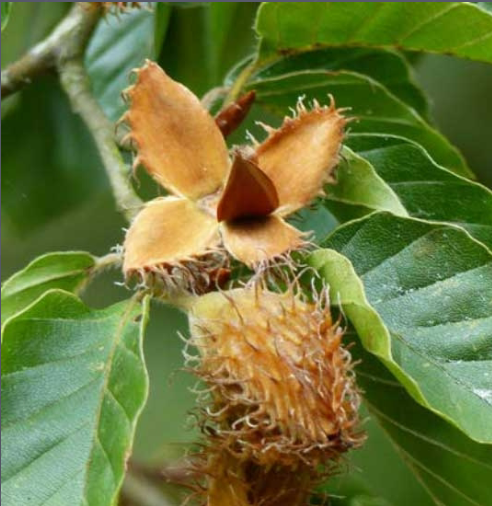
American Beech

Mockernut hickory: A hickory species that produces hard nuts enclosed within thick husks.

Pignut hickory: A tree producing hard nuts enclosed in thin husks. Winter twigs have alternate branching and buds, smooth bark, heart-shaped leaf scars, and a terminal bud that is larger than the lateral buds and often dome-shaped.

Sawtooth oak: A non-native oak tree whose acorns are set within large, distinctly shaggy caps.