D4.1 Natural Selection
 Call Kai
 Learn
 Practice Test
 Spaced Repetition
 Match
 Flashcards
 Knowt Play
1/29

There's no tags or description
Looks like no tags are added yet.
30 Terms
Theory proposed by Charles Darwin
Natural Selection
natural selection
A process in which individuals with heritable traits that improve survivial and reproduction in a particular environment leave more offspring than others, causing allele frequencies in the gene pool to shift over generations
4 steps in Natural Selection
Variation, inheritance, overproduction, descent with modification
Lamarckism
Adapting during individuals' own lifetimes
Sources of genetic variation
Sexual reproduction, mutations, meiosis
Overproduction
The capacity of a species to produce more offsrping than the local environment or its carrying capacity can support
Abiotic
Non-living factor
Density-independent
Characteristics that are not affected by population density
Temperature
Density-independent factor
Density-dependent
Characteristics that vary depending on the population density
Intraspecific competition
Competition within a species
Evolutionary fitness
Takes into account the survival value and reproductive potential of a genotype
Example of evolutionary fitness
Giraffe ossicones
Selection pressure in sexual reproduction
The ability to mate
Sexual selection
When the sexes acquire distinct features because one sex is choosy
Intersexual selection
Males who compete for the right to mate with the females
Intrasexual selection
Males who compete for the right to mate with the females
John Endler
Evolutionary Biologist who studied Trinidadian guppies in the 1970s
Findings of Endler
Males tended to be more colorful, even though this does not allow easy camoflage
Gene pool
The total number of genes and alleles in a population, specifically among its reproducing members
Genetic equilibrium
Equal chance of contributing to the gene pool
Neo-Darwinism
Integration of understandings of natural selection and genetics
Evolution
Change in allele frequencies in a gene pool

Disruptive selection
The mean trait is selected against
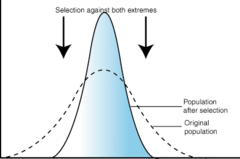
Stabilizing selection
The mean trait is selected for
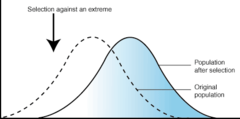
Directional selection
One extreme phenotype is selected for, and the other is selected against
Factor for directional selection
Change in the environment
Hardy-Weinberg Equilibrium
Model used to determine if the allel frequency in a population is changing or not therefore whether it is evolving
Conditions for Hardy-Weinberg
No mutations, random mating, no immigration, large population, no natural selection
Antibiotic resistance
Natural selection because humans are only inducing the pressure, but it isn't intended to happen