Other periodic table groups
0.0(0)
Studied by 1 person Call Kai
 Learn
Learn Practice Test
 Spaced Repetition
 Match
Match Flashcards
 Knowt Play
Card Sorting
1/81

Earn XP
Last updated 6:20 PM on 11/17/22
Name | Mastery | Learn | Test | Matching | Spaced | Call with Kai | Chat |
|---|
No analytics yet
Send a link to your students to track their progress
82 Terms
1
New cards
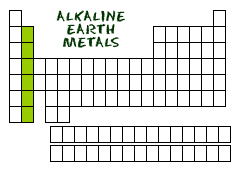
What is the name of group 2?
Alkaline earth metals (highlighted green)
2
New cards
What are some characteristics of alkaline earth metals?
They are shiny, soft, and highly reactive
3
New cards
Why are alkaline earth metals so reactive?
Because they have two valence electrons, making it easy to become an ion
4
New cards
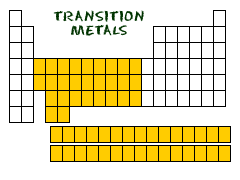
What are transition metals?
Groups 3-12 (highlighted yellow)
5
New cards
What are some characteristics of transition metals?
They are lustrous, hard, strong, they have a high density, they are malleable and ductile, good conductors for electricity and heat, and they have a high melting and boiling point
6
New cards
What does lustrous mean?
Bright and shiny
7
New cards
What does malleable mean?
It can be bent and pressed into different shapes
8
New cards
What does ductile mean?
It can be drawn into wires
9
New cards
What is the one exception of the transition metals having a high melting and boiling point?
Mercury, it is liquid at room temperature
10
New cards
Are transition metals less or more reactive than the alkali metals?
Much less reactive
11
New cards
True or false: Transition metals are dull
False
12
New cards
True or false: Transition metals properties are similar to alkali metals properties
False, but could be arguably true
13
New cards
True or false: Transition metals and harder and stronger than alkali metals
True
14
New cards
True or false: Transition metals are good at conducting heat
True
15
New cards
True or false: Transition metals are soft and easy to cut with a knife
False
16
New cards
True or false: Transition metals make good electrical cables
True
17
New cards
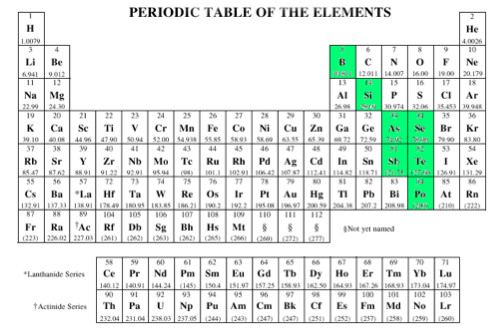
What are metalloids?
Elements that are halfway between metals and non-metals (highlighted green)
18
New cards
What state are metalloids at room temperature?
Solid
19
New cards
How do metalloids react?
In some ways like metals and in some ways like non-metals
20
New cards
Are metalloids conductors?
Semi-conductors
21
New cards
What elements classify as metalloids?
Boron, silicon, germanium, arsenic, antimony, tellurium, and astatine
22
New cards
What is the difference between silicone and silicon?
Silicone is a type plastic and silicon is an element
23
New cards
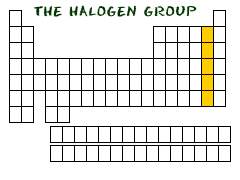
What group are the halogens in?
Group 17 (highlighted yellow)
24
New cards
What does halogen mean?
Salt former
25
New cards
Are halogens very reactive or not reactive at all?
Very reactive
26
New cards
What are some characteristics of halogens?
They are toxic and harmful, they are non-metals, they do not conduct electricity, and they are brittle and crumbly when solid
27
New cards
Why are halogens so toxic and harmful?
Because of how reactive they are
28
New cards
Why are halogens so reactive?
Because they have 7 valence electron, which means all they need to do to become ions is gain one electron
29
New cards
Are halogens naturally found in nature?
No because they are so reactive
30
New cards
What do halogens react well with?
Alkali
31
New cards
When halogens react with alkali, what does it form?
Salts
32
New cards
What do halogens smell like?
Breathing halogen vapours in could kill you since they are so toxic, but halogens smell very bad
33
New cards
What group does astatine belong to?
It is both a halogen and a metalloid
34
New cards
What are all the halogens?
Fluorine, chlorine, bromine, iodine, and astatine
35
New cards
What is a pattern in the halogens as you go down the group?
They become darker in colour going down the group and the melting and boiling point gets higher as you go down the group
36
New cards
What is fluorine often used for?
Sodium fluoride to clean your teeth
37
New cards
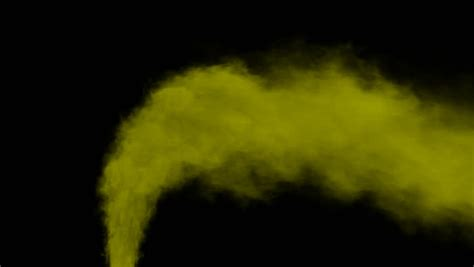
What colour is fluorine?
A pale yellow (lighter than the picture)
38
New cards
What was chlorine used for during the holocaust?
Gas chambers
39
New cards
What is chlorine often used for now?
Cleaning pools and hot tubs
40
New cards
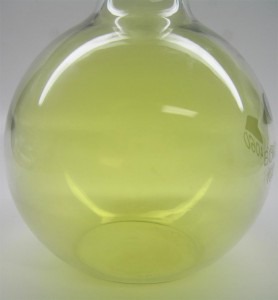
What colour is chlorine?
Green/yellow
41
New cards
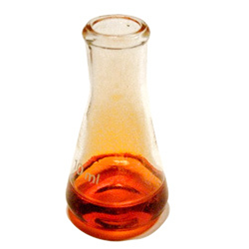
What colour is bromine?
Red/brown
42
New cards
What was iodine used for?
Before antiseptics were a thing, it was used to clean wounds
43
New cards
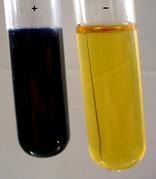
What colour is iodine?
Dark grey (left tube)
44
New cards
What colour is astatine?
Black
45
New cards
What is the symbol for fluroine?
F
46
New cards
What is the symbol for chlorine?
Cl
47
New cards
What is the symbol for bromine?
Br
48
New cards
What is the symbol for iodine?
I
49
New cards
What is the symbol for astatine?
At
50
New cards
What is the melting point for fluorine in ºC?
-220
51
New cards
What is the melting point for chlorine in ºC?
-100
52
New cards
What is the melting point for bromine in ºC?
-7
53
New cards
What is the melting point for iodine in ºC?
120
54
New cards
What is the melting point for astatine in ºC?
302
55
New cards
What is the boiling point for fluorine in ºC?
-180
56
New cards
What is the boiling point for chlorine in ºC?
-34
57
New cards
What is the boiling point for bromine in ºC?
59
58
New cards
What is the boiling point for iodine in ºC?
190
59
New cards
What is the boiling point for astatine in ºC?
337
60
New cards
What is the vapour colour of fluorine?
Pale yellow
61
New cards
What is the vapour colour of chlorine?
Yellow/green
62
New cards
What is the vapour colour of bromine?
Red/brown
63
New cards
What is the vapour colour of iodine?
Dark purple
64
New cards
What is the vapour colour of astatine?
Black
65
New cards
What state is fluorine at 20ºC?
Gas
66
New cards
What state is chlorine at 20ºC?
Gas
67
New cards
What state is bromine at 20ºC?
Liquid
68
New cards
What state is iodine at 20ºC?
Solid
69
New cards
What state is astatine at 20ºC?
Solid
70
New cards
Why does the reactivity of halogens decrease as you go down the group?
The atoms with less shells are more reactive. It is easier to gain an electron if the atom has less shells because it is easier to attract an electron. The reason it is easier to attract and electron is because the distance between the nucleus and the valence shell is smaller, so the pull electrons feel is stronger.
71
New cards
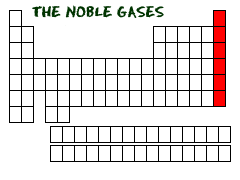
What group are the noble gases in?
Group 18 (highlighted in red)
72
New cards
Are noble gases reactive or unreactive?
Very unreactive
73
New cards
What state are noble gases in at room temperature?
Gas
74
New cards
What colour are noble gases?
Colourless
75
New cards
Why are noble gases called noble?
Because they have similar properties to "noble metals" (gold, platinum, silver)
76
New cards
Why are noble gases unreactive?
They have a full valence shell
77
New cards
Do noble gases form bond?
Not usually
78
New cards
What does monatomic mean?
They exist as individual atoms
79
New cards
What does diatomic mean?
Two atoms of the same element that bond together as a molecule
80
New cards
What is an example of a diatomic element?
Oxygen (O2 means two oxygen atoms bonded together)
81
New cards
Are noble gases diatomic or monotomic?
Monotomic
82
New cards
What are the noble gases?
Helium, neon, argon, krypton, xenon, radon