Lab Exercise 9 - Cultural and Physiological Characteristics of Bacteria II
 Call Kai
 Learn
Learn Practice Test
 Spaced Repetition
 Match
Match Flashcards
 Knowt Play
1/47

There's no tags or description
Looks like no tags are added yet.
Name | Mastery | Learn | Test | Matching | Spaced | Call with Kai | Chat |
|---|
No analytics yet
Send a link to your students to track their progress
48 Terms
quick tests (yield results within minutes)
catalse
oxidase
tube media that test for other metabolic processes
nitrate broth
gelatin
urea broth
phenylalanine
SIm
IMViC
respiration
a cycle after glycolysis in which the final electron acceptor is an inorganic molecule
if the final electron acceptor is oxygen → aerobic respiration
if the final electron acceptor is nitrate or sulfate, etc → anaerobic respiration
catalase test
a test that detects catalase, which converts 2H2O2 → 2H2O + O2
catalase is important in breaking down reactive oxygen species produced during aerobic respiration
What is a positive result of the catalase test?
after 3% H2O2 is added to a colony → O2 product appears as bubbling
function of cytochrome C oxidase
removes electrons from (oxidizes) cytochrome C and transfers them to oxygen (reduces) or oxidizes a chromogenic reducing agent
chromogenic reducing agents, e.g. dimethyl-p-phenylenediamine, develop color when oxidized

oxidase test
a test that detects cytochrome C oxidase, which transfers electrons to oxygen (the final e- acceptor)
indicator in the oxidase test
dimethyl-p-phenylenediamine hydrochloride
an aromatic amine
What is a positive result of the oxidase test?
cytochrome c oxidase is present → reagent oxidizes → turns dark blue/black
nitrate broth
a test that detects nitrate reductase, which reduces nitrate to nitrite (NO3 → NO2)
What are the reagents in nitrate broth?
Nitrate I: sulfanilic acid
Nitrate II: dimethyl-alpha-naphthylamine
What is a positive result in nitrate broth?
option 1: nitrate reductase reduces NO3 to NO2 → nitrate I and nitrate II react with NO2 → brick red color
option 2: NO3 denitrifies all the way down to N2 → remains clear even after addition of zinc
brick red appears after addition of nitrate I and II, before Zn; or doesn’t appear at all

What is a negative result in nitrate broth?
nitrate reductase is not present, NO3 remains after addition of nitrate I and II
Zn catalyzes reaction of NO3 → NO2
brick red color appears after addition of Zn, not before

urea broth
a test that detects urease, which degreates urea → 2 ammonia (NH3) and CO2
What is the indicator in urea broth?
phenol red, a pH indicator
What is a positive result in urea broth?
urease is present → degrades urea → pH increases >8.1 → cerise color

What is a negative result in urea broth?
urease is not present
pH remains neutral → color remains red
pH can decrease → color changes to yellow

What does the gelatin medium test?
presence of gelatinase, which catalyzes hydrolysis of gelatin → amino acids
What is needed to determine results of a gelatin test?
ice bath, because gelatin solidifies in low temperatures
What is a positive result for a gelatin test?
gelatinase is present → hydrolyzes gelatin
no gelatin → no solidification after ice bath
see last tube in picture

What is a negative result for a gelatin test?
no gelatinase → no gelatin hydrolysis
gelatin remains → resolidification after ice bath
see second tube in picture
What does a phenylalanine slant test for?
detects production of phenylalanine deaminase
process: phenylalanine → phenylpyruvic acid → ammonia
(Phe → PPA + NH3)
What is the reagent in a phenylalanine slant?
FeCl3 (ferric chloride), 5-10 drops
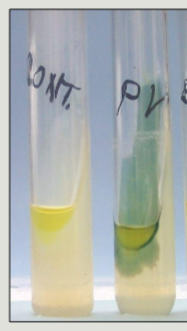
What is a positive result for a phenylalanine slant?
phenylalanine deaminase present → PPA present → FeCl3 reacts and appears deep green
(PP in the pool turns green)
SIM medium
a medium that tests for sulfide production, indole, and motility
reagents in SIM media
iron (to detect sulfide production)
Kovac’s reagent, 3-5 drops (detects indole production)
What is the result for SIM if an organism produces H2S?
FeS production → black precipitate
What is the result for SIm if an organism produces indole?
cerise ring at the top of broth
What is the result for SIM if an organism is motile?
turbidity (cloudiness)
fermentation
a pathway after glycolysis in which the final electron acceptor is an organic molecule
does not produce as much energy as respiration
can also refer to breakdown of polysaccharides → monomers that can be fermented
MR-VP broth
one broth to perform two separate tests: MR and VP
MR test
methyl red
tests for mixed acid fermenters

What is the reagent in MR-VP broth for MR test?
methyl red, 3-4 drops
What is a positive result of MR in MR-VP broth?
MR detects high acid production (pH lowered to 4.4 or less), produces red color
What is a negative result of MR in MR-VP broth?
low acid concentration (pH higher than 4.4) → no retention of red color from MR
VP test
Vogues-Proskauer
tests for 2,3-butanediol fermenters

pathway of 2,3-butanediol fermentation
glucose → acetoin intermediate → 2,3-butanediol
acetoin can react with VP reagents
What are the reagents in VP for MR-VP broth?
Barritt’s reagents
VP I: alpha naphthol, 10 drops; intensifies red color
VP II: KOH, 10 drops; produces alkaline conditions that favor acetoin oxidation
What is a positive result for VP test?
acetoin oxidation occurs → diacetal and O2 are made → O2 presence produces a red color
tryptone broth
a test that detects tryptophanase, which hydrolyzes tryptophan → indol, pyruvate, and NH3
What is the reagent added to tryptone broth?
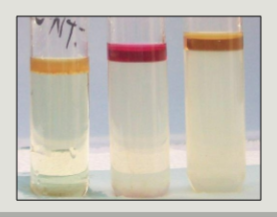
Kovac’s reagent (DMABA and HCl dissolved in amyl or butyl alcohol); 3-5 drops
nonpolar, extracts indole to the top
reacts with indole to produce cerise color
What is a positive result in tryptone broth?
tryptophanase → indole production → cerise ring at top
What does Simmons citrate slant test?
detects utilization of citrate as the sole carbon source for growth
What is the indicator in Simmons citrate sland?
bromothymol blue
What is a positive result on Simmons citrate slant?
growth, NOT blue reaction
however, blue reaction often accompanies growth, can be helped to determine if growth occurred
“if it’s blue, it grew”
IMViC
a set of four tests that differentiate E. coli from Enterobacter aerogenes

What four tests are included in IMViC?
Indole
Methyl red
Vogues-Proskauer
Citrate
What are the results of IMViC?
E. coli tests positive for indole and MR, tests negative for VP and citrate
E. aerogenes tests negative for indole and MR, tests positive for VP and citrate