Chapter 13 - The Genetic Code and Transcription
 Call Kai
 Learn
 Practice Test
 Spaced Repetition
 Match
 Flashcards
 Knowt Play
1/32

There's no tags or description
Looks like no tags are added yet.
33 Terms
Central dogma
The central dogma:
Transcription of DNA into RNA
Translation of RNA into protein
Complications:
Not all DNA is transcribed into RNA (e.g., promoters, etc.)
Not all RNA is translated into protein (e.g., microRNA)
RNA is generally processed into its final usable form
Proteins are frequently modified into their mature forms

Learning Goals
Be able to describe the functional roles for the different classes of RNA (rRNA, tRNA, mRNA)
Understand the basics of transcription:
The mechanism for synthesis of RNA from a DNA template
The stages of transcription (initiation, elongation, termination)
Put transcription into the genomic context (where does it occur?)
Understand the requirements for prokaryotic transcription:
DNA promoter elements (-10 and -35)
Proteins required: core RNAP and a sigma (σ) subunit
Understand the requirements for eukaryotic transcription:
DNA promoter elements (TATA box)
The general transcription factors (GTFs) for RNA Pol II;
Focus on TFIID, one of the key factors (TFIID = TBP + TAF)
RNA polymerase directs the synthesis of RNA
RNA is synthesized on a DNA template during transcription.
RNA molecules have multiple different functions
Coding: mRNA, tRNA
Catalytic, structural: rRNA
Regulatory: microRNA, snRNA
mRNA serves as the intermediate molecule between DNA and proteins.
It carries the information for the order of addition of amino acids during translation
RNA polymerase directs RNA synthesis
RNA polymerase directs the synthesis of RNA using a DNA template. The catalytic reaction is similar to DNA synthesis by DNA polymerase.
Synthesis goes in the 5’ to 3’ direction, but no primer is required to initiate.
The enzyme uses ribonucleotides (NTPs).
The reaction for RNA synthesis can be expressed as:

Prokaryotic transcription
Why start with prokaryotes?
Best understood → underlies all we know
Many features are conserved
Target of antibiotics
There is one RNA polymerase (RNAP) that produces all types of RNA
The focus will be on mRNA synthesis
Transcription requires three stages
Initiation, elongation (or synthesis), and termination.
No more steps; the mRNA is not modified after synthesis.
Genes are usually arranged in polycistronic (multiple gene) operons
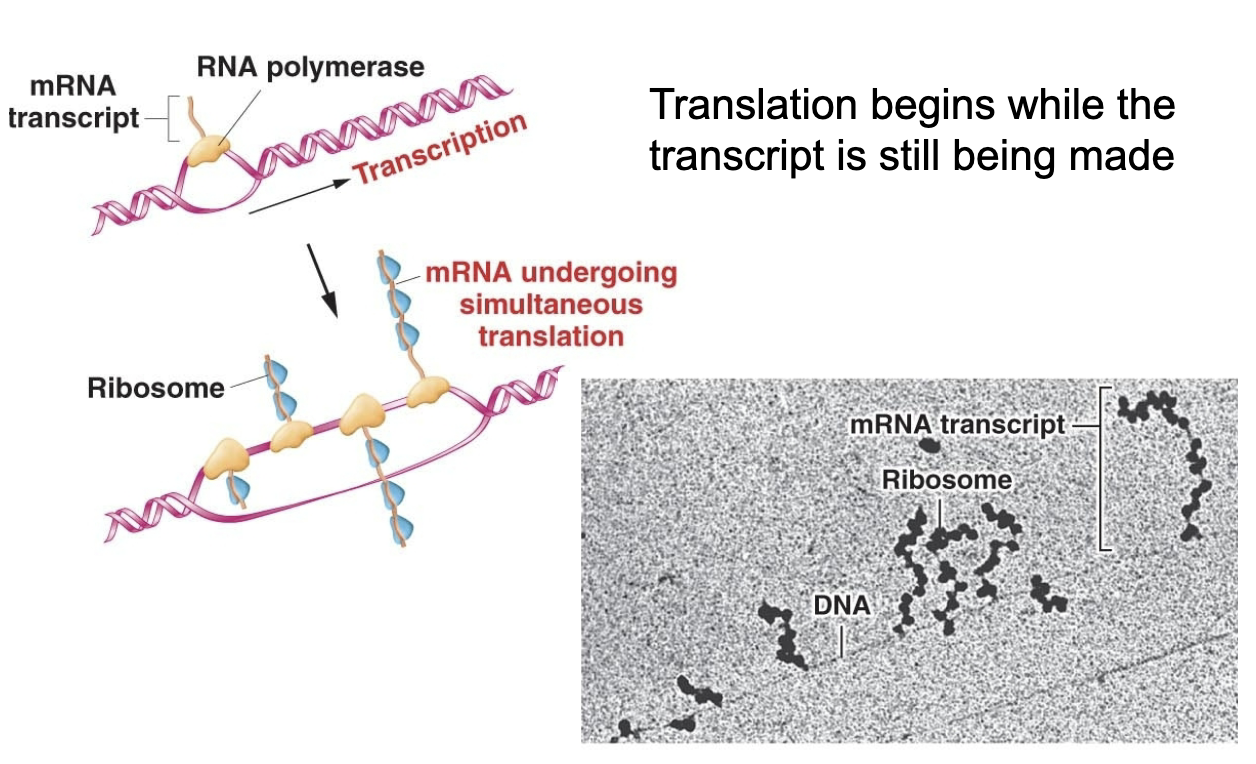
Transcription and translation are coupled
Translation begins while the transcript is being made
Coupled transcription-translation
Transcription begins while the transcript is still being made
E. coli RNA polymerase
There is one RNAP that is responsible for transcription of all RNAs (mRNA, tRNA, rRNA)
RNA synthesis is in the 5’ to 3’ direction.
RNA polymerase holoenzyme (whole enzyme) from E. coli contains core subunits and one that temporarily associates, the (sigma) subunit.
The RNAP (RNA polymerase) core enzyme lacks sigma
the core enzyme consists of a2, b, b', w [don’t memorize]
The sigma subunit is responsible for promoter recognition during initiation. It is not present during elongation.
There are multiple sigma subunits that recognize different types of promoters under special circumstances
E.g.,, nitrogen starvation, stationary phase
Structure of E. coli RNA polymerase core enzyme
The crab claw

Sigma factors confer specificity
Allows different genes to be expressed
Some bacteria have many sigma factors, others only a few

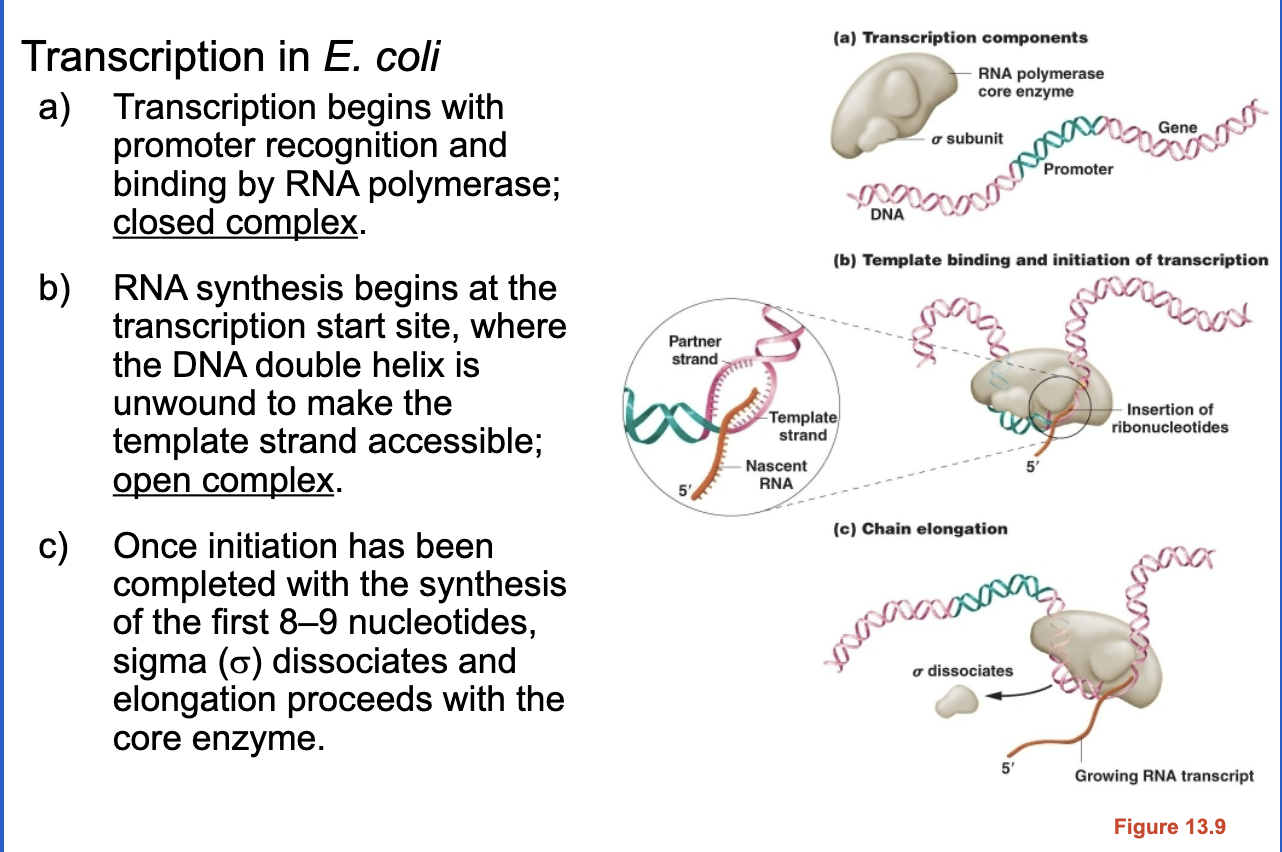
Transcription of E. coli
Overview
A) Transcription begins with promoter recognition and binding by RNA polymerase; closed complex.
B) RNA synthesis begins at the transcription start site, where the DNA double helix is unwound to make the template strand accessible; open complex.
C) Once initiation has been completed with the synthesis of the first 8–9 nucleotides, sigma () dissociates and elongation proceeds with the core enzyme.
Promoter recognition
First step: RNAP finds and recognizes promoters
as dsDNA
based on their DNA sequence
through the σ subunit

Genome organization
What does transcription look like in a genome?
How does RNA polymerase know where to start the synthesis of an RNA molecule?
Recall: in replication, there was an origin of replication (a sequence of DNA) and proteins that were necessary to regulate where and when to start
Are there similarities? Is there a particular DNA sequence and special protein(s) that recognize it?
Prokaryotic (E. coli) genome organization

Operon - example
Zoom in more….
The RBS operon of E. coli (schematic view)
All 6 genes are transcribed on a single mRNA
Each of the genes has something to do with the metabolism (uptake, biosynthesis) of the sugar ribose

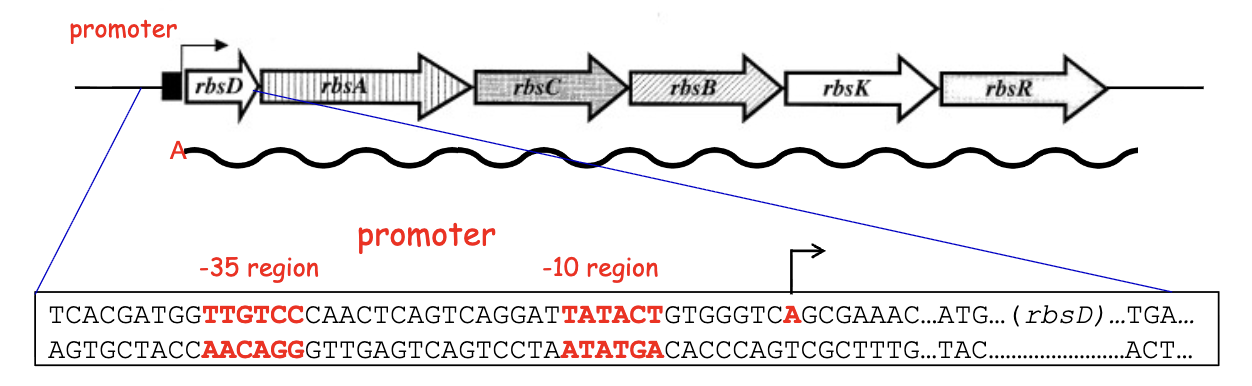
E. coli rbs operon (zoom in more) Sense strand shown; 1st half of operon
ORFs for first 3 genes shown in dark or light blue; start with ATG (the start codon) and end with one or two stop codons (TAG,TGA, TAA).
Very small intergenic space between ORFs (yellow): 5, 4, and 21 bases
Promoter (red): 5’-….TTGTCC …(15 bp)…TATACT….-3’; the single red A is +1 - where the transcript starts

Transcription initiation
Initiation of transcription
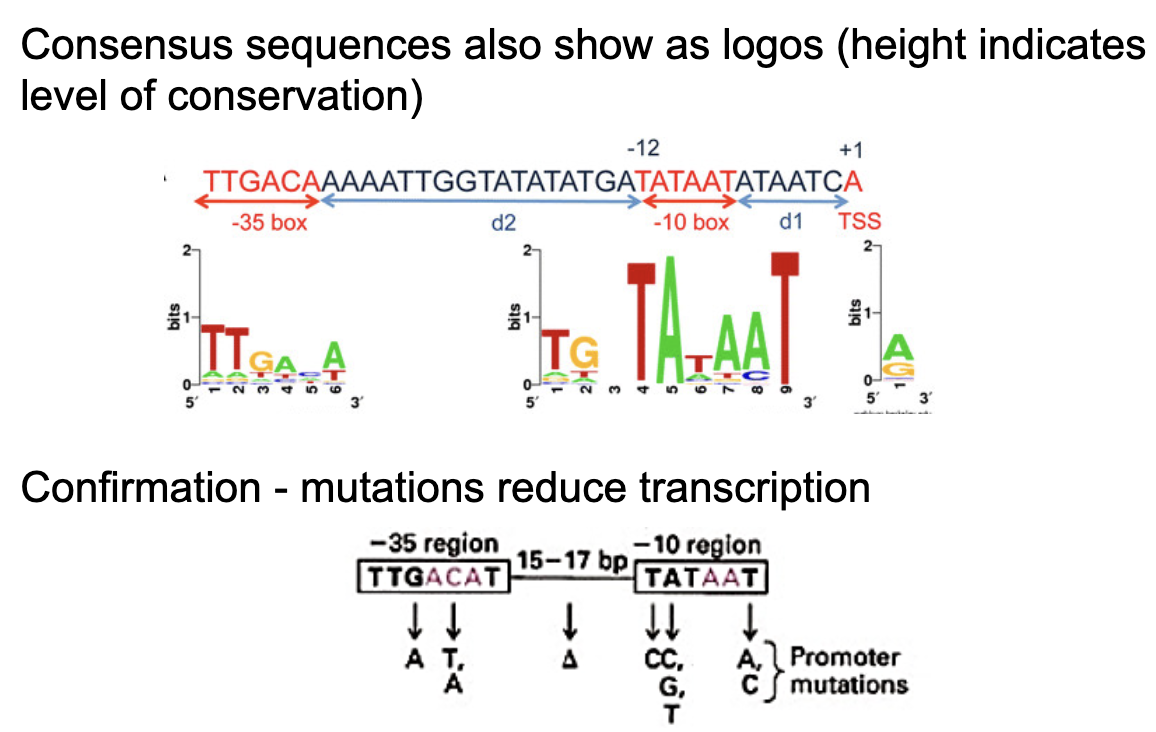
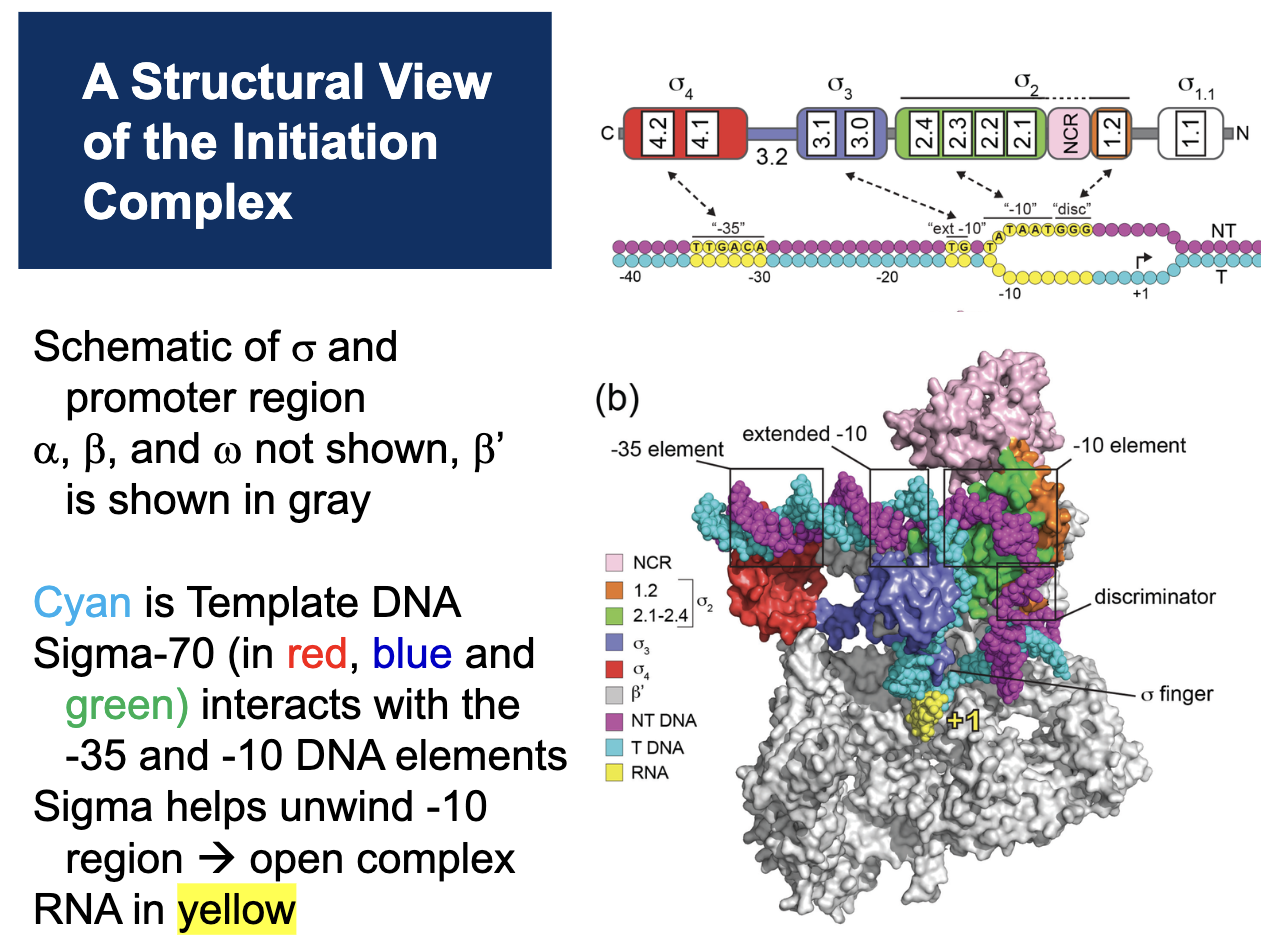
Most E. coli promoters have two consensus sequences that comprise the promoter
The two sequences, TTGACA and TATAAT, are positioned at –35 and –10 with respect to the transcription initiation site.
What is a consensus sequence?
How was it discovered?
Identification of consensus promoter sequences
Promoter regions of many genes are aligned by start site of transcription
Found to have similar sequences at set distances
Note: DNA sequences are the “top” strand
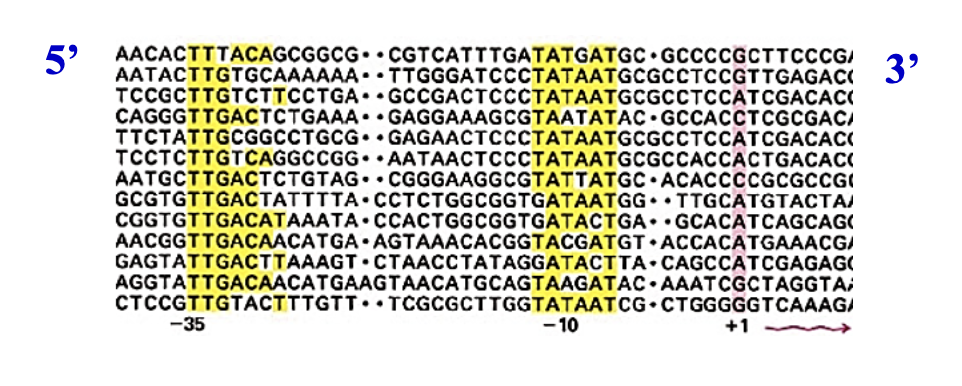
Identification of consensus promoter sequences
Consensus sequences also show as logos (height indicates level of conservation)
Confirmation - mutations reduce transcription
Transcription initiation
Initiation of transcription
Most E. coli promoters have two consensus sequences that comprise the promoter
The two sequences, TTGACA and TATAAT, are positioned at –35 and –10 with respect to the transcription initiation site.
The consensus sequence is a sequence of DNA nucleotides most frequently found at each position and is necessary for a particular function.
These two parts together form the type of promoter that is recognized by the major sigma factor in the E. coli cell
The major sigma factor is named 70.
Operon - example (zoom out!)
The RBS operon of E. coli
All 6 genes are transcribed on a single mRNA: operon
Each of these genes has something to do with the metabolism (uptake, biosynthesis) of the sugar ribose
The promoter is where RNA polymerase (RNAP) binds to start transcription (the answer to ‘ where to start?’)
transcription goes in one direction, synthesizing 5’ to 3’
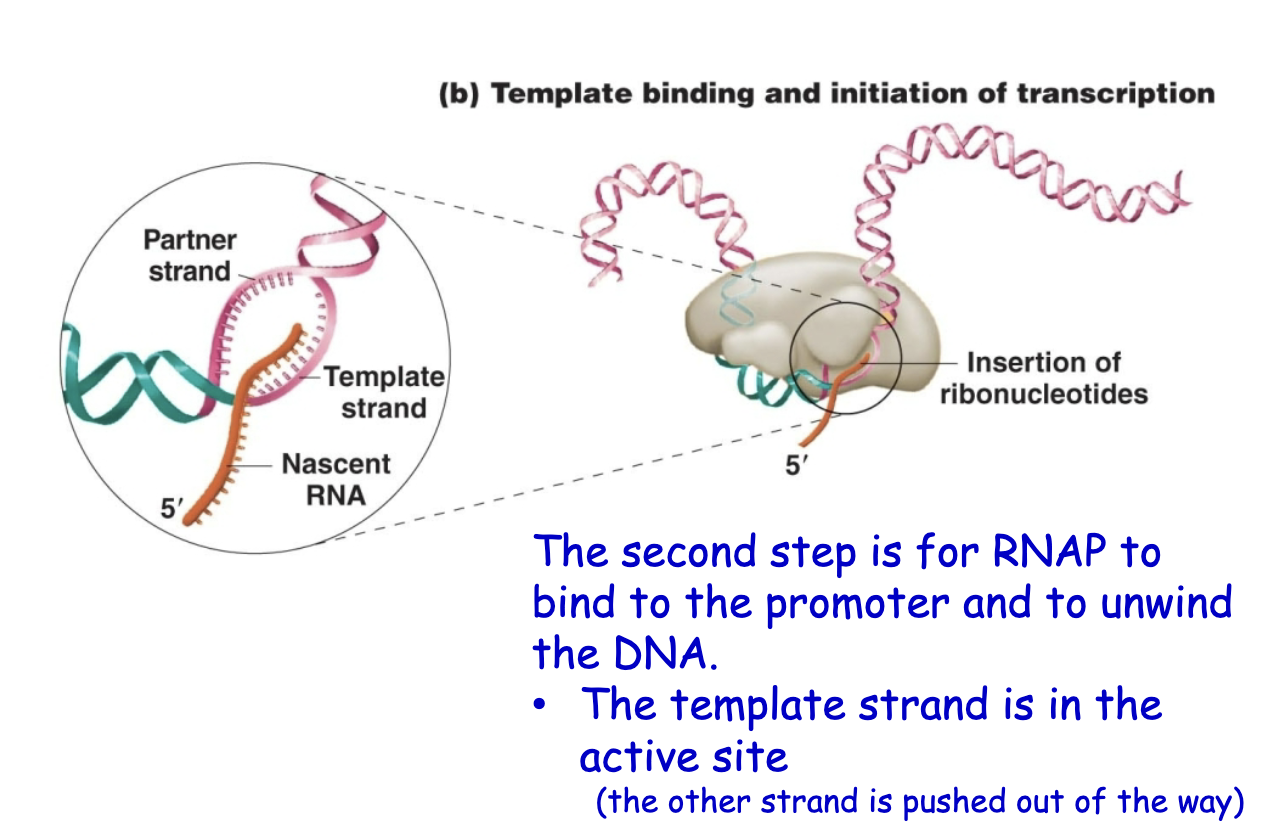
Initiation and open complex formation
The second step is for RNAP to bind to the promoter and partially unwind the DNA
The template strand is in the active site
The non-template strand is pushed out of the way)

Elongation (promoter escape)
RNAP moves away from the promoter and into the coding region of the gene
Releases σ
The core enzyme synthesizes the RNA

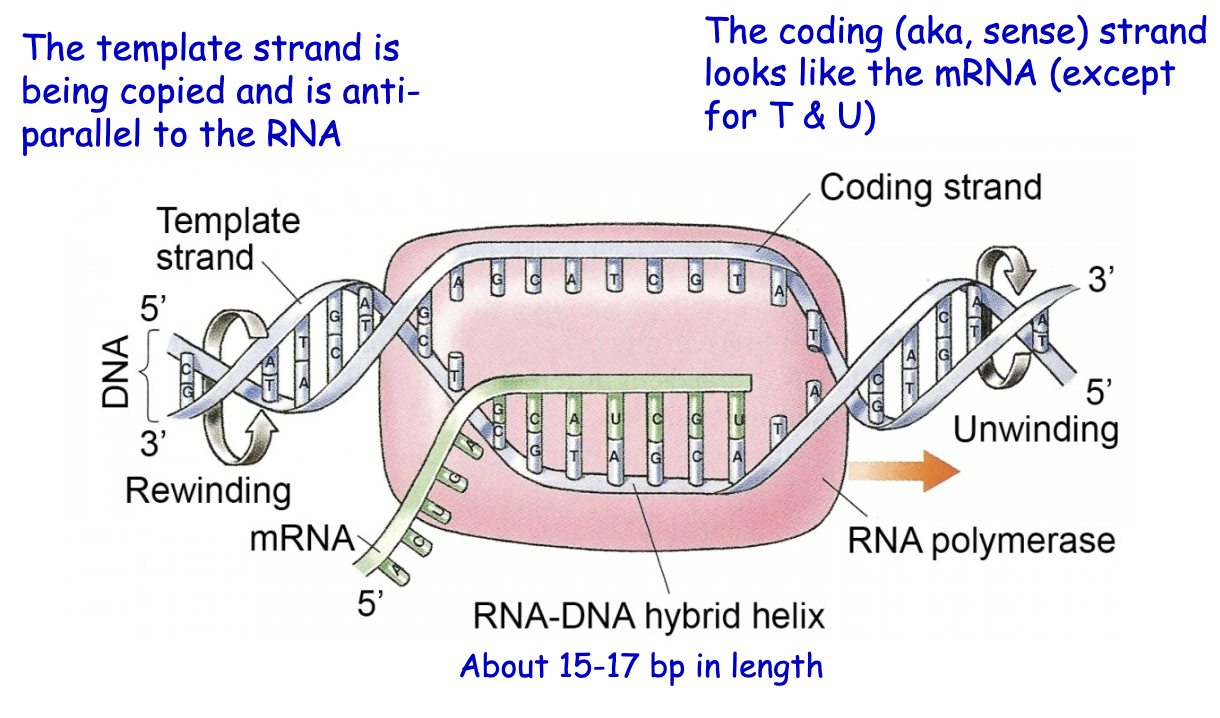
Transcription elongation
Synthesis of the growing RNA chain continues in the 5’ to 3’ direction.
The 3’ hydroxyl serves as the nucleophile to attack the a-phosphate of the incoming nucleotide (aka, nucleoside triphosphate).
The enzyme is highly processive but slower than DNA polymerase
RNAP goes at the rate of 40 nt/sec vs. 800 bp/sec for DNA polymerase III (ie., slower than DNA Pol III)
RNAP progresses at about the same rate as translation (the ribosome yields 15 aa/sec, moving at ~45 nt/sec).
Transcription - elongation
Transcription termination
How does RNAP know when to stop?
Termination of transcription
There are two mechanisms to terminate transcription.
Rho-independent: At the end of the gene, transcription terminates due to hairpin formation in the RNA. This terminator, a rho-independent terminator, depends on the formation of a GC-rich stem-loop that is followed by a sequence of U
Rho-dependent: In some cases, termination depends on the rho (p) termination factor (i.e., a protein). Rho is a hexamer that uses ATP to dissociate the RNA from the DNA template.
Rho-independent terminators
Rho-independent terminators
No protein is required; termination is based on the sequence of nucleotides in the RNA molecule.
The RNA folds into a stem-loop structure.
G-C rich stem
Run of U resides
Important point:
rU-rA bonds are stronger than rU-dA
Weakens the RNA interactions with DNA template → dissociation

Rho-dependent terminators
Rho factor: transcription termination in four steps
Rho protein recognizes specific base sequences in the mRNA (called rut sequence).
Rho is a hexamer that wraps RNA around itself.
It uses the energy of ATP to pull the RNA away from the DNA template.

Think-pair-share question
E. coli RNA polymerase, associated with the 70-kDal sigma subunit (sigma70), transcribes virtually all of the bacterial genome recognizing the consensus sequences of TTGACA at -35 and TATAAT at -10.
Very shortly after infection of E. coli with the bacteriophage (phi), transcription from the bacterial genome ceases and transcription from the phage is detected.
Transcription of the phage genome requires the phage protein gp28 (a 28-kdal protein): in the absence of this protein no phage transcription is seen and normal E. coli transcription is evident. Although the gene that encodes gp28 has the consensus sequence described above, the rest of the phage genes whose transcription requires gp28 have an unusual promoter sequence:
AGGAGA at –35 and TTTNTTT at –10.
Propose a mechanism for transcription that accounts for these data and include in your answer how transcription of gp28 occurs.
Extra slides: Transcription in E. coli
Extra slides: promotor recognition

Extra slides: a structural view of the initiation complex
Extra slides: open complex and initiation
Extra slides: elongation (promoter escape)
