sourcing module 5
 Call Kai
 Learn
Learn Practice Test
 Spaced Repetition
 Match
Match Flashcards
 Knowt Play
1/55

There's no tags or description
Looks like no tags are added yet.
Name | Mastery | Learn | Test | Matching | Spaced | Call with Kai | Chat |
|---|
No analytics yet
Send a link to your students to track their progress
56 Terms
Key Drivers for Decisions
Limited time, attention and resource as an organization grows
Decisions can be changed..
but it is not easy to implement
Making or Buying have similar considerations
Quality, Quantity, Delivery, Price/Cost, Service, Risk, Competitive Advantage, Customer Satisfaction
Economic: Making
Cheaper
Competitive: Making
Competitor acquires ownership of a key source of raw materials
Political: Making
Government requires a certain amount of processing be done within national boundaries
Social: Making
High unemployment area and economic development zone
Environmental: Making
Risks to organize reputation
Additional Reasons for Making
No supplier is interested, lower cost, reduce risk, control quality, forecasts shortage or rising prices
Buying: Economic
cheaper
Buying: Competitive
use a preferred strategic supplier
Buying: Political
Government contracts require a certain percentage of woman, veteran, minority owned spend
Buying: Social
Workforce willingness to do work
Buying: Environmental
Natural resources not available, disposal considerations
Additional Reasons for Buying
Lack of technical experience, insufficient production capacity, flexibility, may open markets, market faster, improve customer service
The Gray Zone in Make or Buy
There is a range of options between 100% Make or 100% Buy
middle ground may be useful for testing and learning wihout making a full commitment
Creative, win-win solutions
Automotive Example
Supplier takes on design responsibilities from the car manufacturer
Maintenance Example
Servicing done by the purchaser of the equipment
Subcontracting
Special class of the make/buy spectrum
common in military and construction procurement
prime/general contractors bid out part of the work to other contractors
Subtracting is used when work
Is difficult to define, takes a long period of time, is anticipated to be extremely costly
Aerospace subcontracting
Structural (wings and landing gear)
Avionics (radar systems)
Subcontracting is complex and requires a high degree of control
Cost, schedule, technical, configuration
Conceptual Framework Developed by Mishra & Sinha (insourcing, outsourcing, offshoring)
Focused on global technology projects. Classified by firm and country boundary
Domestic-Insourcing
Carried out internally, within country boundary, could be with a different part of the firmor in a different city
Domestic-Outsourcing
Carried out by a different firm, located in the same country, could be in the same or different city
Offshore-Insourcing
Carried out internally, by a division/unit located in a different country
Examples: Target India, Microsoft Shanghai
Offshore-Outsourcing
Carried out by a different firm and located in a different country
Ex: Foxconn for iPhones, other International vendors for manufacturing
Reversal of an original decision to make or buy
Why? Things change
Which products or services are we currently buying that we should be doing in-house?
Potential Reaction: Insourcing
Which products and services that we are currently doing in-house should we be buying from suppliers?
Potential Reaction: Outsourcing
The Outsourcing Matrix
Current State
Future State
Q1 and Q4 are good
Action needed in Q2 and Q3

Reasons to Insource: The necessity argument
We would prefer not to produce this product or service in-house, but we really do not have any other options
Reasons to Insource: The opportunity argument
We would prefer to do this in-house because it would give us a strategic competitive advantage
The Necessity Argument
Anything that threatens assurance of supply
Ex: A sudden massive increase in price. The purchase of a sole source by a competitor. Political events and regulatory changes
Transition from existing supplier is risky
Reasons to Outsource: The necessity argument
We would prefer not to outsource this product or service, but we really do not have any other options
Reasons to Outsource: The opportunity argument
We would prefer to outsource this product or service because it would give us a strategic competitive advantage
Deciding what might be outsourced
Determine strategic, critical and noncore activities
Confirm scope of outsourcing: an entire function or some elements of an activity
Process: Deciding what might be outsourced
Identify a function/activity as a potential outsourcing target
Break into its components
Determine which are strategic or critical and should remain in-house
Determine which can be outsourced
Domestic outsource=
Onshoring
International outsource =
Offshoring
Examples of deciding what might be outsourced
Transportation services from school districts, payroll and benefits administration, travel departments
Service Triads
An emerging area of outsourcing management
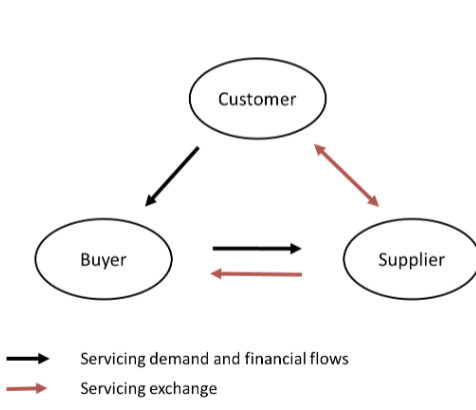
Features of service triads
Buyer contracts with a supplier. Supplier delivers services to the buyers customer
Examples of Service Triads
Outsourcing help desk services and repair or installation of customer equipment
Use of performance-based contracts in Service Triads
Focus on the outcome, flexibility on how the service is delivered, customer experience considerations
Risks of Outsourcing
LOSS OF CONTROL, exposure to supplier risks, costs, attention required by senior management, concerns with long-term flexibility
Implications of Outsourcing Supply
Direct or core spend more critical to the organizational mission (more likely to be retained)
Procurement of indirect or noncore spend (more likely to be outsourced)
Three types of procurement outsourcing contracts
Procure to pay (P2P)
Source to contract (S2C)
Source to pay (S2P)
Procure-to-Pay (P2P)
Day to day purchasing, performance management, accounts payable
Source to contract (S2C)
Strategic activities and sourcing, spend analysis, demand and supplier management
Source-to-pay (S2P)
End-to-end service, includes all services in P2P and S2P
Outsourcing serve providers may have special capabilities
Market expertise, efficient and effective processes, state-of-the-art procurement technologies, cost advantages through scale and purchasing volumes.
Three reasons for outsourcing logistics activities
Improved Service
Reduced Costs
Increased ability to focus on core competencies
Organizations can either outsource
Entire logistics function and selected activities to a third-party logistics service (3PL) provider
The most frequently outsourced logistics activities are transactional, operational, and repetitive
Transportation, Warehousing, Freight forwarding
Supply’s role in insourcing and outsourcing
Provide a comprehensive competitive process, identify opportunities for in/outsourcing, aid in selection of sources, identify potential relationship issues, develop and negotiate contract, monitor and manage supplier relaitonship