Exam 1 - Visual Culture & Politics
 Call Kai
 Learn
Learn Practice Test
 Spaced Repetition
 Match
Match Flashcards
 Knowt Play
1/74

There's no tags or description
Looks like no tags are added yet.
Name | Mastery | Learn | Test | Matching | Spaced | Call with Kai | Chat |
|---|
No analytics yet
Send a link to your students to track their progress
75 Terms
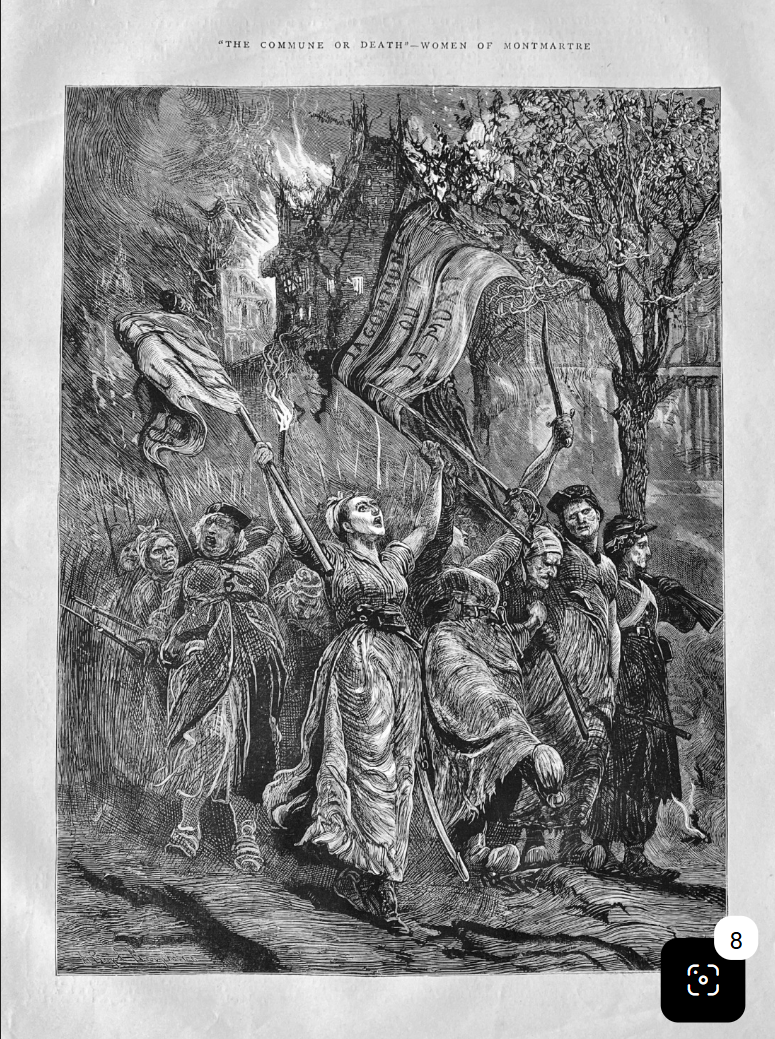
Arthur Boyd Houghton, Women of Montmartre, from “The Graphic”, vol. 3, 1871, Pre-Raphaelite, Wood-Engraving
Konstantin Chebotarev, Red Army, 1917, Painting, Futurism

Rodchenko & Maiakovskii, “Buy Cheap Bread,”, 1923, Ink on Paper/Poster, Constructivism

Diego Rivera, Panels from the Corrido of the Proletarian Revolution, third floor, Murals of the Ministry of Public Education, Mexico City, Painting, Mexican Muralism and Social Realism - A SINGLE FRONT

Diego Rivera, Panels from the Corrido of the Proletarian Revolution, third floor, Murals of the Ministry of Public Education, Mexico City, Painting, Mexican Muralism and Social Realism. THE COOPERATIVE, THE PROTEST

Grigori Shegal, Leader, Teacher, and Friend (Stalin at the Presidium of the II Congress of Shock Collective Farmers in February 1935), 1936-1937, Painting, Socialist Realism

Kliment Redko, Insurrection, Painting, Futurism & Suprematism 1925

Boris Kustodiyev, The Bolshevik, 1920, Art Nouveau with aspects of Social Realism

Kathe Kollwitz, Help Russia, 1921, Charcoal Drawing, German Expressionism

El Lissitzky, The Constructor, 1924, Photography/Photomontage, Constructivism

Red Revolution (Oct. 25th, 1917)
Petrograd is considered to be the origin of the revolution, because the workers in factories there had been advocating for higher wages by striking. They formed a mob, and the strike became a general one as they were joined by sympathizers and other workers.
Art Forms/Movements:
Constructivism
Suprematism
Dada
Surrealism
Rayonism
Avant-Garde in general
Russian Civil War (1917-1922)
Important Figures: Lenin, Trotsky, Stalin
It was sparked by the overthrowing of the Russian Provisional Government in the October Revolution as different factions vied for leadership. The Bolsheviks seized power in the October Revolution. However, they were not universally accepted, and the country descended into chaos largely between two groups: the Red Army (Bolshevik state led by Vladimir Lenin), and the White Army (right-leaning officers of the Russian Empire, militant socialists, etc).
The Bolsheviks took control.
Art Forms/Movements:
Constructivism
Suprematism
Dada
Surrealism
Rayonism
Avant-Garde in general
Early Soviet Union (1922-1928)
Important Figures:
Vladimir Lenin (1870-1924)
Known as a great orator
Many images of him are cropped or edited (Stalinism)
Leader of the Bolsheviks
Expanded on Marx’s theoretical ideas and applied them to actually running a communist nation
More centralized, top-down power
Attempts to distinguish Communism from Socialism
Lenin Trotsky (1879-1940)
Served as the people’s Kamizar, built the Red Army
All images are him wearing uniform to define his military status
Viewed as a man of the people
Lenin’s ideal successor
Key member because he helped unite disparate factions
Trotskyism
De-centralized economic planning
Worker’s control of production
Election of representation for multiple soviet socialist parties
Cultural autonomy of artistic movements, no gov control over it
Socialist internationalism
Art Forms/Movements:
Constructivism
Suprematism
Dada
Surrealism
Rayonism
Avant-Garde in general
New Economic Policy:
Implemented by Vladimir Lenin
Type of market socialism
Goal: encourage economic growth in Russia, which was suffering greatly due to WWI and the Russian Civil War
Allowed private individuals to own businesses, while the state continued to own the majority of larger aspects of industry
Citizen’s duty to state to buy
Russia's path to modernization
Needed to support industrialization, cost of war - through citizen’s capital
Pre - NEP Posters: more diverse in style, no overarching government policy
NEP- Posters: designed to encourage consumerism and purchasing of goods
Stalin Era (1927-1953)
Art Forms/Movements: Socialist Realism
Characterized by:
Period of fear, famine, collective farming
Increase in state power
Erasure and editing of Soviet Union’s past, erasure of public figures from the party
Socialist Realism - Utopian, positive and idealistic (not reflective of the harsh reality of citizens in this era)
International Communism (1918-1950)
Art Forms/Movements:
Expression (Germany)
Kathe Kollwitz
Dadaism
George Grosz
Mexico (Muralists/Painters)
David Siquerios
Diego Rivera
Cubo-Futurism (1912-1922)
Characterized by:
Recognizable forms of realistic objects
Geometric objectless planes
Subject of the proletariat
very interested in movement and dynamic
In Russia:
Russians wanted to emphasize their differences from italian futurists
Drew from russian traditional techniques:
Lubok
Folk costume
Ancient pagan sculptures
Icon painting
Pure colors, abstract forms
They often used techniques like application and collage
Primary painters
Artists:
Kazimir Malevich
El Lissitzky
Olga Rozanova
Examples:
Olga Rozanova, The Factory and the Bridge, 1913
Liubov Popova, Objects from a Dyer’s Shop, 1914
Kazimir Malevich, the Knife Grinder, 1912
Constructivism (1915-)
Founded by Tatlin & Rodcenko in 1915
Abstraction and forms that reflect the industrial world
Art as a utilitarian tool for a new industrial society
Need for a new aesthetic language
Borrowed elements from other avant-gardes like Cubism and Futurism
Photography, fashion, graphic/textile, cinema, theatre
Artwork that sought to have a PRACTICAL role in society
Images composed using REAL materials
Artists:
Vladimir Tatlin
El Lissitzky
Alexander Rodchenko
Examples:
El Lissitzky, Self-Portrait (The Constructor), 1924
Vladimir Tatlin, Monument to the Third International, 1919-20
El Lissitzky, Beat the Whites with the Red Wedge, 1919
Dada (1916 - mid 1920s)
Emerged amid WWI (1914-1918). Artists were disillusioned and wanted to reliant against social structures that led to violence, corruption, and unquestioning conformity. They declared an assault on all conventional definitions of art, prioritizing the ideas a work conveyed and experimenting.
Used techniques like collage and photomontage; others explored experimental theatre
Lubok
A traditional Russian folk print, typically a woodblock engraving, characterized by simple graphics and narratives derived from literature, religious stories, or popular tales.
Expressionism (1905 - )
This style emerged in Germany as a response to anxiety about humanity’s increasingly discordant relationship with the world, and lost feelings of authenticity and spirituality. (1905-1920) Anxieties of the modern world.
Reaction against Impressionism and academic art in part.
Focused on the distortion of form, and use of strong colors, exaggerated brushstrokes to convey a variety of anxieties and yearnings.
They often represented alienated individuals within cities (prostitutes, etc.)
Artists:
Wassily Kandinsky
Kathe Kollwitz
Muralism
Painting applied to and made integral with the surface of a wall or ceiling.
Artists:
Diego Rivera
Siquieros
Photomontage
Technique of combining photograph fragments with the aim of creating a new image, to the point where it is almost impossible to notice dividing lines of multiple images. (first developed in 1915)
Type of collage made from photographs. Often used as a tool for political dissent and gained importance in the 20th c with movements like Dadaism and Surrealism.
Artists:
El Lissitzky (Constructivist)
Alexander Rodchenko (Constructivist)
John Heartfield
Montage
Assembly of images or elements to create a unified work. Emphasizes the arrangement of images to tell a story or message.
Photomontage is a form of montage.
Public Works
Any work of art which is designed for a space accessible to the general public.
Socialist Realism (1927-1953)
Formally realistic, artificial style of painting in Russia after Joseph Stalin’s ascent to power in 1924. Artist were forced to present positive, propagandist images of Stalin.
They could consist of:
Portraiture (Stalin)
Historical/Patriotic
Industrial
Goal:
Establish cult of the leader
Instill patriotism
Influence citizens, show artificial joyful russia. Focus on positivity
Modernization
Idealism
The future is bright and progressive
Emotion/happy expression
Artists:
Tetyana Yablonska, Bread, 1949
Grigori
Suprematism (1913-1920s)
Radical abstract art movement developed by Kazimir Malevich in the mid-1910s, prior to the Russian Revolution. Reduced painting to geometric abstraction; non-objective.
Characteristics:
Basic geometric forms
Flat fields of colors like black, white, red, yellow, blue, green
White grounds that suggest open, unmeasured space
Irregular paint surfaces
Title that preserves traces of earlier subjects while the image remains non-objective
Examples:
Kazimir Malevich, Last Futurist Exhibition of Paintings 0,10 at Marsovo Pole, Petrograd, 1915-1916
Surrealism (1914-1945)
Meant to reunite conscious and unconscious realms of experience so that the worlds of dream and fantasy would be joined to the everyday, rational one.
Grew out of the Dada movement, but was more focused on positive expression and a move away from the “rationalism” that had culminated in WWI.
Rayonism (1914-)
Avant-Garde movement founded by Mikhail Larionov and Natalia Goncharova. Developed new ways to express energy and movement.
Originally a subset of Russian Futurism, it drew on scientific discoveries and was very modern while still adapting elements of traditional folk culture. Highly nationalistic.
Examined how light was displayed in imagery
Dynamism of futurism + pictorial vocabulary of Cubism
Subject of the proletariat
Multiple perspectives in 1 image
Example:
Natalia Goncharova, The Weaver (Loom + Woman), 1913
Non-Figurative
Abstract art. Art that exists with a degree of independence from visual references in the world.
Lithography
The process of printing from a plane surface (typically metal plate).
Five-Pointed Star
Symbol of the Red Army
Hammer & Sickle
Symbol for labor and the proletariat/international proletarian unity
Proletariat
Socioeconomic class of wage laborers.
Russian/Religious Icons
These were traditionally seen in the home, often hung from corners.
They were believed to be the intercessors or go-between God and normal people
This practice is reflective of:
Stalin & Lenin Portraiture
Malevich’s Black Square (hung where an icon would be)
Hand
“Five fingers has the hand! With these five grab the enemy!”
The hand of the worker is what will overcome fascism
Also reminiscent of the five-pointed star of communism, splayed fingers reference this
Symbolize the unifying collective power of workers
Fists
Proletariat rising up, strength, resistance.
Red/Red Flag
The Paris Commune was the first to adopt the red flag as their symbol, later leading to this being used in communist countries.
Authoritarianism
The enforcement or advocacy of strict obedience to the authority at the expense of personal freedom.
Avant-Garde
Art that pushed the boundaries of conventional art and aesthetics.
Bolshevik
A member of the majority faction of the Russian Social Democratic Party, or the Communist Party, after seizing power in the October Revolution of 1917.
Bourgeoise
The capitalist class who own most of society’s wealth and means of production, materialistic values.
Capitalism
An economic and political system in which a country’s trade and industry are controlled by private owners for profit.
Collective Portrait
A group portrait that depicts multiple identifiable individuals together with the intent of representing them as a cohesive unit
Comintern
The Third International, Marxist political organization that advocated world communism from 1919-1943.
Communism
A political theory derived from Karl Marx, advocating class war and leading to a society in which all property is publicly owned and each person works and is paid according tot heir abilities and needs.
Consumerism
Preoccupation of society with the acquisition of consumer goods/consumption of goods as a basis for a sound economy.
Cult of Personality
A leader intentionally attempts to create an idealized and heroic image of themselves, often developed through dissemination of propaganda, manipulation of the arts, spectacles, instilling of patriotism, etc.
Data Visualization
The use of graphical elements like charts, plots, infographics, etc.
Dictatorship
Government where one person makes all rules and decisions without exception.
Fascism
Authoritarian and nationalistic right-wing system of government that is often intolerant and oppressive.
Five-Year Plan
A government plan for economic development, beginning in the late 1920s. Aimed to achieve rapid industrialization.
Immortalization Commission
The idea of conquering death.
Lenin’s body was preserved by Stalin and displayed. Joseph Stalin’s embalmed body was eventually placed next to him. It was removed later as de-Stalinization.
Leninism
Marxism as interpreted by Vladimir Lenin, supporting direct rule by workers.
Light Industry
Industries that are less capital-intensive, and more consumer-oriented. They produce smaller goods.
Marxism
The political and economic theory of Karl Marx and Friedrich Engles, later developed by their followers to form the basis for the theory and practice of communism.
Mass Production
The production of large quantities of a standardized article by an automated mechanical process.
Monumentalism
Aesthetic style that emphasizes grandeur, colossal scale, durability, and potent symbolic significance.
New Economic Policy (NEP)
Implemented by Vladimir Lenin
Type of market socialism
Goal: encourage economic growth in Russia, which was suffering greatly due to WWI and the Russian Civil War
Allowed private individuals to own businesses, while the state continued to own the majority of larger aspects of industry
Citizen’s duty to state to buy
Russia's path to modernization
Needed to support industrialization, cost of war - through citizen’s capital
October Revolution
Petrograd is considered to be the origin of the revolution, because the workers in factories there had been advocating for higher wages by striking. They formed a mob, and the strike became a general one as they were joined by sympathizers and other workers.
Paris Commune
French Revolutionary government that seized power in Paris for two months. Consisted of working-class and soldiers of the National Guard. They promoted progressive and anti=religious beliefs that have since flowered into communism, social democracy, socialism, etc.
Important because it is a precursor to the revolutions of communism in the 20th century, AND THE ORIGIN OF THE RED FLAG AS A SYMBOL OF RADICALISM.
Proletariat
Workers or working class people, regarded collectively in relation to Marxism.
Propaganda
The use of biased information to promote a particular ideology or cause.
Socialism
Political and economic theory that advocates the means of production, distribution, and exchange should be owned or regulated by the community as a whole.
Stalinism
Form of Marxism-Leninism associated with Joseph Stalin, who ruled the USSR from 1929-1953.
Marked by a concentration of power, aggressive social engineering, political repression including purges, state trials, and elimination of dissent.
Wanted to turn the country into a self-sufficient industrial superpower, led to forced collectivization of agriculture that caused famine and suffering.
Third International
International group founded in 1919 ata congress convened by Lenin and the Russian Communist Party.
Intended to be a global push for communism, they wanted revolution of the proletariat to occur in multiple states
These hopes were not realized, so they transformed into a united workers front and towards the end of the 1920s, advocate for alliances against fascism
Totalitarianism
System of government that is centralized, dictatorial, and requires complete subservience to the state.
Trotskyism
Branch of Marxism and Leninism developed by Leon Trotsky. Lenin’s desired “heir”.
Advocated for decentralized economic planning, worker’s control of production, elected representation of multiple Socialist parties, etc.
Big supporter of Socialist internationalism. They disliked Stalin's ideas of socialism in one country.
U.S.S.R.
A state from 1922-1991, led by the Communist Party of the Soviet Union.

Define “communism” and describe some of the similarities and differences between communism and other political systems/theories. Using a specific historic example from the course content, explain how the visual work relates to the ideologies, aesthetics, and/or symbols of communism as well as the specific historical context in which it was created.
communism
political and economic ideology created by Karl Marx
rise of the proletariet, revolution
collective ownership
each person works and is paid according to their own abilities and needs
Need to have a REVOLUTION over capitalism to be true communist system
different in practice due to:
cultural variances
number of leaders in party
form of Socialism
socialism advocates for similar communal ownership
VS Capitalism
competition between private owners of property
individualistic
Arthur Boyd Houghton, Women of Montmartre, 1871, Wood-Engraving
Paris Commune is the precursor to the Red Revolution, many believe
Paris Commune
1871
French Revolutionary government of working class and National Guard soldiers seized power in Paris for 2 months
first instance of a merging collective of various revolutionary ideologies, including those like feminism, social democracy, socialism
ARTWORK
black and white, wood engraving print
women marching under flag that says, “The Commune or Death”
references the plain red flag, which was adopted as their official symbol
eventually adopted by communist party in russia, international and vital symbol

Define the term “avant-garde” and discuss how revolutionary aesthetics relates to revolutionary politics. Using a specific historic example from the course content, describe how the work connects to the context of the Red Revolution and/or the Russian Civil War. What symbols, forms, and level of abstraction does the work use and how do these choices impact the work’s political messaging?
avant-garde
artwork that pushes conventional boundaries & traditions
message behind work
revolutionary aesthetics and artwork can encourage societal upheaval and represent the desire to move away from previous aesthetic tradition
reflects the change in taste, and forward-looking nature of revolutionary ideals
difference between revolutionaries and their oppressors
Konstantin Chebotarev, The Red Army, Futurism, 1917
depicts a group of highly abstracted soldiers marching in an urban landscape, while a red flag waves above them
flag = they are from the Red Army, and title
dynamic composition
reflects Futurists’ interests in modern technology and the rise of urbanism
Historical context
created during the period of russian civil war, when two factions were warring for leadership over Russia: the White Army, and the Red Army (Bolsheviks)
Chebotarev’s fear of Bolsheviks, and vision of future russia if they take over
homogenization - reflected through repetitive forms of people & buildings
modernization

Define the term “propaganda” and explain how it is utilized in the context of the Early Soviet Union (1922–1928). Using a specific historic example from the course content, describe how the work relates to the New Economic Policy (NEP) and what role this form of visual production has in the early years of the U.S.S.R.
propaganda
the use of biased information to promote ideology or cause
soviet union used posters which explored photomontage, data visualization, illustration and iconography in their propaganda
desired for citizens to support gov and control flow of info
New Economic Policy, NEP
established by Vladimir Lenin
form of market socialism
to encourage economic growth in russia
russia suffering because WWI and Russian Civil War
This system allowed private individuals to own businesses while the state continued to own the majority of larger aspects of industry
Lenin encouraged consumerism
citizens duty to state
russias path to modernization
he needed to support industrialization of the nation, cost of war
Rodchenko & Malakovskii, "Buy Cheap Bread”, 1923, Ink on Paper/Poster, Constructivism
highly graphic
use of line and pattern to navigate viewer’s eye through poster
central diamond with red stroke, frame four different types of bread
larger type saying 15% discounted
diagonal lines on each side guide your attention to this center piece
breads: more realistic, water-color perhaps to entice consumers to actually go purchase
Use of blue, red, white - maybe made printing cheaper because there’s lots of negative space
“No need to fear the Nepman and high prices! All types of fresh bread available with discounts of 15 percent at all Mosselprom outlets..”

Define “Third International” and discuss the spread of communism in the interwar period. Using a specific historic example from the course content, describe the artist’s relationship to communist parties or groups. What forms, elements, or styles of the work are drawn from regional visual traditions? Conversely, are there aspects derived from an international lexicon of communist symbols?
Third International
advocated for global communism in the hope that proletariat revolution would occur in more nations (didnt happen)
began to provide aid to workers internationally
spread marxist ideas
During the 1920s, several communist groups formed:
Mexican Communist Party
Germany
Mexican Communist Party
heavily involved with artists of the region bc of the sway they had over culture, and used influence to propagate their message
Diego Rivera
known for his murals
kicked out of party for being too focused on painting
had leadership position
Diego Rivera, Panels from the Corrido of the Proletarian Revolution, third floor, Murals from the Ministry of Public Education, Mexico City, Painting, Mexican Muralism/Social Realism
A Single Front
The Cooperative
The Protest
commissioned by the government, snuck in communist messages. tolerated because of his popularity even as the mexican government moved against the party
separate scenes are inspired by corridos, Mexican narrative ballads
depict local workers known as campesinos + Russian proletariat
these two indicate the spread of communism and relationship of russia to other communist parties
russia thought it was their duty to assist in guiding and teaching these newly formed parties how to operate
even invited them to celebrate May Day in Moscow - international workers day, anniversary of the Red Revolution
Reflected in The Cooperative
soviet instructs people
A Single Front
Soviet looks on while campesino and soldier shake hands, the union of the two halves of the proletariat: soldier and laborer
desire by rivera to promote union
background factory, themes of industrialization within the series
The Protest
factory
international symbols
red hammer and sickle red flag
raised hands of the workers
also seen in works like Gustav Klutsis
This is also representing the idea of a factory run by workers and owned by workers


Define the term “totalitarianism” and discuss changes to art policy and practice enacted in the Stalin era. Using a specific historic example from the course content, describe the work’s style, scale, and mode of production. How does the concept or theme expressed in the work support a vision of the Soviet Union’s new direction under Stalin?
totalitarianism
system of government that is highly centralized, dictatorial, complete subservience to the state
run by one leader
stalin
Stalin’s Russia
aggressive social enginering
political repression: purges, state trials, erasure to eliminate dissent
Art
Used art as a tool to hide the horrors that the country was experiencing
propagate ideas of a utopian russia, modernized, full of joy
Socialist Realism style or exile from nation, condemnation to gulags, etc.
Socialist Realism
works of a much larger scale, reminiscent of traditional history paintings
could consist of portraiture, genre paintings, history/patriotic
very idealized, used expression to show artifical sense of joy
focus on modernization
heroic depiction of labor
sunlight - happiness and peace in nation
Stalin used them to affirm right to rule Russia, establish cult of leader, establish himself as Lenin’s true “heir”
fake photographs with lenin
Grigori Shegal, Leader, Teacher, and Friend, 1936-1937, Painting, Socialist Realism
vertical in orientation
large scale
Stalin conversing with collective farm works
man of the people
accepts feedback on his rule
workers dressed in regional fashions, showing how the territories of the soviet union are united under him and like him
large marble statue of lenin looking on
guided by lenin
has lenin blessing
Kathe Kollwitz, Help Russia, 1921, Charcoal Drawing, German Expressionism

El Lissitzky, The Constructor, 1924, Photography/Photomontage
