Genetics Unit 3
 Call Kai
 Learn
 Practice Test
 Spaced Repetition
 Match
 Flashcards
 Knowt Play
1/108

There's no tags or description
Looks like no tags are added yet.
109 Terms
what are the four criteria for genetic material?
information, transmission, replication, and variation
describe Gtiffeth’s experimental design?
injected mice with four different variations of a bacteria, one live S, one live R, one heat killed S, and one heat killed S with life R
describe the results of Griffeths experiment
mice with Live S died
mice with Live R survived
mice with heat-killed S survived
mice with heat-killed S+ live R died
what principle did Gritth’s experimental results establish?
transforming principle, some material gives the properties of one cell to another
what are the four types of changes in chromosome structure?
deletion, duplication, inversion and translocation
What chromosome deletion?
loss of chromosome segment
What is a chromosome duplication?
abnormal repetition of a chromosome sequence
how are chromosome deletions and duplications similar?
both change the total amount of genetic material
what are chromosomes inversions?
a changes in the direction of genetical material while remaining on the same chromosome
what are chromosome translocations?
when a segment from one chromosome becomes attached to a different chromosome
how are inversions and translocations similar?
both rearrange genetic material but maintain the total amount remains the same
what are the two types of chromosome deletion?
terminal (at the end of a chromosome) and interstitial (in the middle of a chromosome)
what is the difference between paracentric and pericentic inversion
paracentic does not involve the centromere while pericentric does involve the centromere
what is the breakpoint effect?
when the split causes a gene to be non-functional
what I the position effect?
when the repositioning of a gene alters the intensity of it’s expression
what are the types of translocation?
nonreciprocal, reciprocal, robertsonian
what is non-reciprocal translocation?
when one section of chromosome moves to another non-homologous chromosome
what is reciprocal translocation
when segments of equal amounts are swapped between non-homogous chromosomes
what are the two mechanisms of reciprocal translocation?
repair of broken chromosomes and abnormal crossover between non-homologous chromosomes
what is aneuploidy?
variation in the number of chromosomes within a set
what is euploidy?
variation in number across every set of chromosome
what are the two types of aneuploidy?
trisomic and monosomic
what is trisomic aneuploidy?
3 copies of a chromosome
what is monosomic aneuploidy
1 copy of a chromosome
describe robertsonian translocation?
when the short arm of one chromosome is exchanged with the long arm of another, leaving one large chromosome and one fragment that is often lost
what does aneuploidy tend to cause phenotypic effects?
it causes over or underproduction of a gene expression
describe Avery-MacLeod’s experimental design ?
heat-killed S cells were mixed with R cells and an enzyme to kill either DNA, RNA, or proteins, if there continued to be cell growth then transformation was not occurring
what were the results of Avery-MacLeod-McCarty’s experiment?
the cells mixed with DNAse saw no growth while those mixed with RNAse or protease continued to grow
what was the implication of the Avery-MacLeod-McCarthy experiment?
that DNA was the transforming material
describe the experimental design of the Hershey-Chase experiment?
bacteriophages were grown with their protein being radioactive sulfur and protein labeled in radioactive phosphorus and introduced to new cells. Cells were blended to seperate
what were the results of the Hershey-Chase experiment?
only phosphorus 32, attached to DNA was involved in the replication of new particles
what did the results of the Hershey-Chase experiment confirm?
that DNA in hereditary material?
which experiments contributed to discovering the role of DNA
Griffeth, Avery-MacLeod-McCarthy, and Hershey-Chase
which experiments contributed to the discovery of DNA’s structure?
Chargoff, Frankin, Watson and Crick
describe the structure of Chargoff’s experiments
nucleic acids were isolated, purified ad their composition measured
what was the results of Chargoff'‘s experiments?
% of adenine was equal to % thymine, % of cytosine was equal to % of guanine
what rule emerged from Chargoffs experiment?
adenine always pairs to thymine, cytosine pairs to guanine
what were the results of Franklins experiments?
helical shape with consistent width between bases
sugar phosphate backbone on the outside of the bases
what were the results of Watson and Crick’s experiment
the full structure of DNA+ it runs anti-parallel
what are the key features of DNA?
double helix-two strands twisted together
complimentary bases hydrogen bonded to each others
major and minor asymmetrical groves
deoxyribose sugar
nitrogenous bases
phosphate backbone
what are the key features of RNA
usually single stranded
ribose sugar
nitrogenous based, uracil instead of thymine
phosphate group
what are the possible types of double-stranded RNA?
bulge loop, internal loop, multi branch loop, stem/hairpin loop
what is a nucleotide?
the structural unit of both DNA and RNA
what are the components of a nucleotide?
phosphate group, pentose sugar, nitrogenous bases
what bases are purines?
adenine and guanine
what bases are pyrimidines?
cytosine and thymine

what base is this?
adenine?
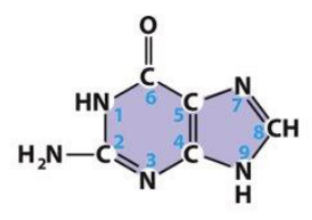
what base is this?
guanine
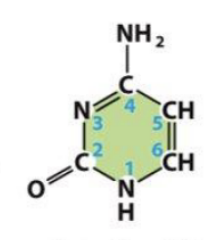
what base is this?
cytosine

what base is this?
thymine
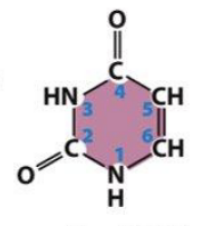
what base is this?
uracil
what is the primary difference between purines and pyrimidines?
purines have two rings, pyrimidines have one
what bases are in DNA
Adenine, Guanine, Cytosine, and Thymine
what bases are in RNA
adenine, guanine, cytosine and uracil
what are the functional sites on a prokaryotic chromosome?
origin of replication, repetitive sequence, intergenic regions
what is the origin of replication?
the location DNA replication begins
what are repetitive sequences?
sequences of DNA that don’t code for specific genes
what are antigenic regions?
short regions between adjacent genes?
what are micro domains?
coils formed by Nucleoid-associated proteins that compact chromosomal DNA 1,000 fold
what is DNA supercoiling?
formation of additional coils in addition to loop domains
what is the role of DNA Gyrase?
to form negative supercoils using ATP and relies positive supercoils
what is the role of DNA topoisomerase I
relaxes negative supercoils
what are the functional sites of eukaryotic chromosomes?
origin of replication, centromere, repetitive sequences, telomeres?
what are centromeres?
binding sites of the kinetochore
what are telomeres?
regions at the end of a chromosome that aid in the stability of genetic material
what are repetitive sequences?
sequences of DNA that don’t code for specific genes, often a tandem sequence and account for 59% of the human genome
what types of sequences are considered unique?
protein coding genes, introns
roughly how many times does a moderately repetitive sequence appear in the genome
a few hundred to several thousand times
how many times will a highly repetitive sequence appear?
tens of thousands to millions of times
what are nucleosomes?
DNA wrapped around histone proteins, the structural unit of chromatin
what is chromatin?
the DNA protein complex that makes up a chromosome
what is a histone?
a protein group that DNA wraps around
what are the four histone proteins?
H2A, H2B, H3, H4
how do histones and DNA stay bonded to each other?
the lysine and arginine in the histones is positively charged with the DNA is negatively charged, binding them to each others
what is euchromatin?
loosely packed chromatin that can be transcribed
what is heterochromatin?
densely packed chromatin that cannot be transcribed
what is acetylation?
an acetylene group attached to an amino acid, nitrating the charge and separating the DNA from the histone so it can be transcribed
what does histone acetylation create?
euchromatin
what is DNA methylation
addition of a methyl group makes the nucleosomes tighten
what are the features of DNA that allow it to be replicate?
consistant base pairing and structure
what is the conservative model of replication
when the result is one entirely new set and one parent set
what is the semiconservative model?
one all new strand and one original parent strand
what is the dispersive model of replication?
both strands are a mix of old and new DNA
describe the set up of the Meselson and Stahl experiment
bacterial were culturerd in 15N forming heavy DNA, the 14N, meaning it replicated with lighter nitrogen, DNA was centrifuged and analyzed
what was the results of the first replication for the Measelson and Stahl experiment?
a band of DNA in the middle of the test tube
what models of replication did the first replication results leave as options?
semi-conservative and dispersive
what was the results of the second replication is the measles and stahl experiment
an additional band of lighter wight DNA formed above the miid-weight band
what did the results of the Measleston Stahl experiment prove?
the semiconservative model of replication
what is GATC methylation site?
sites that regulation DNA replication in bacteria
what are DnaA boxes?
locations for the binding of DnaA protein helping strands separate
what happens at AT-Rich regions
DNA strands separate
what is the oriC
origin of replication in E.coli
describe initiation of replication in bacteria?
DAM enzyme methylates the GATC sites, allowing the replication to begin
DnaA proteins binds to the DnaA boxes seperating strands
DNA helices binds to the origin and creates a replication bubble
where does initiation of replication occur in Eukaryotes?
several autonomously replicating sequences located in nucleosome free region
what is the role of Helicase
to unzip the two strands opening for the fork
what is the role of DNA Gyrase in replication?
nic’s DNA upstream of the fork to prevent supercoiling
what is the role of single-stranded binding proteins in replication?
to prevent bones from being reformed between complimentary nucleotides
what is the role of primase?
adds an RNA primer to unzipped DNA, creating a two-stranded section that that the polymerase can work on
what is the role of DNA polymerase III in replication?
adding nucleotides forming the next strand of DNA in the 5’-3’ direction